

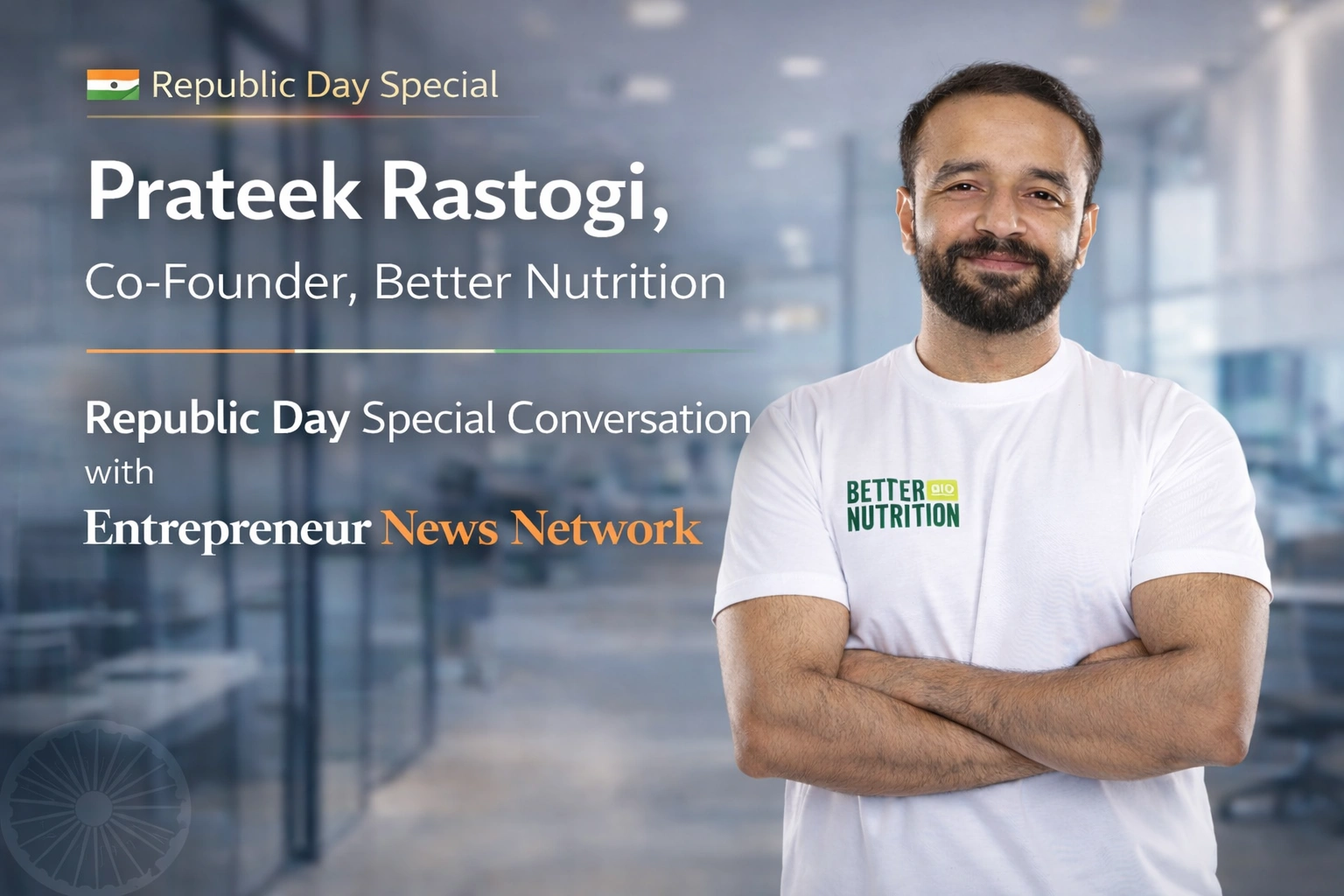
New Delhi, India, 26 January, 2026 – India is facing a silent but severe crisis—micronutrient deficiency, often referred to as “hidden hunger.” Iron, zinc, calcium, and protein deficiencies affect over 60–70% of the population, cutting across age, income, and geography. While supplements and nutraceuticals have grown into a multi-billion-dollar market, a new class of agri-nutrition startups believes the solution lies not in pills—but in food itself.Better Nutrition is challenging the $18 billion Indian nutraceutical industry by proving that the solution to “hidden hunger” isn’t found in a pill bottle, but in the very soil that grows our daily food.
In an exclusive virtual discussion with Entrepreneur News Network, Prateek Rastogi, founder of Better Nutrition shared how the company is re-engineering the agricultural value chain to make biofortified, nutrient-dense staples a part of everyday Indian diets—while simultaneously improving farmer incomes and sustainability.
Backed by deep agricultural R&D, cutting-edge testing technology, and a rapidly growing D2C presence, Better Nutrition is positioning itself at the intersection of agriculture, health, and food technology.
The Market & The Mission
ENN: Prateek, most founders look at the health market and see a gap for a new protein bar or a supplement. You looked at the soil. What was the specific data that sparked this journey in 2023?
Prateek: It started with a startling realization: India has a “content” problem, not a volume problem. While we’ve solved the hunger crisis of the past, we’ve entered a micronutrient crisis. Over 70% of Indians suffer from deficiencies in iron, zinc, or protein—often without even knowing it.
When we looked at the numbers, the packaged staples market in India is hurtling toward a ₹1 lakh crore valuation by 2030. Within that, “healthy staples” isn’t just a niche; it’s the fastest-growing vertical. We saw that the industry was obsessively focused on post-consumption fixes—powders, pills, and tonics. But staples like atta and rice make up 80% of an Indian household’s plate. If we could embed the nutrition directly into those grains during cultivation, we wouldn’t have to fight for “mindshare” or ask people to change their habits. We just had to change the seeds.
ENN: You’ve described your work as the “opposite” of the supplement industry. That’s a bold stance for a health-tech brand. How do you define that difference?
Prateek: Supplements are essentially a “tax” we pay because our food has failed us. We are trying to make supplements optional. By using biofortified seeds and specific agronomic practices, we ensure that the iron and zinc are part of the grain’s DNA, not just a spray-on coating. When you eat our ragi or bajra, your body absorbs nutrients naturally, the way nature intended, rather than through a synthetic chemical delivery system.
The Scientific Edge
ENN: The word “natural” gets thrown around a lot in marketing. How do you provide a “receipt” for the nutrition you claim?
Prateek: Transparency is our biggest moat, and we back it with heavy machinery. We are the only private company in India utilizing an XRF (X-Ray Fluorescence) Analyzer at the consumer level. Typically, you’d only find these in high-level government research labs like ICAR.
This machine is a game-changer for us. In under 100 seconds, it gives us a precise “nutrient scorecard” for every single batch. We aren’t guessing; we are measuring exact levels of zinc, iron, and calcium. But more importantly, we use it for safety. Because of groundwater pollution, heavy metals like lead, mercury, and arsenic are a silent threat in Indian agriculture. We screen for these before we even procure the crop from the farmer. If it isn’t clean and nutrient-dense, it doesn’t get the Better Nutrition label.
ENN: Your team isn’t full of food marketers. Tell us about the “brain trust” behind the brand.
Prateek: Exactly—our R&D isn’t driven by “flavor profiles” but by soil science. We are led by PhDs and MScs in Agriculture who specialize in plant agronomy. We don’t just buy crops; we collaborate with global titans like CIMMYT and ICAR to ensure our biofortified seeds can actually thrive in Indian soil conditions. We are an agricultural science company that just happens to sell food.
Growth & Logistics
ENN: Since your consumer launch in January 2025, the growth has been explosive. Can you walk us through those milestones?
Prateek: It has been a whirlwind. We started on e-commerce in January 2025 with a modest monthly revenue of ₹7 lakh. Today, just a year later, we have achieved 10x growth, crossing the ₹1 crore per month mark in gross consumer sales.
What’s most rewarding is that this isn’t “hired growth.” We haven’t spent millions on celebrity influencers. This is driven by retention. Families are realizing that for a marginal increase in their monthly grocery bill—maybe ₹500 to ₹1000—they can naturally address issues like anemia, which affects over 60% of our population. That trust is why people keep coming back.
ENN: How does AI find a home in a field of wheat? How are you bridging that gap?
Prateek: We use AI to build a “predictive nutrition” model. We’ve collected years of data on how certain seeds perform in specific soil types. By feeding this into our models, we can provide a “Nutrition Advisory” to our farmers. We can tell them: “If you use this seed and this specific soil management practice, your harvest will have 30% more iron.” We’re moving the needle from growing for “yield” to growing for “impact.”
The Farming Backbone
ENN: You have a network of 20,000 farmers. That is a massive human operation. Where is the heart of this network?
Prateek: Uttar Pradesh is our biggest hub, but we are expanding rapidly into Telangana, Uttarakhand, and Maharashtra. Maharashtra is particularly close to our hearts; we’ve recently started with a cohort of 200 farmers there.
We don’t just give them seeds and walk away. We provide the “Better Seeds” SOPs—a standard operating procedure for biofortification—and a buy-back guarantee. This gives the farmer price stability. They aren’t just selling a commodity anymore; they are selling a high-value health product, and we ensure they are compensated for that quality.
ENN: For someone reading this who wants to switch their pantry over today—where can they find you?
Prateek: We’ve focused heavily on the “instant gratification” of Quick-Commerce. You can find us on Blinkit, Swiggy Instamart, Zepto, and BigBasket, as well as Amazon and Flipkart. For the traditional shoppers, we are currently preparing for our offline retail launch in premium modern trade stores, set to roll out on April 1, 2026.

Ruchi Kumar is the associate editor at Entrepreneur News Network and TVW News India, where she leads editorial strategy, brand storytelling, and startup ecosystem coverage. With a strong focus on innovation, business, and marketing insights, he curates impactful narratives that spotlight India’s evolving entrepreneurial landscape. She has written extensively on fintech, AI and emerging startups.