

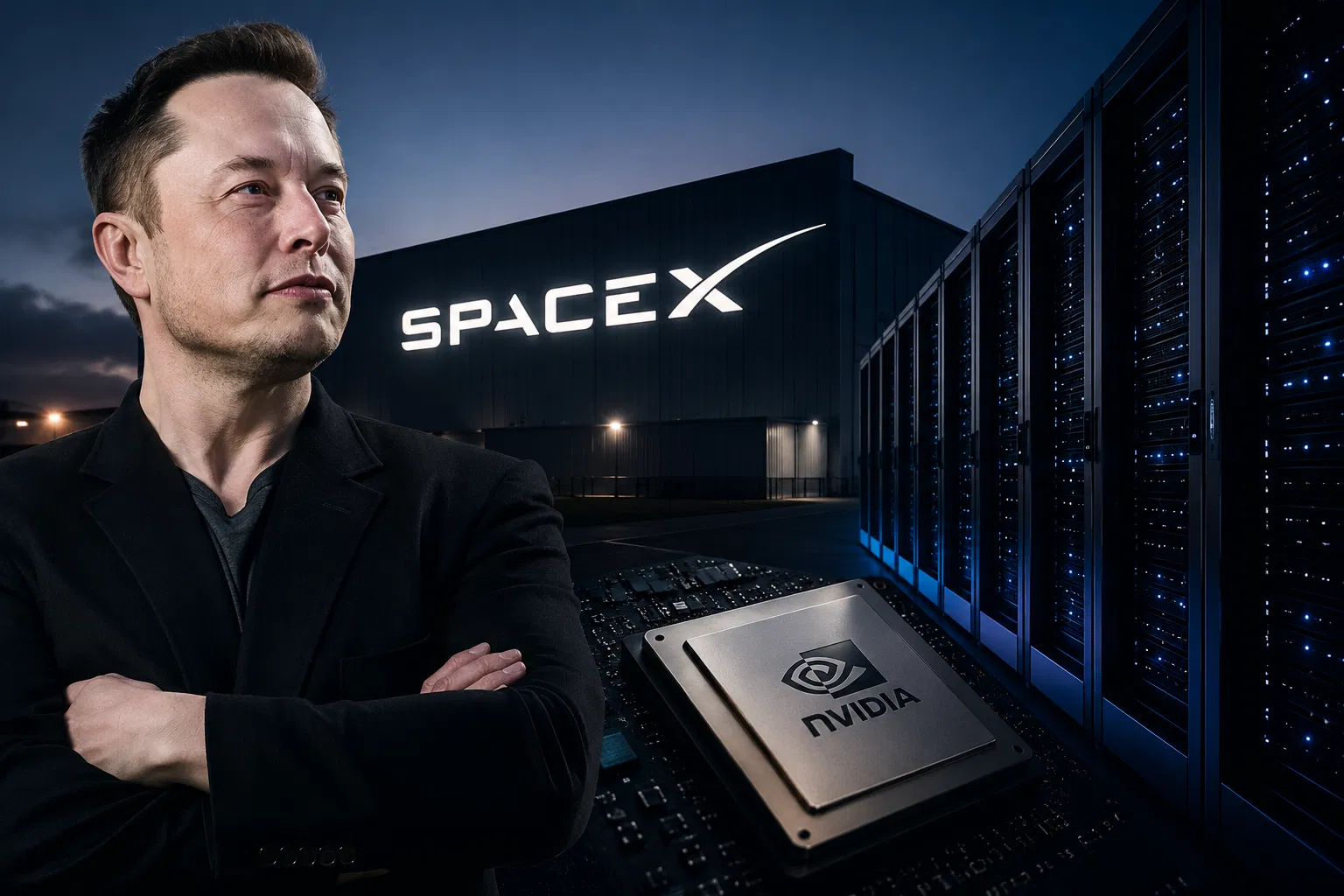
Elon Musk built Colossus to train Grok. Instead, it may end up making SpaceX more money than Starlink — by renting out GPUs to the very companies xAI was supposed to be competing with.
The Number That Started It All: $150 Million a Month
Open-source AI startup Reflection AI has agreed to pay SpaceX $150 million every month, starting July 1, 2026, for guaranteed access to Nvidia’s newest GB300 chips inside SpaceX’s Colossus 2 data center in Memphis, Tennessee. If the contract runs its full course through 2029, the total payout reaches roughly $6.3 billion — a striking commitment from a company that, as of this deal, has not yet released a public model.
What makes the deal notable isn’t just the size. It’s who’s paying it, and why a rocket company is the one collecting the check.
Colossus, By the Numbers
SpaceX’s Colossus complex began life as xAI’s answer to OpenAI and Google — a facility built at breakneck speed to train Grok. After Musk merged xAI into SpaceX earlier this year (folding the AI unit into a division now called SpaceXAI), the underused capacity of that facility became something else entirely: a commercial product.
Here’s the scale involved:
- ~555,000 Nvidia GPUs installed across the Memphis campus, reportedly acquired for around $18 billion
- A planned total power footprint of 2 gigawatts — enough to power a mid-sized city
- Colossus 1 alone houses over 220,000 GPUs, including H100, H200, and GB200 accelerators
- Colossus 2’s cooling infrastructure was reportedly built to manage 350 megawatts, with 19 natural-gas turbines deployed on-site to keep the lights on
- Grok’s own usage has been sliding — app downloads reportedly fell from over 20 million in January 2026 to about 8.3 million by April, a 60% drop in three months — freeing up exactly the kind of spare capacity SpaceX is now monetizing
In other words: SpaceX built a supercomputer for one customer (itself), watched that customer’s demand shrink, and pivoted into becoming a landlord for the entire AI industry.
The Tenant List Reads Like an AI Power Ranking
Reflection isn’t the first name on SpaceX’s rent roll — it’s the fourth major one in a matter of months:
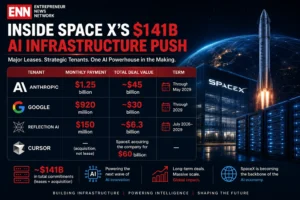
Stack those numbers up and SpaceX has now locked in more than $80 billion in committed compute revenue from outside clients through 2029 — a figure that rivals what many established cloud providers generate from entire business lines.
The Anthropic deal is especially striking given the backstory. Musk had spent months publicly sparring with Anthropic — at one point accusing the company on X of hating “Western civilization.” A few months later, Anthropic was leasing the entire Colossus 1 facility, and Musk was posting that he’d come away “impressed” by the team. Business, apparently, beats beef: Anthropic’s own compute needs, tied to scaling Claude Pro and Claude Max, made the $15-billion-a-year price tag worth paying.

Why Everyone Suddenly Wants In
The common thread across every one of these deals is the same scarce resource: Nvidia’s most advanced chips. Training and running frontier AI models requires enormous, reliable GPU capacity — and that capacity is in short supply industry-wide. Renting from Colossus lets AI labs skip years of data-center construction and jump straight to the front of the compute queue.
For Reflection specifically, the calculus is even sharper. The startup:
- Was founded in 2024 by two former Google DeepMind researchers
- Carries a $25 billion valuation
- Has received an $800 million investment from Nvidia
- Has no public flagship model yet, but has cultivated government ties — including work connected to the Department of Energy’s Genesis Mission and Pentagon AI programs
- Is betting its entire compute strategy on open-weight models, positioning itself as a hedge against reliance on closed AI providers
That last point created an unusual loop: Nvidia is simultaneously an investor in Reflection and an indirect supplier to it, since Reflection’s SpaceX-leased chips are Nvidia hardware in the first place. Nvidia effectively gets paid whether the hyperscalers win or the open-source challengers do.
The Market’s Verdict: Confused, Then Convinced
The reaction to the Reflection deal wasn’t universally positive — at least not immediately. SpaceX, which had gone public just two weeks earlier at a $1.77 trillion IPO valuation (the largest in history, raising roughly $75 billion), saw its stock fall by double digits on the news, its worst single-day drop since its Nasdaq debut.
The apparent reasoning: investors initially read a pre-revenue, product-less startup committing $1.8 billion a year as a red flag rather than a vote of confidence. But the more common read among analysts was the opposite — that a company with no shipped product being willing to pay full price, in advance, for the industry’s most sought-after chips is itself the signal. It suggests real demand for AI compute extends well beyond the handful of giants (OpenAI, Google, Anthropic, Meta) that usually dominate the conversation.
There’s a built-in stress test, too: every one of these contracts includes a 90-day exit clause after an initial lock-in period. Analysts have flagged that whether tenants like Reflection actually ride out those exit windows — rather than walking once they’re able to — will be the real indicator of whether this is durable demand or a temporary land grab.
The Bigger Picture: Infrastructure Is the New Oil Well
SpaceX’s pivot mirrors a pattern playing out across the AI industry: the companies that own the physical infrastructure — chips, power, cooling, land — are increasingly positioned to profit regardless of which AI lab or model ultimately “wins.” A few data points reinforce just how fast this shift is moving:
- SpaceX’s AI division still posted a $2.47 billion operating loss in Q1 2026 — even as its compute contracts scale, the segment isn’t yet profitable
- The Anthropic deal alone accounted for 76% of SpaceX’s $10.1 billion in Q1 2026 capital spending
- Nvidia raised $25 billion in debt with a 30-year tranche this year, a bet that data center demand will remain strong for decades, not quarters
- Rival infrastructure players are scaling just as fast: Groq raised $650 million to expand its inference cloud, while CoreWeave has continued stacking multi-billion-dollar infrastructure commitments
SpaceX’s ambitions don’t stop on the ground, either. Its agreement with Anthropic includes early-stage interest from both companies in developing multiple gigawatts of AI compute capacity in space — orbital data centers cooled by the vacuum and powered by solar panels, an idea that sounds like science fiction until you remember this is the same company that made reusable rockets routine.
The Takeaway
A company once defined entirely by orbital mechanics and Mars ambitions has, almost as a side effect, become one of the most consequential landlords in artificial intelligence. Between Anthropic, Google, Reflection, and Cursor, SpaceX has converted a supercomputer originally built to train its own chatbot into an $80-billion-plus compute leasing business — proving that in the AI race of 2026, the surest way to profit isn’t necessarily building the best model. It’s owning the room where everyone else’s models get trained.
Figures and deal details compiled from SpaceX’s IPO (S-1) filings and reporting by CNBC, Bloomberg, TechCrunch, Forbes, Yahoo Finance, Axios, and Data Center Dynamics (June 2026).

Ruchi Kumar is the associate editor at Entrepreneur News Network and TVW News India, where she leads editorial strategy, brand storytelling, and startup ecosystem coverage. With a strong focus on innovation, business, and marketing insights, he curates impactful narratives that spotlight India’s evolving entrepreneurial landscape. She has written extensively on fintech, AI and emerging startups.