
A top-tier Indian celebrity endorsement contract pays a fee, once, for a defined term. Alia Bhatt’s Ed-a-Mamma was reported to be in acquisition talks with Reliance Brands at around ₹300–350 crore. One is income. The other is an exit.
That gap — between being paid to hold a product and owning the company that makes it — is the whole story. Everything else is detail.
The market they are all walking into
India’s health and wellness market was valued at roughly USD 164 billion in 2025 and is projected to reach about USD 258 billion by 2034.
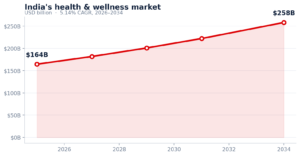
India’s health and wellness market, 2025–2034
But treating that as one market is the most common mistake in this conversation, and it hides where the money actually is.
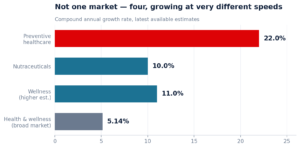
Segment growth rates diverge sharply
The broad health and wellness market compounds at a modest 5.14%. Preventive healthcare is estimated to be growing at around 22% — more than four times faster. Nutraceuticals sit around 10%, and some analysts put the narrower “wellness” segment at 10–12%.
A word of caution that most coverage of this sector skips: these estimates diverge wildly by source. India’s nutraceuticals market has been sized at USD 32 billion by one research house and USD 6.1 billion by another for the same year, because they are measuring different things — one counts functional foods and fortified staples, the other counts supplements alone. Any article quoting a single confident number for “the Indian wellness market” is quoting a definition, not a fact.
What is not in dispute is the demographic engine. The 18–35 cohort — Millennials and Gen Z — is the largest consumer base, and its spending is concentrated in fitness, appearance and immunity: protein powders, multivitamins, beauty supplements. That is a young, urban, digitally-acquired customer. Which happens to be precisely the audience a film star or cricketer already owns.
Who actually owns what
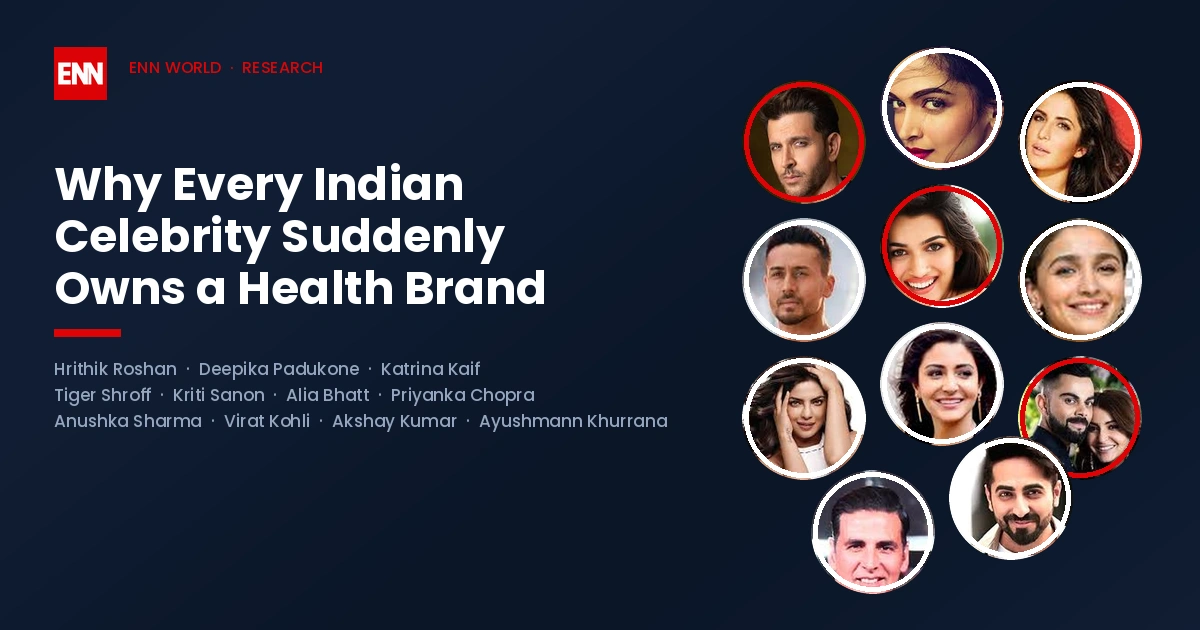
Two distinct behaviours get conflated in most coverage. Some celebrities founded brands. Others invested in someone else’s. The economics, the risk and the time commitment are entirely different.
| Celebrity | Brand | Category | Role |
|---|---|---|---|
| Hrithik Roshan | HRX (2013) | Athleisure & fitness | Co-founder |
| Deepika Padukone | 82°E (2022) | Skincare & self-care | Co-founder |
| Katrina Kaif | Kay Beauty | Beauty & cosmetics | Co-founder |
| Tiger Shroff | Prowl | Fitness & lifestyle | Founder |
| Kriti Sanon | Hyphen (2023) | Skincare | Co-founder |
| Alia Bhatt | Ed-a-Mamma (2021) | Kidswear & maternity | Founder |
| Priyanka Chopra | Anomaly | Haircare | Founder |
| Deepika Padukone | Epigamia, Nua | Food; women’s hygiene | Investor |
| Anushka Sharma | Wholsum Foods (Slurrp Farm) | Children’s nutrition | Investor & ambassador |
| Anushka Sharma & Virat Kohli | Blue Tribe | Plant-based meat | Investors |
| Akshay Kumar | GOQii | Health-tech & wearables | Investor |
| Ayushmann Khurrana | The Man Company | Men’s grooming | Investor |
HRX is the origin point. Hrithik Roshan launched it in 2013 with Myntra, and it is generally credited as India’s first homegrown celebrity brand of any consequence. Every deal since has been built on the template it proved.
The uncomfortable finding: most of this isn’t health
Read the table again by category rather than by name.
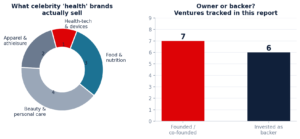
Category breakdown and ownership mode
Of the ventures tracked here, the largest cluster is beauty and personal care, followed by food and nutrition. Athleisure accounts for two. Health-tech and medical devices — the actual health category — accounts for one.
HRX sells T-shirts, sneakers and joggers. Kay Beauty sells cosmetics. Ed-a-Mamma sells children’s clothing. Anomaly sells shampoo. These are excellent businesses. They are not health businesses, and the industry’s habit of filing them under “celebrity wellness” inflates the apparent size of the phenomenon considerably.
The genuine health plays are a much shorter list: GOQii in wearables and health-tech, Nua in women’s hygiene, Epigamia and Slurrp Farm in functional nutrition, Blue Tribe in plant-based protein. Notably, almost all of them are ventures celebrities invested in rather than founded — because building a health product requires regulatory competence, clinical substantiation and supply chains that a personal brand cannot supply.
That distinction matters for anyone drawing conclusions from this trend. Celebrities are founding image businesses and investing in health businesses. They are not the same bet.
Why the economics work — four reasons, in order of importance
- Customer acquisition cost is the largest line in a D2C P&L, and a celebrity deletes it.
This is the entire commercial logic and everything else is secondary. A new direct-to-consumer brand in India spends heavily on Meta and Google to buy its first hundred thousand customers. A founder with tens of millions of followers reaches that audience at zero marginal cost, on day one, repeatedly. In a category where paid acquisition costs have risen every year, owning distribution is worth more than owning a factory.
- Health and wellness has the shortest credibility distance of any category.
An actor endorsing a cement brand is borrowing authority they do not have. An actor selling fitness or skincare is selling the very thing the audience already believes they possess. The product and the persona are the same asset. No other category offers that alignment — which is why you see celebrity skincare and celebrity athleisure everywhere, and almost no celebrity industrial equipment.
- The category is capital-light and outsourceable.
None of these founders built manufacturing. Contract manufacturers make the product, Nykaa and Amazon and Myntra handle distribution, an agency runs performance marketing. The celebrity supplies brand and reach; specialist partners supply everything else. HRX with Myntra and Kay Beauty with Nykaa are the clearest examples — these are structured partnerships, not vanity projects.
- Equity is an annuity; endorsement is a salary.
Film and sporting careers are short and volatile. An endorsement fee stops when the contract ends or the public moves on. A shareholding continues to compound, and can be sold. The reported Ed-a-Mamma transaction is the proof point every talent manager in Mumbai now cites.
Why the sector itself is booming
Four structural forces, independent of celebrity:
- Preventive spending replaced curative spending. Post-pandemic, Indian consumers began paying for health before they were unwell — supplements, wearables, diagnostics, fitness. That is the shift behind the 22% preventive healthcare growth estimate.
- A trust vacuum in an unbranded market. Large parts of Indian wellness remain unbranded, unregulated and unverifiable. In a category where the consumer cannot assess the product, a recognisable face functions as a trust proxy. Celebrity works better in low-trust categories than in high-trust ones — which is exactly why it works here.
- Digital-first distribution matured. Nykaa, Amazon, Myntra and quick commerce made it possible to reach a national customer without a single retail lease.
- Young, urban, willing to pay a premium. The 18–35 cohort treats wellness as identity rather than as medicine, and prices accordingly.
What the coverage usually leaves out
Three qualifications, without which this is a press release rather than analysis.
Survivorship bias is severe. The brands named above are the ones that worked. Celebrity ventures fail at least as often as any other consumer startup, and quietly — there is no press release for a shuttered skincare line. Judge the pattern by the failures you cannot see as much as the exits you can.
A famous founder is an acquisition engine, not a moat. Fame gets the first purchase. Nothing about fame secures the second. Every brand on that list that has lasted — HRX at thirteen years, Kay Beauty, 82°E — has professional operators and a real supply chain behind the name. The ones that treated the celebrity as the entire strategy did not last.
The regulatory perimeter is tightening. ASCI has progressively tightened disclosure norms for celebrity and influencer promotion, and health claims specifically are policed. A founder-celebrity promoting their own product occupies a more complicated position than an endorser, not a simpler one — the ownership has to be disclosed, and the claims have to be substantiable.
What to watch next
The interesting question is no longer whether celebrities will launch wellness brands. They will. It is whether any of them will build in the hard part of the category — diagnostics, clinical nutrition, medical devices, therapeutics — where the growth rate is four times higher and the barrier to entry is competence rather than fame.
So far, exactly one name on the list has gone near it, and as an investor rather than a founder.
Until that changes, the honest description of this phenomenon is not that Indian celebrities are building health businesses. It is that they are building consumer brands with health-adjacent positioning, in a market where the health framing sells better than the product category would on its own.
That is a perfectly good business. It is just a different one from the one the headlines describe.
Methodology and sources: market sizing from IMARC Group, Grand View Research, Research and Markets and Ken Research; brand and investment details from company announcements, Business Today, BBC and StartupTalky reporting. Charts prepared by ENN World from the cited figures.

A note on the numbers: sector estimates for Indian health and wellness diverge substantially between research houses because of differing category definitions. Where sources conflict — as with nutraceuticals, sized between USD 6.1 billion and USD 32 billion for the same year — both figures are reported rather than one being selected. Deal values are as reported in the press and were not independently confirmed; the Ed-a-Mamma figure reflects reported acquisition talks, not a completed transaction disclosed by either party.
Virat Kohli, Vikas Kohli Increase Stake in ‘Vault by Virat Kohli’

Ruchi Kumar is the associate editor at Entrepreneur News Network and TVW News India, where she leads editorial strategy, brand storytelling, and startup ecosystem coverage. With a strong focus on innovation, business, and marketing insights, he curates impactful narratives that spotlight India’s evolving entrepreneurial landscape. She has written extensively on fintech, AI and emerging startups.