

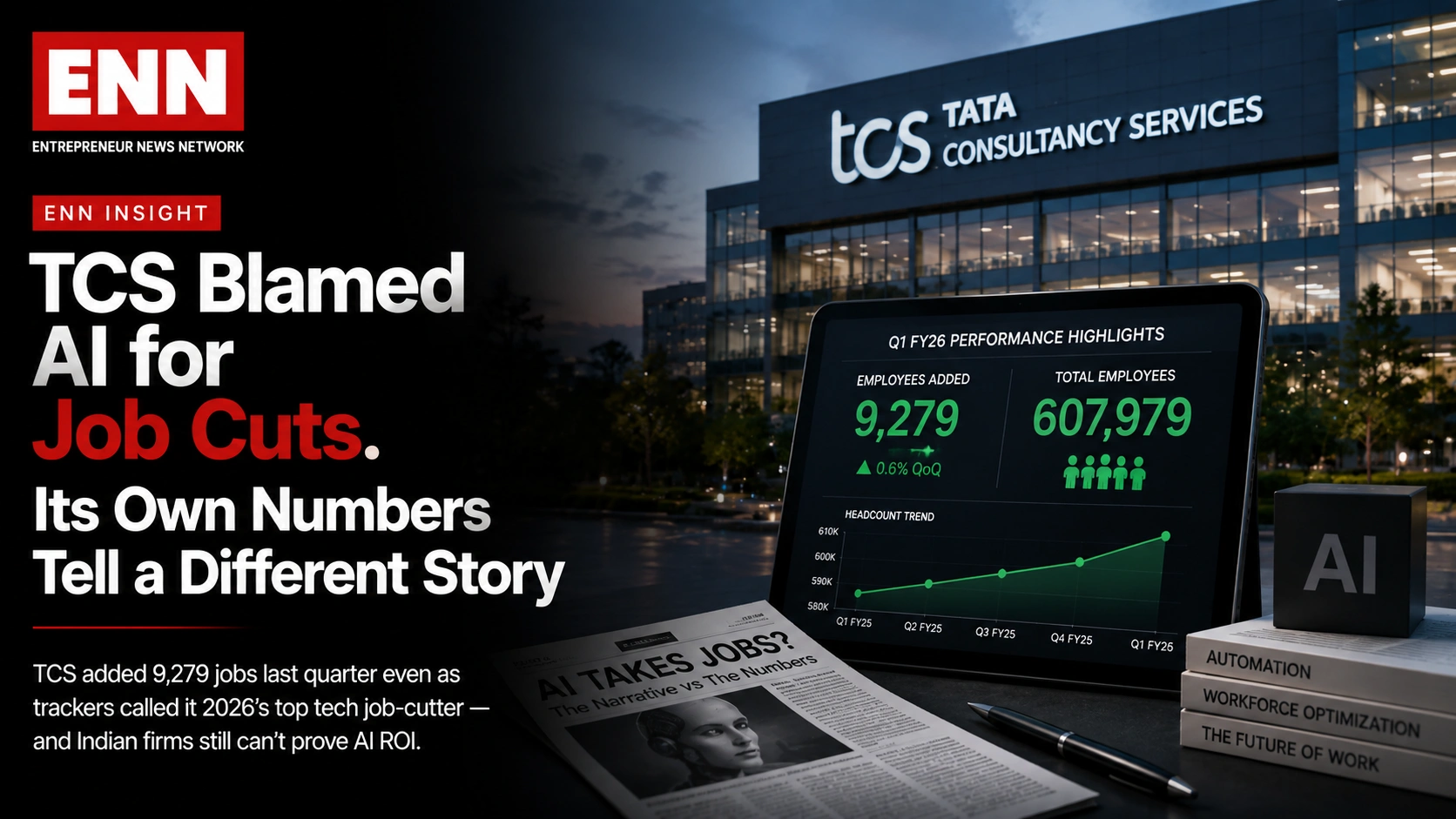
New Delhi | Thursday, August 14, 2026 | 11:30 AM IST – Tata Consultancy Services was among India’s biggest technology job cutters during the recent workforce correction. Yet its latest numbers tell a more complicated story: the company added 9,279 employees in the quarter ended June 30, 2026, taking its total workforce to 593,798.
The increase, disclosed in TCS’s Q1 FY27 fact sheet filed with investors on July 9, marks the company’s sharpest quarterly headcount increase in more than a year.
That sits uneasily alongside claims that TCS has been the world’s biggest technology job cutter in 2026, with one tracker attributing 23,460 cuts to the company.
The numbers suggest a more nuanced reality. TCS has cut jobs, but it has also resumed hiring. And while artificial intelligence has been cited as a major force reshaping the IT industry, the company’s own workforce data does not support a simple narrative of AI replacing employees at scale.
TCS’s headcount tells a two-part story
TCS’s workforce reached 613,069 employees in June 2025, its highest level in the period covered by the company’s recent disclosures.
By December 2025, headcount had fallen to 582,163, a reduction of roughly 30,900 employees over six months.
The trend then began to reverse.
TCS reported 584,519 employees in March 2026, followed by 593,798 in June.
That represents a recovery of approximately 11,600 employees from the December low.
The company also onboarded around 14,000 campus graduates during the latest quarter, according to its fact sheet.
The figures do not erase the earlier workforce reductions. Instead, they suggest that TCS’s employment strategy is moving through different phases: rapid pandemic-era hiring, subsequent workforce rationalisation and renewed recruitment as business demand stabilises.
The AI explanation is harder to prove
TCS announced in July 2025 that it planned to cut around 12,000 employees, or about 2% of its global workforce.
The company described the reductions in terms of limited deployment opportunities and skill mismatch. The announcement came as TCS was simultaneously increasing its focus on artificial intelligence, leading to widespread speculation that AI automation was driving the cuts.
AI is undoubtedly changing the technology-services business.
But attributing the entire workforce reduction to AI risks overlooking another explanation: the correction of excess hiring accumulated during the pandemic-era technology boom.
TCS’s latest headcount numbers reinforce that possibility.
If AI were driving a straightforward and continuous replacement of employees, a sharp rebound in overall workforce numbers — particularly alongside large-scale graduate hiring — would be difficult to explain.
The more likely picture is one of workforce restructuring, changing skill requirements and selective hiring rather than a simple collapse in technology employment.
The 23,460 layoffs figure needs a closer look
One of the most widely cited numbers behind the TCS job-cut narrative is 23,460, reportedly making the company the biggest technology job cutter globally in 2026.
But the figure requires caution.
The number has been attributed to a short post on Naukri.com’s Minis platform, without a clearly disclosed methodology or original source.
It is therefore unclear whether the figure represents layoffs formally announced during 2026, cumulative workforce reductions connected to earlier plans, or another measurement.
That distinction matters.
A company can announce significant layoffs in specific functions or locations while simultaneously hiring in other areas. Gross job cuts and net headcount changes are not inherently contradictory.
What remains unclear is how the 23,460 figure reconciles with TCS’s own recent disclosures showing two consecutive quarters of workforce growth.
ENN could not independently verify the 23,460 figure against a primary source and therefore does not treat it as confirmed.
India’s AI ROI problem complicates the narrative
There is another reason to be cautious about attributing workforce reductions entirely to AI: Indian companies are still struggling to demonstrate measurable returns from their AI investments.
The State of AI in Indian Enterprises 2026 report, cited in recent industry coverage, surveyed more than 300 senior technology executives.
It found that around 60% of organisations remain at the pilot or exploration stage of AI adoption despite having invested in the technology for two or more years.
Only 12% reported significant, measurable returns from their AI investments.
Another 57% either had no measurable AI ROI or could not determine whether their investments were generating returns.
The findings raise an obvious question.
If most enterprises are still struggling to demonstrate significant financial returns from AI, how much of today’s workforce restructuring can reasonably be attributed to proven AI-driven productivity?
The answer is unlikely to be straightforward.
AI spending is growing, but measurement remains weak
The same report found that 58% of companies allocate less than 10% of their IT budgets to AI.
Meanwhile, 55% either experienced AI cost overruns or did not separately track AI expenditure.
That creates a measurement problem for companies attempting to connect AI investment with workforce productivity.
A company may deploy AI tools, automate selected processes and restructure teams without having a clean measurement of how much revenue or productivity the technology actually creates.
For IT services companies, that makes the AI narrative particularly important.
They are not only deploying AI internally. They are also selling AI transformation to global clients.
TCS wants to be part of the AI transformation
TCS has been positioning itself as a major provider of AI services to enterprises.
The company has said its AI services business reached an annualised revenue run rate of approximately $2.3 billion in early 2026.
That makes AI an increasingly important part of its growth strategy.
The broader Indian IT industry is following a similar path.
Infosys has said it is undertaking AI work for a large majority of its major clients, while Indian technology companies are increasingly building AI platforms, transformation services and automation capabilities around enterprise customers.
The opportunity is substantial.
But so is the credibility challenge.
Indian IT companies increasingly need to demonstrate that AI is not simply a new services category but a technology capable of delivering measurable improvements in productivity, cost and revenue for clients.
The deployment gap
The challenge facing the industry is what some analysts describe as an AI deployment gap.
Companies have access to increasingly capable models, but integrating them into legacy technology systems, workflows, data environments and regulatory frameworks remains difficult.
That gap could create an opportunity for Indian IT services companies.
Instead of losing business to AI, they could become the organisations that help enterprises deploy it.
But that also changes the nature of the work.
Traditional labour-intensive outsourcing models could increasingly give way to higher-value services built around AI implementation, cloud infrastructure, data and automation.
For employees, that means the critical question may not simply be whether AI eliminates jobs.
It may be which skills remain valuable as the composition of technology work changes.
Hiring is shifting, not disappearing
TCS’s campus hiring provides an important signal.
The company added thousands of employees while simultaneously restructuring parts of its existing workforce.
That suggests demand for new skills is coexisting with pressure on some existing roles.
The transition could therefore produce a workforce with fewer opportunities in certain legacy areas but stronger demand for AI, cloud, data, cybersecurity and advanced engineering skills.
Nasscom estimates cited in the supplied reporting suggest that only around 16% of India’s IT workforce is currently AI-skilled, even as demand for AI-related roles continues to expand.
That creates a potentially significant skills gap.
For technology companies, the challenge becomes one of reskilling and redeployment, rather than simply reducing headcount.
What TCS’s numbers really tell us
The simplest version of the story is attractive:
AI is replacing IT workers. TCS is cutting jobs.
But TCS’s own numbers make that explanation incomplete.
The company reduced its workforce sharply during 2025, then began adding employees again.
It hired thousands of graduates while continuing to reshape its workforce.
At the same time, Indian enterprises are still struggling to prove meaningful ROI from their AI investments.
Taken together, the evidence points toward something more complicated.
AI is changing the economics and skill requirements of IT services. But the current data does not prove that AI alone is responsible for TCS’s workforce reductions.
The distinction matters because the future of India’s technology workforce depends on whether AI primarily destroys jobs, transforms them or creates a new mix of roles.
For now, TCS’s headcount suggests the answer is likely to be all three — but at different speeds and in different parts of the workforce.
Editor’s Note
The TCS quarterly headcount figures — 613,069 in June 2025, 582,163 in December 2025, 584,519 in March 2026 and 593,798 in June 2026 — are based on the company’s investor disclosures cited in the supplied material.
The 23,460 layoffs figure attributed to TCS could not be independently verified against a primary source and should therefore be treated as unconfirmed. Gross layoffs and net headcount growth can coexist because companies may cut roles in some areas while hiring elsewhere.
The AI ROI figures cited above are based on the State of AI in Indian Enterprises 2026 report as described in the supplied source material.

Ruchi Kumar is the associate editor at Entrepreneur News Network and TVW News India, where she leads editorial strategy, brand storytelling, and startup ecosystem coverage. With a strong focus on innovation, business, and marketing insights, he curates impactful narratives that spotlight India’s evolving entrepreneurial landscape. She has written extensively on fintech, AI and emerging startups.