

In 2020, building a data center cost roughly $7.7 million per megawatt of capacity. By 2026, that global benchmark has climbed to $11.3 million per megawatt — a 47% increase in six years, driven mostly by construction labor, electrical equipment, and land scarcity near power-rich sites. That was already a steep curve. Then artificial intelligence rewrote the math entirely.
An AI-optimized facility — one built to house dense racks of graphics processing units (GPUs) rather than conventional servers — now costs $15 million to $25 million per megawatt just for the shell, power distribution, and structural work, before a single chip goes in. Add the GPUs themselves and the liquid-cooling systems needed to keep them from melting, and the all-in figure reaches $30 million to $45 million per megawatt. By one industry index, the AI Construction Cost Premium as of the second quarter of 2026 sits at 3.30 times the cost of a standard operational megawatt.
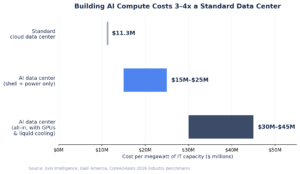
Figure 1: Cost per megawatt, standard vs. AI-optimized data centers, 2026 benchmarks.
Where the money actually goes
Strip out the GPUs and look only at the building itself, and the budget is dominated by power. Electrical infrastructure — switchgear, uninterruptible power supplies, backup generators — typically eats 40% to 45% of a shell-and-core construction budget. Cooling systems take another 15% to 25%, and that share is rising fast as air cooling gives way to liquid cooling for high-density AI racks. The remaining third or so covers the structural shell, site work, land, and permitting.
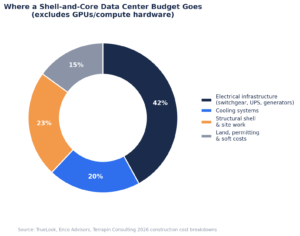
Figure 2: Shell-and-core budget breakdown, excluding compute hardware.
That breakdown, however, understates the real story, because it excludes the single largest line item in an AI build: the chips. A single Nvidia B300 GPU purchased outright runs about $53,000 as of mid-2026, and a fully configured 8-GPU DGX B200 system costs $280,000 to $320,000 — roughly $35,000 to $40,000 per GPU once networking and storage are included. An air-cooled HGX B200 rack runs $3.0 million to $3.4 million on its own, or about $3.9 million once networking and storage are folded in. One widely cited estimate found that 100 Nvidia H100 GPUs — about $3 million in hardware — represent only 35% of the five-year total cost of ownership; the remaining 65%, roughly $5.6 million, goes to power, cooling, networking, staff, and maintenance over the chips’ working life.
The hidden cost is electricity, not concrete
A traditional server rack draws 5 to 15 kilowatts. A modern AI training rack draws 30 to 110 kilowatts, and new facilities are now being designed for 100 to 300 megawatts of total capacity — some for a full gigawatt, roughly the output of a nuclear reactor. That demand is colliding with a US power grid that has barely grown in two decades.
According to Goldman Sachs Research, US data center power demand is projected to rise from 31 gigawatts in 2025 to 41 gigawatts in 2026 and 66 gigawatts in 2027 — more than doubling in two years. PJM Interconnection, which serves 67 million people across the Mid-Atlantic and includes Virginia’s dense cluster of data centers, has already issued emergency grid alerts as demand hits record highs. Gartner forecasts that power shortages will physically constrain 40% of planned AI data centers by 2027, meaning the binding constraint on the industry is no longer capital or chips — it is transformers, substations, and transmission lines.
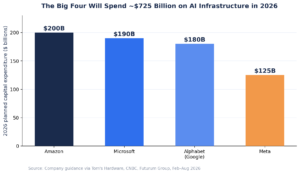
Figure 3: Forecast US data center power demand, 2025–2027.
Cooling adds a second, less-discussed resource cost: water. A typical data center consumes around 300,000 gallons a day, and the largest hyperscale sites use up to 5 million gallons daily. Google’s Council Bluffs, Iowa campus alone withdraws roughly 3.9 million gallons a day; a Meta facility in Newton County, Georgia draws about 500,000 gallons a day — close to 10% of the entire county’s water supply. Evaporative cooling systems consume roughly 0.26 to 2.4 gallons of water for every kilowatt-hour of server energy used, depending on climate and system design.
Who is footing the $725 billion bill
None of this is being built cautiously. Amazon, Microsoft, Alphabet, and Meta together plan to spend approximately $725 billion on capital expenditure in 2026 — a 77% jump from $410 billion the year before, with the bulk going to Nvidia GPUs, custom silicon, data center shells, and power procurement. Amazon alone is guiding to roughly $200 billion, Microsoft to about $190 billion, Alphabet to $175–$185 billion, and Meta to $115–$135 billion. Independent estimates put the aggregate hyperscaler capital spend on compute, data centers, and power at $7.6 trillion between 2026 and 2031.
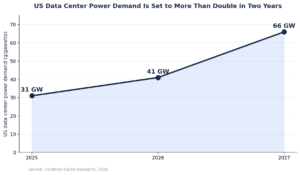
Figure 4: Planned 2026 capital expenditure, four largest hyperscalers.
The most extreme individual project is OpenAI’s Stargate, a four-year, $500 billion initiative — backed by OpenAI, SoftBank, Oracle, and Abu Dhabi’s MGX — to deploy 10 gigawatts of AI compute inside the United States. Sam Altman has said Stargate plus OpenAI’s broader cloud-computing commitments now total roughly $1.4 trillion. Elon Musk’s xAI has taken a different scale of bet, investing more than $40 billion in its Colossus site in Memphis, Tennessee, which went from zero to 100,000 Nvidia H100 GPUs in just 122 days in 2024 and had expanded to 230,000 GPUs by July 2025. A follow-on facility, Colossus 2, is targeting 1 million GPUs and is being positioned as the first data center built around a full gigawatt of training capacity.
A depreciating asset built on borrowed money
The spending is increasingly financed with debt rather than cash. Total AI-related debt outstanding is on pace to approach $570 billion in 2026, and the marginal financing dollar is shifting away from public bonds toward private credit and off-balance-sheet vehicles; coverage ratios on hyperscaler bond deals fell from roughly five times in February 2026 to under two times by July. That matters because of a mismatch buried in the economics: data center buildings are engineered for 20- to 30-year economic lives, but the GPUs inside them lose an estimated 30% to 35% of their value every year, with an effective competitive lifespan of about one year before a newer chip architecture arrives. Rental rates for widely used AI chips have already fallen 70% to 90% since 2023 as supply has caught up with early scarcity.
That leaves lenders holding depreciating collateral inside buildings with multi-decade lifespans — a structure regulators including the Bank for International Settlements have flagged as a new category of collateral risk with no clean historical precedent. Analysts tracking the space expect the first wave of loan defaults or lease renegotiations to surface in 2027 or 2028, when initial financing terms come up for renewal and underwriting assumptions meet the reality of chip obsolescence and, potentially, softer-than-projected AI demand.
The bottom line
A single AI-ready megawatt now costs three to four times what a conventional data center megawatt cost five years ago, and that figure sits inside a broader buildout — $725 billion in 2026 alone from four companies — that is being financed increasingly with debt against equipment that loses roughly a third of its value annually. The physical constraint is no longer money or even chips; it is electricity, water, and grid capacity that take years to build and cannot be conjured by a funding round. Whether that combination of capital intensity, resource strain, and depreciation risk is sustainable is now one of the central questions hanging over the AI industry heading into 2027.
Sources
Axis Intelligence (AI Data Center Cost per MW: 2026 Benchmarks; AI Data Center Financing Statistics 2026); Gain America (AI Data Center Cost Per MW: Budgeting a 2026 GPU Buildout); CoreAdvisors (AI Data Center Development Costs in 2026); TrueLook, Enco Advisors, Terrapin Consulting Group (2026 data center construction cost breakdowns); IntuitionLabs and Tech Insider (Nvidia Blackwell GPU pricing, 2026); Introl (GPU Infrastructure TCO Model); Goldman Sachs Research (US Data Center Power Demand, 2026); Gartner (AI data center power shortage forecast); MOST Policy Initiative, The Network Installers, Illinois CEE (data center water usage statistics, 2026); Tom’s Hardware, CNBC, Futurum Group, ValueAddVC (2026 hyperscaler capex tracking, Feb–Aug 2026); Forbes, Data Center Dynamics, NextBigFuture (Project Stargate and xAI Colossus reporting); Chicago Booth Review, Ropes & Gray, Axis Intelligence (AI debt financing and GPU depreciation risk, 2026).
TCS Blamed AI for Job Cuts. Its Own Numbers Tell a Different Story

Ruchi Kumar is the associate editor at Entrepreneur News Network and TVW News India, where she leads editorial strategy, brand storytelling, and startup ecosystem coverage. With a strong focus on innovation, business, and marketing insights, he curates impactful narratives that spotlight India’s evolving entrepreneurial landscape. She has written extensively on fintech, AI and emerging startups.