
Houston, September 1, 2026 — The next bottleneck in artificial intelligence may not be chips. It may be heat.
That is the thesis behind SLB’s $4.1 billion acquisition of Kelvion, a global provider of thermal management and heat-exchange technologies. The oilfield-services giant has agreed to acquire Kelvion for approximately $3.4 billion in cash and assume roughly $700 million of debt, significantly expanding its presence in the rapidly growing data center infrastructure market.
For SLB, the transaction is more than a conventional acquisition. It is a strategic attempt to move deeper into the physical infrastructure required to power the AI economy—where rising computing density is creating unprecedented demand for cooling, power efficiency and integrated data center systems.
“AI is driving the most significant infrastructure investment cycle in our lifetime,” SLB CEO Olivier Le Peuch said in announcing the deal.
The numbers suggest why SLB is making the move.
Kelvion is expected to generate $2.3 billion to $2.4 billion in revenue in 2026, with adjusted EBITDA of approximately $350 million to $400 million. Data centers are already its largest and fastest-growing end market, expected to contribute $1.2 billion to $1.3 billion in revenue this year.
For SLB, the acquisition could turn thermal management into a central component of a much larger data center infrastructure strategy.
The AI Infrastructure Problem Is Moving Beyond GPUs
The AI boom has created a massive investment cycle in data centers, but increasingly powerful processors are changing the engineering economics of those facilities.
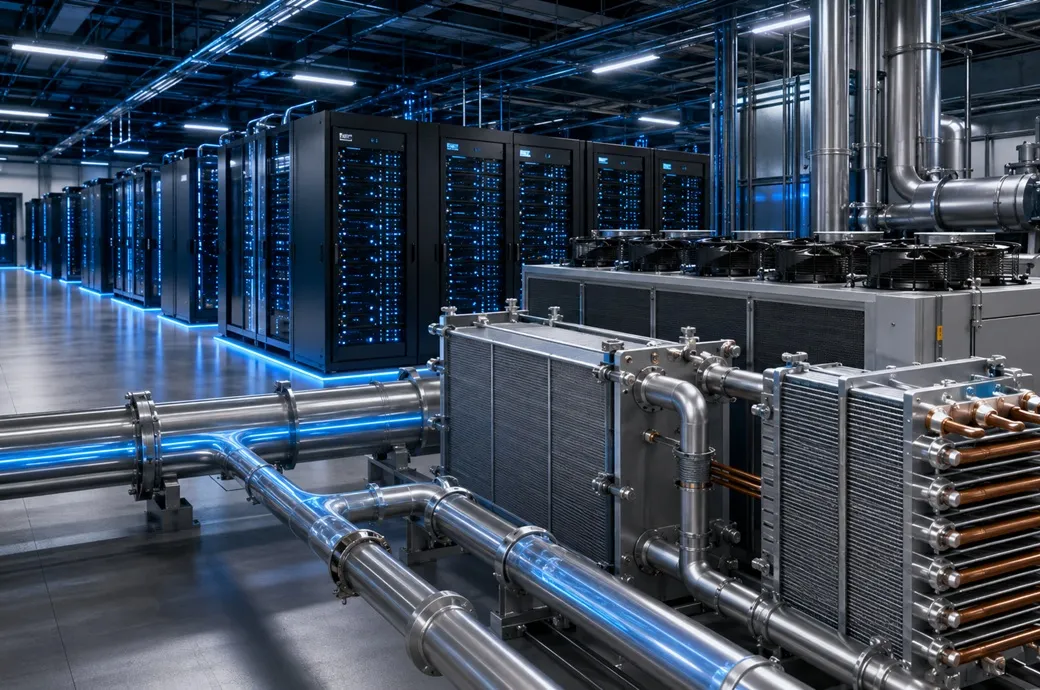
As computing density rises, managing heat becomes a critical part of maintaining performance, reliability and energy efficiency.
That makes technologies such as heat exchangers and advanced cooling systems increasingly strategic.
Kelvion brings SLB a portfolio spanning thermal management and heat-transfer applications across data centers, energy and industrial markets. The company also has exposure to emerging areas including heat pumps, renewable energy, carbon capture and processing technologies.
The acquisition therefore gives SLB exposure to multiple infrastructure trends rather than just data centers.
SLB Wants to Become a Data Center Infrastructure Partner
SLB’s existing Data Center Solutions business has already been growing rapidly.
Revenue is expected to have increased at a compound annual growth rate of more than 90% between 2024 and 2026, while cumulative delivered capacity is expected to exceed 2 gigawatts by the end of 2026.
The company uses modular manufacturing, offsite construction, engineering and digital technologies to deliver infrastructure from design through system integration.
SLB says its modular approach can reduce onsite construction complexity and shorten the time required to bring facilities into operation by up to 40%.
Kelvion adds another critical piece to that platform: thermal management.
The strategic logic is straightforward. Instead of supplying isolated infrastructure components, SLB wants to integrate more of the systems required to build increasingly complex AI data centers.
The $4.1 Billion Price Tag
Under the agreement, SLB will acquire Kelvion from Apollo-managed funds, which hold the majority stake, and funds advised by Triton, which owns a minority interest.
The transaction carries a total value of approximately $4.1 billion, including assumed debt.
SLB values the transaction at approximately 11 times estimated 2026 EBITDA before synergies. Including expected annual run-rate synergies, the multiple falls to approximately 8.5 times EBITDA.
The company expects the deal to be accretive to both earnings per share and free cash flow per share within the first 12 months after closing.
It is targeting approximately $120 million in annual EBITDA synergies within three years, generated through cost efficiencies and additional revenue opportunities.
The transaction remains subject to customary closing conditions and regulatory approvals and is expected to close during the first half of 2027.
Aiming for a $5 Billion Data Center Business
The acquisition could substantially reshape the scale of SLB’s data center operation.
On a pro-forma basis, SLB and Kelvion are expected to generate more than $2 billion in data center revenue and approximately $300 million in adjusted EBITDA in 2026.
SLB is targeting an even more ambitious trajectory.
By 2028, the company expects its combined Data Center Solutions business to generate:
- $4.5 billion–$5 billion in revenue
- $700 million–$800 million in adjusted EBITDA
That would transform data centers from an emerging business for SLB into a significant technology and infrastructure growth engine.
Cooling Is Becoming a Strategic AI Infrastructure Market
The deal reflects a broader shift in how investors and industrial companies view data center infrastructure.
The AI infrastructure stack is no longer limited to semiconductors, servers and networking. Power generation, grid infrastructure, cooling, thermal management, construction and energy efficiency are becoming equally important parts of the equation.
For operators building large AI facilities, cooling can directly influence energy consumption, computing density and operating costs.
SLB’s acquisition of Kelvion effectively places the company closer to that infrastructure bottleneck.
Gavin Rennick, president of SLB’s New Energy and Industrial business, described thermal management as central to the challenge of building increasingly sophisticated and energy-intensive data centers.
The combination is intended to allow SLB to integrate cooling technologies more directly into its modular infrastructure offering while improving thermal efficiency and accelerating innovation.
The Deal Also Fits SLB’s Energy Transition Strategy
Kelvion’s business extends beyond data centers.
Its technologies are used in markets including heat pumps, renewables, carbon capture and industrial processing—areas where managing heat efficiently can have a direct impact on energy consumption and emissions.
That creates an additional strategic dimension for SLB.
The company is effectively acquiring a technology platform that sits at the intersection of AI infrastructure, energy efficiency and industrial decarbonization.
For an energy-services company seeking to broaden its technology portfolio, that combination could prove important as capital flows increasingly converge around digital infrastructure and energy transformation.
SLB Says Balance Sheet Remains Strong
Despite the size of the acquisition, SLB expects to maintain its investment-grade financial position.
The company said its net debt-to-EBITDA ratio will remain within its previously stated through-cycle target of up to 1.5 times.
SLB is also reaffirming its commitment to return more than $4 billion to shareholders in 2026 through dividends and share repurchases.
While formal 2027 capital-return targets will be established through the company’s annual planning process, SLB expects total shareholder returns to remain at least in line with 2026 levels.
The Bigger Bet: Infrastructure Behind the AI Boom
SLB’s Kelvion acquisition ultimately represents a bet on what comes after the AI chip race.
The world’s biggest technology companies are committing enormous sums to AI data centers, but those facilities require far more than processors. They need power, cooling, advanced thermal systems, construction expertise and increasingly integrated infrastructure.
By combining Kelvion’s thermal management capabilities with its existing modular data center platform, SLB is positioning itself to capture a larger share of that spending.
The transaction also highlights a broader reality of the AI economy: the companies enabling AI may extend far beyond traditional technology players.
As AI systems become more powerful—and more demanding—the infrastructure required to keep them running could become one of the industry’s biggest investment opportunities.
And SLB is betting that controlling the heat will be just as important as powering the intelligence.
Kepler Aerospace Raises $8 Million to Scale Swarming ISR Satellites and Space Infrastructure

Ruchi Kumar is the associate editor at Entrepreneur News Network and TVW News India, where she leads editorial strategy, brand storytelling, and startup ecosystem coverage. With a strong focus on innovation, business, and marketing insights, he curates impactful narratives that spotlight India’s evolving entrepreneurial landscape. She has written extensively on fintech, AI and emerging startups.