

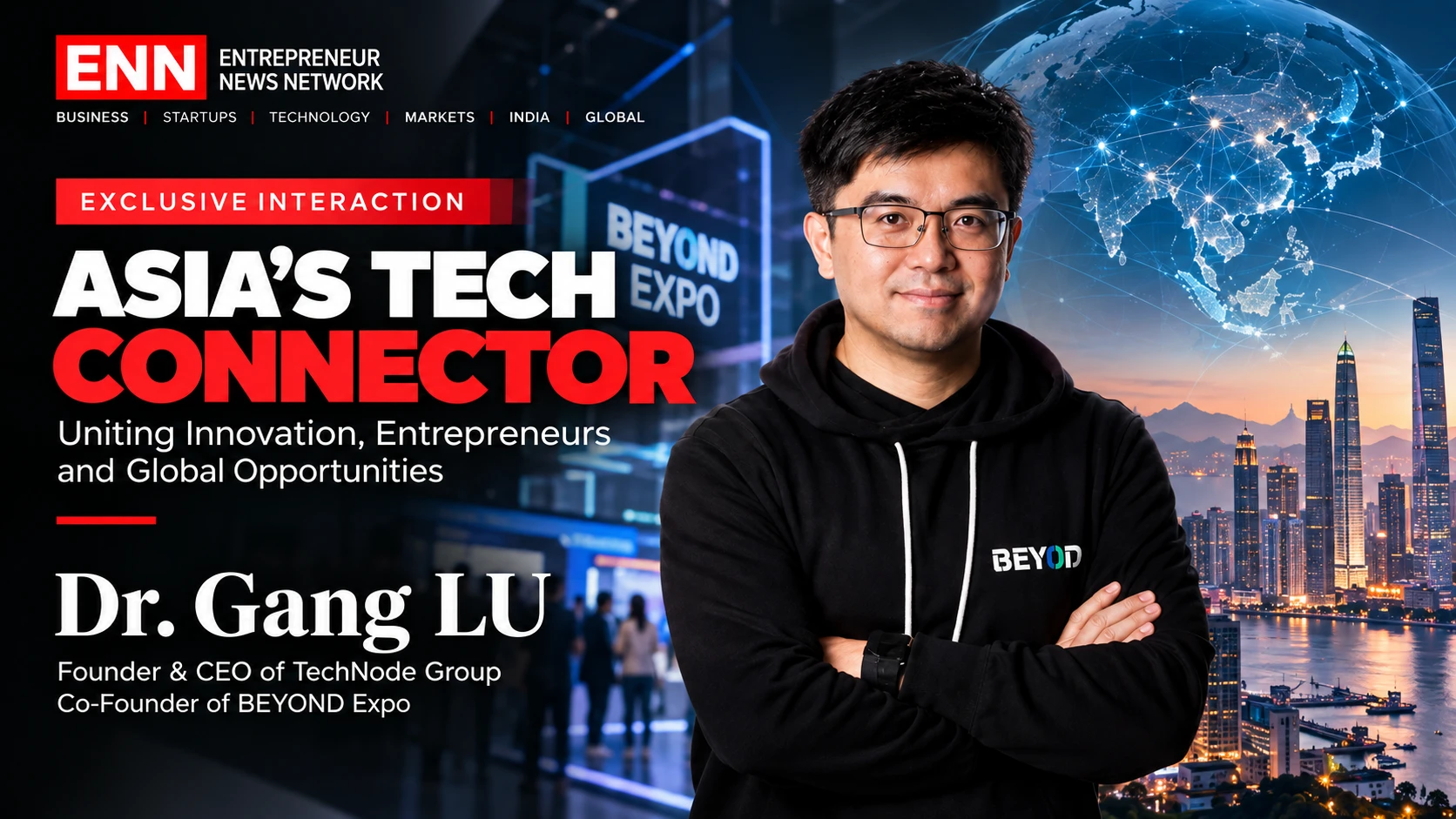
7 October 2026 | India – In an exclusive interaction with Ankitt Y, Editor, ENN, Dr. Gang LU — Founder & CEO, TechNode Group, and Co-Founder, BEYOND Expo — shared the thinking behind one of Asia’s most ambitious technology platforms, and was refreshingly candid about what it has not yet achieved.
Dr. Lu started TechNode in 2007 as a hobby, while completing his PhD in the UK, for a reason that was almost naive in its simplicity: the world was reading plenty about China, and almost none of it was about innovation. Nearly two decades later, that blog has become a bilingual media house, a Southeast Asia arm in TechNode Global, and BEYOND Expo — a Macau-based platform now positioned as Asia’s answer to CES. In this conversation he talks about the fragmentation that makes an Asian CES so hard and so necessary, how geopolitics has changed what happens after a story is published, where he draws the line between the editorial desk and the sponsorship deck, why BEYOND’s policy influence is still a work in progress, what he expects from robotics over the next three years, and the India-shaped gap in Asia’s innovation map. Edited excerpts:
You’ve positioned BEYOND Expo as Asia’s answer to CES. But CES has a decade of American corporate backing behind it, and Asia is fragmented — different regulations, different capital pools, different languages. What makes you confident this can work?
It’s an important question, and the answer really starts with my own career.
I began TechNode as a personal blog in 2007, almost 20 years ago. I was still a PhD student in the UK at the time. I’m from China, and as a Chinese internet user I was reading all the international media writing about China — and there wasn’t much information at all. I knew there were so many things happening, and so many things about to happen. But very little of that coverage understood what was actually going on. It was about censorship, about politics. Nothing about innovation. That felt like a real pity.
So I thought, maybe I can do something — just write about what’s happening in China, in English. I started reaching out to Chinese entrepreneurs and founders, convincing them to do interviews, and writing it all up in English. The idea was simple: we need English-language media to bring China’s story to the world.
Around 2012–13, I decided to turn the hobby into a career. And about five years ago I saw more and more Chinese tech companies going international — but because of the US–China situation, instead of going to the US, they were looking at Asia, because it’s close. So we opened a small office in Malaysia and launched a separate publication, TechNode Global, focused on everything outside China, with Southeast Asia as the priority.
Then the same feeling returned, but bigger. It’s no longer just about China. China’s tech space has moved very fast over the last ten years — but look at Southeast Asia, Korea, Japan, and of course India, a huge market with huge potential. So much is happening on this side of the world. And yet at CES, even with all the Asian companies exhibiting, the headlines still go to American companies.
In the West you have CES every January, you have Viva Technology in France, Web Summit. Great shows, great platforms. In Asia, we don’t really have one table where everybody can come together, share insight and showcase what they’ve built.
And you’re right — when we started working on it, it was really difficult. The language barrier, the cultural differences. Shanghai to Seoul is a one-and-a-half-hour flight, and even that close, there is so much distance. But that’s exactly the argument for doing it. If something is difficult and you can still build it, it brings huge value to the ecosystem. Asia is fragmented, so if we can build the one table, it also makes it much easier for the rest of the world. They come once a year, see what’s happening here, meet everyone, and then go do business in India, in Singapore, in Thailand.
Geopolitics has made China tech coverage an adversarial subject rather than a curious one. Has that changed what TechNode is willing or able to publish?
Yes and no.
Content-wise, it hasn’t changed much. We publish in English and in Chinese, and on the English side we’re still breaking the same stories about what’s happening in China every day. The readers are still there — geopolitics didn’t take them away. If anything, media became more important, because international executives who used to just fly to China and do business can’t do that as easily now. They still want to understand what’s happening, so they rely on media to keep track.
What changed is what happens after the story. Media is a bridge. Five years ago, someone in Silicon Valley would read something on TechNode and then go and contact that Chinese company to build a partnership — or the other way around. Now they read the news, and often nothing happens afterwards. There are just too many other factors involved. The business that used to follow the coverage doesn’t follow it in the same way.
I used to go to Silicon Valley twice a year. I could talk to anyone, do any interview — I interviewed Sam Altman when he was running Y Combinator. That doesn’t happen as easily now. If you ask an American VC whether they’re interested in Chinese tech companies, they’ll say yes. But there’s no way they can invest, because it would bring them too much trouble. The same is true in the other direction.
So the media didn’t change that much. The effect of the media changed. And of course, instead of focusing only on Silicon Valley, we now have to look at other parts of the world — because that’s where the companies are going.
You run a media company that depends on access to founders and officials, and an events business that depends on people paying to exhibit. Has that ever softened a story?
We work hard to separate the editorial team from the business team. It’s probably the same for all media: media is media, events are events. Of course they support each other — editorial supports events, and events should support editorial. But we try to keep that line clear, and to keep editorial independent.
On the events side, take speakers. We host quite a few summits at BEYOND, and I would say I personally select or decide on most of the speakers. It doesn’t really matter to me whether the speaker or the company behind them is a sponsor. What matters is whether the profile is interesting enough to be on that stage. Naturally, if an interesting company is also a partner, that’s good for the event. But a company coming from nowhere saying “I’ll give you money and I want to speak” — that doesn’t work. At least not with me.
We’re trying to make the media more and more influential, and that in turn supports the events. That’s the right order.
BEYOND operates at impressive scale. But can you point to where it has influenced policy, rather than just drawn attendance?
I’ll be honest with you: this is something we want to do, and we haven’t done it well yet.
Each year we do have some government officials — from mainland China, Malaysia, Thailand, Singapore, and this year from Japan, Korea and Indonesia as well. But not that many. We’re an independent events and media company, so we haven’t built that depth of relationship with international governments yet, even though we really want to.
We have six stages and a lot of topics across the days, but most of our speakers come from industry. We might have one or two panels touching on governance or policy. That’s not because we don’t want more — we want it very much. What we’d love is regulators and policymakers from different countries sitting together for a public roundtable, or even a private one, on the actual policy questions. That matters enormously, especially in the AI era. We just don’t have that convening power yet.
At the Japan Tech Forum and the Korea Tech Forum we do get officials who come and speak. But they mostly speak on their own — they present how they see things. It would be far more interesting to have all of them on one panel, in discussion. Hopefully we can get closer to that next year.
Do you plan to take BEYOND beyond Macau — to India, or the US?
The answer is definitely yes. But let me put it in context: our first edition was in 2021, so BEYOND is only about five years old. It’s still a baby. We have to move each step carefully.
Right now, our top priority is something I mentioned before this interview: from day one, we never wanted to build something for China only. We wanted to build for Asia. We’ve achieved things we’re proud of, and we’re seeing more and more attention from Japan, Korea and Southeast Asia. But we’re talking about Asia — and I don’t think we’ve had a single speaker from India. India is such a potential, such a huge market. Reading the media, I can see how much is happening in tech there. We’re looking forward to seeing entrepreneurs, investors, government representatives and media from India come and join the party.
So the first priority for next year is to become genuinely international — the leading platform for Asia. Once we achieve that, we will look for opportunities to take BEYOND somewhere else. It probably makes more sense, and is easier, to bring BEYOND to another country in Asia first.
From the China angle, India makes enormous sense. More and more Chinese companies are looking beyond the domestic market — if you were at BEYOND, you could feel it. Everyone is interested in India, but they don’t know how. If we could bring BEYOND to India, the benefit would be huge for those companies. But again, it isn’t easy. We’re trying, and we’re looking for the right opportunity and the right partner.
Robotics and AI dominated the floor this year. What matters over the next three years?
The whole industry right now is about AI, and about robots. That trend is certain — whether we want it or not, we’re going to see more and more robots, and the market is moving so fast that I genuinely don’t know what next year will look like.
But here’s my instinct: next year you may see fewer humanoids. Humanoid robots might be a hype. It should be about robots — it isn’t necessary for them to be humanoid. And most of what you see today is dancing and fighting. I’m really looking forward to robots that do real work for human beings: robots that can take care of people, that can actually do things at home for your family.
The gap is the brain. Most humanoids today are very good hardware, but they don’t have the intelligence. The real question is how AI integrates into the hardware — physical AI. Next year I’m sure we’ll see more AI hardware, and more mature products. I’d personally love to see more robots for children and for education; that could be a real market for the next generation. And beyond robots, AI glasses and other gadgets are getting genuinely interesting.
Several of the Chinese hardware companies at BEYOND told us they want to enter India. What’s stopping them?
The Chinese market is extraordinarily competitive. There are several AI glasses makers, so many robotics companies — even though the domestic market is massive, everyone faces brutal competition at home. That pressure pushes them overseas. And their technology and products are ready for international markets.
The problem is familiarity. They knew the US market, and now they face geopolitical constraints there. They’re getting familiar with Southeast Asia. Japan and Korea aren’t easy either. India is huge — but honestly, they don’t know the channel. Should they talk to the government? Should they find local partners? There’s a real gap between the Indian market and the Chinese market. Both sides know the potential is there. What’s missing is somebody filling that gap.
Asia’s startup press talks constantly about “catching up to the US on AI.” Is that framing simply wrong?
I’d separate it into two parts.
On large language models and on research, the US is still ahead — OpenAI, Google, Meta and the others are doing tremendous work, and Asian tech companies are behind on that frontier. I won’t pretend otherwise.
But on application — on how you actually monetise all this AI technology — I’m confident Asia will do the better job, because we have enormous markets to deploy into. Look at Chinese tech companies, look at the robotics sector. There’s still a debate about how robots really make money, but it’s on its way. We are good at industrialising and commercialising AI.
And in some areas we aren’t following at all. Take hardware. Thanks to manufacturing and supply chains, a US startup can raise a huge amount of money and still take a year to produce a robot. In Shenzhen, maybe three months. I’ve heard the same from investors and founders in Silicon Valley.
I’m sure India has its own advantages in its own spaces. The question isn’t whether Asia is catching up. It’s whether we can leverage the resources Asia already has and make it happen.
Five years from now, where is TechNode?
It’s always been my wish — I don’t know whether it will happen — that TechNode becomes one of the leading tech media representing Asia. Not just China. Not just North Asia. Asia.
It’s a big goal, and it’s hard, precisely because Asia is so fragmented. But look at what we work on: TechNode is the media, BEYOND is the event. They’re very different things, but to me the media is a virtual platform and BEYOND is the physical one. The goal is identical — to bring Asia’s tech stories and founder stories to the world, and to showcase the best of Asia. Same direction, different format.
If in five years TechNode is the place the world goes to understand what’s happening in Asian technology, that’s enough.

Ruchi Kumar is the associate editor at Entrepreneur News Network and TVW News India, where she leads editorial strategy, brand storytelling, and startup ecosystem coverage. With a strong focus on innovation, business, and marketing insights, he curates impactful narratives that spotlight India’s evolving entrepreneurial landscape. She has written extensively on fintech, AI and emerging startups.
1 thought on “EXCLUSIVE INTERACTION | TechNode Founder Dr. Gang Lu on BEYOND Expo, AI, Robotics and Why India Is Asia’s Missing Link”