
October, 31, 2026 – Hyderabad has emerged as India’s leading destination for new Global Capability Centre (GCC) launches in 2026, moving ahead of Bengaluru in greenfield activity. However, Bengaluru continues to dominate the country’s overall GCC landscape, highlighting the difference between attracting new investments and maintaining an established business ecosystem.
India’s Global Capability Centre industry is entering another phase of expansion. Multinational companies are increasingly establishing Indian operations for technology development, artificial intelligence, engineering, finance, analytics and other strategic functions previously concentrated at their global headquarters.
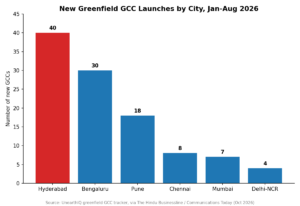
The latest city-level data indicates that Hyderabad is capturing a significant share of this new investment. Research firm UnearthIQ tracked 111 new greenfield GCC launches across India between January and August 2026, with Hyderabad accounting for 40 of them. Bengaluru followed with 30, while Pune ranked third with 18.
The figures point to a changing competitive landscape among India’s established business and technology centres. Hyderabad is attracting a growing number of new operations, while Bengaluru continues to benefit from its extensive talent pool, mature technology ecosystem and large installed base of multinational operations.
For businesses evaluating locations for their next GCC, the distinction matters: the city attracting the most new centres is not necessarily the city with the largest existing ecosystem.
What Is a Global Capability Centre (GCC)?
A Global Capability Centre is an offshore operation established by a multinational company to perform specialised business functions for its global organisation.
Earlier generations of these centres primarily focused on IT support, business processing and other operational activities. Modern GCCs increasingly handle higher-value work, including software engineering, product development, artificial intelligence, cybersecurity, financial operations, research and development, and data analytics.
India has become a major global destination for these operations because of its skilled workforce, established technology infrastructure, broad industry expertise and ability to support complex business functions at scale.
As companies expand their use of AI and digital technologies, GCCs are also evolving from support units into strategic centres for innovation, product development and enterprise transformation.
This shift has intensified competition among Indian cities to attract new centres, international investment and high-value employment.
Top 6 GCC Cities in India in 2026: Ranked by New Launches
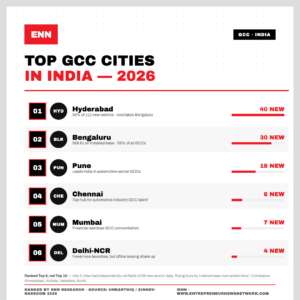
The following ranking uses the supplied city-wise figures for new greenfield GCC launches between January and August 2026.
| Rank | City | New GCC launches | Share of 111 tracked centres |
|---|---|---|---|
| 1 | Hyderabad | 40 | 36.0% |
| 2 | Bengaluru | 30 | 27.0% |
| 3 | Pune | 18 | 16.2% |
| 4 | Chennai | 8 | 7.2% |
| 5 | Mumbai | 7 | 6.3% |
| 6 | Delhi-NCR | 4 | 3.6% |
Source: UnearthIQ greenfield GCC tracking, as reported by Communications Today and corroborated by BW People. Percentages are calculated from the supplied total of 111 centres and rounded to one decimal place.
Together, Hyderabad, Bengaluru and Pune accounted for 88 of the 111 tracked launches, or approximately 79.3%. This concentration underlines the continued importance of India’s established technology and business hubs.
The ranking measures new centre launches during the specified period. It does not represent the total number of existing GCCs in each city.
1. Hyderabad: India’s Leading Destination for New GCC Launches
Hyderabad leads the 2026 greenfield GCC ranking with 40 new centres established between January and August, representing approximately 36% of the 111 launches tracked nationally.
The city’s performance reflects its growing appeal to multinational businesses across technology, manufacturing, life sciences and other sectors.
According to the supplied reporting, Southwest Airlines opened its first centre outside the United States in Hyderabad on May 20, with plans to recruit approximately 1,000 technology professionals. Other companies cited among the city’s 2026 entrants include BASF, HEINEKEN and Swiss life-sciences company Lonza.
These developments suggest that Hyderabad’s appeal extends beyond conventional IT services. The city is increasingly competing for specialised operations that require technology expertise, engineering capabilities and industry-specific knowledge.
The Zinnov-Nasscom India GCC Landscape Report 2026 offers a different perspective on Hyderabad’s position. According to the supplied figures, the city accounted for 14% of India’s installed GCC base in FY2026, up from 12% in FY2024.
Bengaluru, by comparison, continued to hold the largest share, at approximately 29%.
Hyderabad’s rising share indicates that it is strengthening its position within India’s established GCC ecosystem while attracting a substantial portion of new greenfield investment.
The city also has a growing presence in banking, financial services and insurance (BFSI). The supplied Zinnov reporting indicates that Hyderabad captured roughly half of the new BFSI GCC entrants nationally over the preceding year, despite representing a smaller proportion of the existing sector-specific base.
Telangana’s broader investment ambitions provide additional context. The state has promoted its technology, GCC and life-sciences ecosystems as part of its long-term economic development strategy.
Why Hyderabad matters: The city combines an expanding technology workforce with opportunities across several high-value industries. Its leading position in new launches makes it one of the most important locations for companies planning their next Indian GCC.
2. Bengaluru: India’s Largest Established GCC Hub
Bengaluru ranked second for new GCC launches, with 30 centres recorded during the January-August 2026 period.
Despite losing the top position in this particular ranking, the city remains India’s largest established GCC destination.
The supplied Zinnov-Nasscom figures put Bengaluru’s installed base at more than 1,080 GCC units, accounting for approximately 29% of the national total. The city also employs a substantial share of India’s GCC workforce.
Its competitive advantages include a deep technology talent pool, an established startup ecosystem, strong engineering capabilities and a mature network of multinational employers.
These strengths make Bengaluru particularly attractive to companies that require large teams of software engineers, product specialists, data scientists and other highly skilled professionals.
The supplied 2026 reporting also identifies significant activity from companies such as Merck Group, which is developing an integrated campus in Electronic City for approximately 3,300 professionals. Disney and The Standard were also cited as companies expanding engineering capabilities in Bengaluru.
The city’s existing scale creates advantages that are difficult for newer hubs to replicate quickly. Businesses can access experienced professionals, established office infrastructure and a broad network of technology suppliers and service providers.
However, Hyderabad’s stronger greenfield performance shows that Bengaluru now faces greater competition for the next wave of GCC investments.
Why Bengaluru matters: The city remains the benchmark for India’s established GCC ecosystem. Its large installed base and talent depth continue to support expansion, even as Hyderabad leads the latest new-launch figures.
3. Pune: A Strong Contender for Engineering and Automotive GCCs
Pune recorded 18 new GCC launches between January and August 2026, placing it third in the ranking.
The city has a well-established position in automotive engineering, manufacturing technology and industrial research. Its proximity to major manufacturing operations and its engineering talent pool make it attractive to companies building specialised technology and business functions.
According to the supplied Zinnov data, Pune has more than 475 GCC units and accounts for approximately 13% of India’s GCC talent.
The city is particularly relevant for automotive and manufacturing organisations that need to integrate engineering, software, analytics and industrial operations.
ArcelorMittal’s AMGBT unit was among the organisations cited in the supplied reporting as expanding across Pune and Hyderabad, with plans to recruit approximately 2,000 professionals across digital technology, data analytics and finance functions.
This cross-city activity illustrates how companies increasingly use multiple Indian hubs rather than concentrating every function in one location.
Pune’s position is supported by its engineering expertise, manufacturing ecosystem and established corporate infrastructure.
Why Pune matters: For companies seeking engineering, automotive and industrial technology capabilities, Pune remains one of India’s strongest GCC destinations.
4. Chennai: A Major Hub for Automotive and Engineering Expertise
Chennai recorded eight new GCC launches during the first eight months of 2026, placing it fourth in the ranking.
The city has a strong industrial base and is particularly important for automotive engineering, manufacturing and technology-led business operations.
The supplied Zinnov figures put Chennai’s installed base at more than 405 GCC units, with approximately 12% of India’s GCC talent.
Its industrial ecosystem supports companies that need engineering expertise alongside software development, analytics and business operations.
Chennai’s appeal is not limited to automotive businesses. Its established corporate environment and skilled workforce also make it relevant to multinational companies building specialised technology and operational capabilities.
The India GCC Index 2026, as described in the supplied material, also places Chennai among the leading cities for GCC activity.
Why Chennai matters: The city combines industrial expertise with a mature business ecosystem, giving it a competitive position in engineering-heavy and manufacturing-linked GCC operations.
5. Mumbai: India’s Financial Services GCC Centre
Mumbai recorded seven new greenfield GCC launches between January and August 2026, ranking fifth among the six cities with comparable launch data.
Although its new-launch count was lower than Hyderabad’s, Bengaluru’s and Pune’s, Mumbai continues to play an important role in India’s GCC landscape.
The city is India’s principal financial centre, making it a natural location for multinational banks, financial institutions, insurance companies and professional services organisations.
The supplied Zinnov figures place Mumbai’s installed base at more than 375 GCC units, representing approximately 11% of India’s GCC talent.
Its concentration of financial institutions, professional services firms and corporate headquarters creates opportunities for GCCs focused on finance, risk management, analytics, compliance and other specialised functions.
Mumbai’s higher operating costs can influence location decisions, particularly for businesses requiring large office footprints. However, access to financial expertise and industry networks remains an important advantage.
Why Mumbai matters: The city is particularly relevant for companies establishing GCCs around financial services, risk, analytics and other business functions closely connected to India’s financial ecosystem.
6. Delhi-NCR: A Large GCC Base With a Different Growth Pattern
Delhi-NCR recorded four new greenfield GCC launches in the January-August 2026 period, placing it sixth among the cities in this ranking.
However, its relatively low new-launch figure does not mean the region lacks an established GCC presence.
According to the supplied Zinnov data, Delhi-NCR has more than 490 GCC units, placing its installed base above those of Pune and Chennai.
The region benefits from a broad corporate ecosystem, a large professional workforce and access to business, consulting, technology and government-related networks.
The supplied BW People reporting also indicated that NCR’s share of GCC office-space absorption increased from 18% in 2024 to 45% in 2025. This is a real-estate measure rather than a direct count of new GCC launches, so it should not be interpreted as evidence that the region opened more new centres.
The distinction may point towards a different growth pattern: existing operations expanding their office footprint and workforce rather than a large number of entirely new centres being established.
The supplied reporting also cited LG Electronics’ planned ₹1,000-crore Phase II campus in Noida, expected to create 500 jobs, as an example of expansion activity in the region.
Why Delhi-NCR matters: Its established corporate base and substantial existing GCC presence make the region relevant for multinational businesses looking to expand operations, even though it recorded fewer new greenfield launches in the measured period.
Emerging GCC Cities in India to Watch
India’s GCC expansion is not limited to its six largest established hubs. Several emerging locations are building their own business ecosystems and seeking a greater share of multinational investment.
However, the available figures supplied for these cities measure their existing GCC base rather than comparable new launches between January and August 2026. They therefore cannot be directly ranked against the six cities above.
The India GCC Index 2026 cited in the supplied material reports the following installed-base estimates:
| Emerging city | Reported existing GCC units |
|---|---|
| Coimbatore | 60+ |
| Ahmedabad | 45+ |
| Kolkata | 45+ |
| Vadodara | 35+ |
| Kochi | 35+ |
Source: India GCC Index 2026, as cited in the supplied research. These figures describe the reported existing base, not new launches in 2026.
These locations could benefit from companies seeking to diversify operations beyond the largest metropolitan areas. Depending on the industry and workforce requirements, emerging hubs may offer access to specialised talent, alternative operating-cost structures and opportunities to establish a presence in developing business districts.
Nevertheless, the scale of new investment remains concentrated in established hubs. The supplied India GCC Index reporting indicates that approximately two-thirds of new centres continued to select Tier-1 locations, while only around 5% of new GCC units added over the preceding year went to the emerging locations listed above.
The figures suggest that smaller cities have growth potential, but their ability to attract a larger share of new GCC investment will depend on talent availability, infrastructure, corporate connectivity and the development of specialised industry clusters.
India’s GCC Industry in 2026: Key Numbers
The competition between Hyderabad and Bengaluru is part of a much larger expansion of India’s GCC ecosystem.
According to the supplied Zinnov-Nasscom India GCC Landscape Report 2026 figures:
- 2,117 GCCs: India’s reported total number of centres in FY2026.
- 3,728 GCC units: The reported number of individual units or operations within the ecosystem.
- $98.4 billion: Estimated industry revenue.
- 2.36 million professionals: Estimated GCC workforce.
- More than 100 new GCCs: New centres added during FY2026, according to the supplied report summary.
For comparison, the same supplied figures put industry revenue at $61.4 billion and employment at 1.7 million in FY2021.
These estimates indicate that India’s GCC ecosystem has expanded significantly over the five-year period, both in economic contribution and workforce size.
It is important to distinguish the number of GCCs from the number of GCC units. A multinational company may operate multiple centres or specialised units in India, so these measures should not be treated as interchangeable.
Greenfield GCC Launches Accelerated in 2026
UnearthIQ’s tracking, as reported in the supplied research, recorded 111 new greenfield GCC launches between January and August 2026.
The same reporting indicates that US-headquartered companies accounted for 65 of those centres, or approximately 58.6% of the total. UK-headquartered companies contributed 11, with other centres linked to markets including Germany, Japan and Israel.
The sector breakdown also points to demand beyond traditional IT support:
- High technology: 28 new centres.
- Manufacturing: 20.
- Professional services: 12.
- BFSI: 10.
- Healthcare and pharmaceuticals: 10.
The figures show that multinational businesses are using India for a wider range of specialised activities. Technology and engineering remain important, but manufacturing, financial services and healthcare are also contributing to the market’s expansion.
As GCCs take on more strategic responsibilities, cities with strong industry-specific talent and supporting infrastructure may gain an advantage.
Why Hyderabad Is Winning the New-GCC Race
Hyderabad’s lead in the 2026 greenfield ranking reflects its ability to attract a large number of new operations during the measured period.
Several factors help explain its competitive position.
1. A growing multinational presence
The companies cited in the supplied reporting span technology, manufacturing, life sciences and aviation. This broadening mix suggests that Hyderabad’s appeal extends beyond a single industry.
2. A growing share of the established GCC base
The reported increase in Hyderabad’s share of India’s installed GCC base—from 12% in FY2024 to 14% in FY2026—indicates that the city is strengthening its position over time.
3. Opportunities in specialised functions
The reported activity in BFSI, technology and life sciences points to demand for a diverse range of professional skills, including data, engineering and business operations.
4. Competition for future investment
The scale of new launches gives Hyderabad greater visibility among multinational companies assessing locations for future Indian operations.
These factors help explain why the city leads the new-launch ranking. They do not, on their own, establish that Hyderabad has overtaken Bengaluru in total GCC numbers, workforce or revenue.
Hyderabad vs Bengaluru: Which City Is Better for a GCC?
There is no single answer for every multinational company. The right location depends on the intended functions, hiring requirements, operating model and long-term expansion strategy.
| Decision factor | Hyderabad | Bengaluru |
|---|---|---|
| New GCC launches in Jan-Aug 2026 | Leads the supplied ranking | Ranked second |
| Existing GCC ecosystem | Expanding share | Largest established base |
| Technology talent | Growing technology workforce | Deep, mature technology talent pool |
| Industry strengths | Technology, life sciences, BFSI and manufacturing-linked operations | Technology, engineering, product development and multinational corporate operations |
| Strategic consideration | Attractive for new market entry and expansion | Attractive for businesses seeking access to an established technology ecosystem |
This is a qualitative comparison based on the supplied reporting, not a comprehensive cost or workforce assessment.
Companies should evaluate actual hiring availability, compensation, office costs, infrastructure, employee retention and proximity to relevant customers before choosing a location.
The new-launch ranking provides a useful indicator of investment momentum, but it should form only one part of a broader location assessment.
What the 2026 GCC Rankings Mean for India’s Business Landscape
The latest figures point to a market that is growing while becoming more competitive.
Hyderabad’s lead in new greenfield launches shows that the distribution of new investment can shift even when the largest established hub retains its overall dominance. Bengaluru’s position illustrates the advantages of a mature ecosystem, while Pune and Chennai demonstrate the importance of specialised engineering and industrial capabilities.
Mumbai continues to offer a distinct proposition for financial services, and Delhi-NCR retains a substantial installed base despite its lower count of new greenfield launches during the measured period.
Meanwhile, emerging locations such as Coimbatore, Ahmedabad, Kolkata, Vadodara and Kochi offer additional possibilities for future expansion, although comparable new-launch data is needed to measure their performance against the largest hubs.
For India’s economy, the implications extend beyond office leasing and hiring. GCC growth can support high-value employment, technology development, research, specialised business services and deeper integration into multinational companies’ global operations.
The next phase of competition is likely to depend not only on how many centres a city attracts, but also on the complexity of the work performed there, the quality of its talent pool and the ability of its ecosystem to support long-term growth.
Conclusion: Hyderabad Leads New Launches, Bengaluru Retains Its GCC Crown
Hyderabad’s 40 new greenfield GCC launches between January and August 2026 put it ahead of Bengaluru’s 30, according to the supplied UnearthIQ data.
The result marks a significant development in India’s competition for multinational investment. However, Bengaluru remains the country’s largest established GCC hub, with a substantially larger installed base.
Pune, Chennai, Mumbai and Delhi-NCR continue to play important roles, each supported by distinct industry strengths and business ecosystems. Emerging cities may also become increasingly relevant as companies explore additional locations.
For businesses planning their next Indian GCC, the central question is no longer simply which city is largest. It is which location offers the right combination of talent, industry expertise, infrastructure and long-term operating potential.
ENN takeaway: Hyderabad is leading India’s new-GCC launch race in 2026, while Bengaluru continues to anchor the country’s established GCC ecosystem. Both cities remain central to India’s position as a global destination for multinational business operations.
Infosys Expands Hyderabad Pocharam Campus With 1.1 Million Sq. Ft. Facility

Ruchi Kumar is the associate editor at Entrepreneur News Network and TVW News India, where she leads editorial strategy, brand storytelling, and startup ecosystem coverage. With a strong focus on innovation, business, and marketing insights, he curates impactful narratives that spotlight India’s evolving entrepreneurial landscape. She has written extensively on fintech, AI and emerging startups.
1 thought on “Top GCC Cities in India 2026: Hyderabad Overtakes Bengaluru in New Centre Launches”