

The Quiet
Billionaires
Fueling Asia's
Startup Boom
Behind the region's most audacious startups is a new class of investor — the founder-led family office. Patient, private, and increasingly powerful, they are quietly rewriting the rules of venture capital across Asia Pacific.
Somewhere in a minimalist Singapore tower, a third-generation heir opens a cap table. It lists a Southeast Asian super-app, an AI-driven fintech, and a deep-tech robotics firm. No venture fund led these rounds. The money came from a family that made its fortune in palm oil, hotels, or shipping — and decided, quietly, to bet on the future.
This is not an isolated story. Across Asia Pacific — from Seoul to Sydney, from Kuala Lumpur to Mumbai — a generation of founder-led family offices has emerged as one of the most consequential and least understood forces in the startup ecosystem. They move without press releases. They rarely anchor Series A decks. And yet their fingerprints are everywhere that matters.
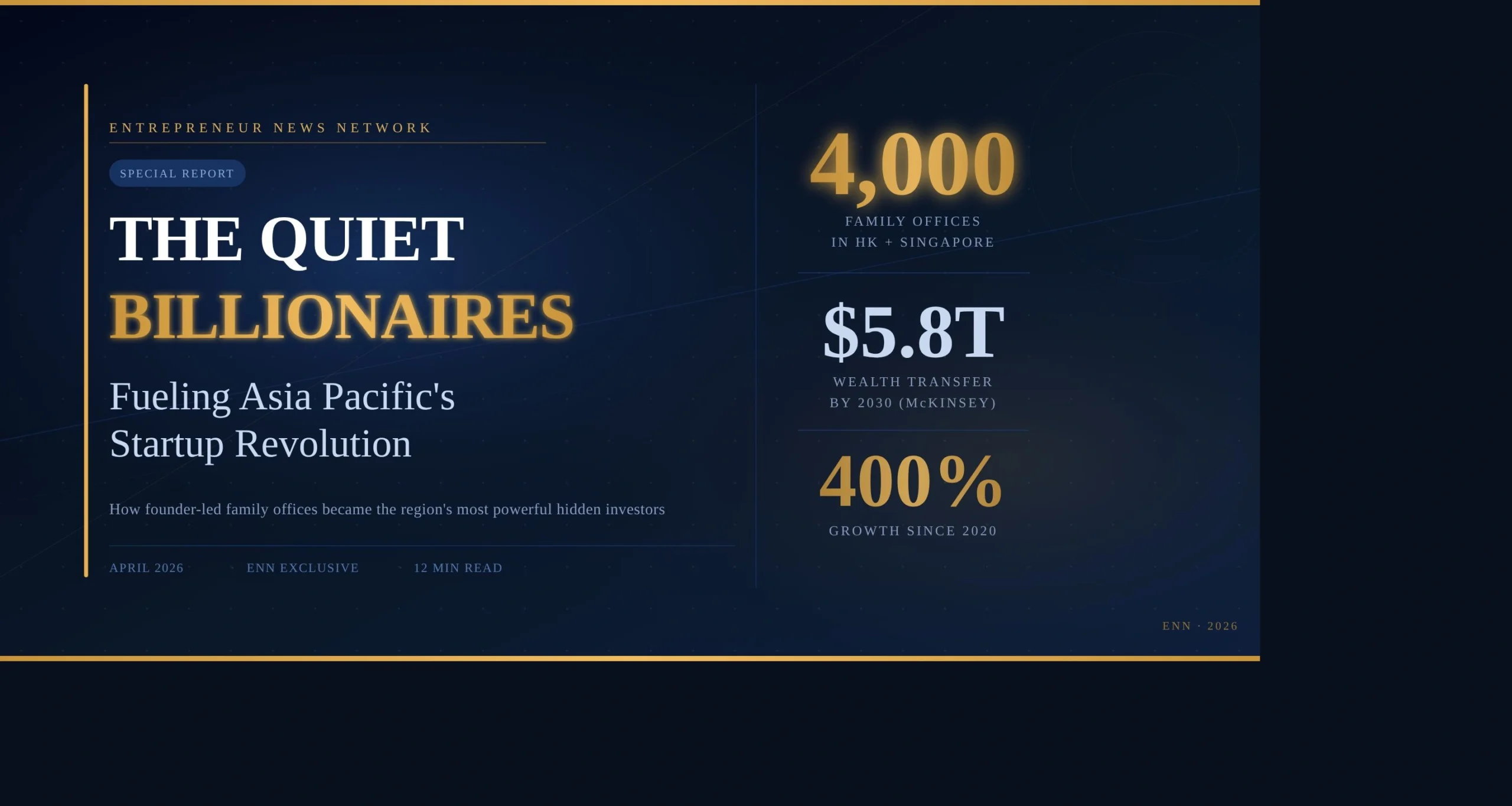
According to McKinsey's landmark 2024 Asia Pacific family office analysis, Hong Kong and Singapore alone now host approximately 4,000 single-family offices, a figure that has quadrupled since 2020. Singapore added roughly 600 new single-family offices in 2024 alone, pushing its total past 2,000 — a 10-fold increase from just five years prior. The aggregate assets under management at Singapore-registered family offices crossed S$90 billion in 2022, with projections suggesting the figure will breach S$120 billion before 2026 closes.
What separates these offices from traditional venture capital is not just the source of their capital — it is the texture of their conviction. Unlike fund managers bound by limited partnership agreements and ten-year horizons, family offices operate with genuinely patient capital. A family that has stewarded wealth across four generations in shipping or commodities does not panic when a portfolio company misses its Series B milestones. They double down. They open doors. They lend their name.
"These will be the companies that could disrupt us next time," Kuok Meng Xiong, grandson of Malaysian business magnate Robert Kuok and founder of Singapore-based K3 Ventures, told an interviewer. His firm has quietly backed more than 38 startups, including China's ByteDance and Singapore's Grab Holdings — two of the most consequential technology companies in the world — all before either became a household name.
"These will be the companies that could disrupt us next time. We come from 12 years of working in traditional business — and we understand what it feels like to be a bellman or the general manager."
Kuok Meng Xiong, Founder, K3 Ventures · SingaporeThe geography of this transformation is shifting as fast as the capital itself. Singapore remains the undisputed command centre — its Variable Capital Company framework, Section 13O and 13U tax incentives, and world-class legal infrastructure have made it the preferred domicile for ultra-high-net-worth families from China, Indonesia, Malaysia, India, and beyond. But the ecosystem is expanding. Malaysia's Forest City Special Financial Zone, launched in 2024, is targeting MYR 2B AUM by end-2026 under a new tax and residency incentive framework. South Korea, Australia, and Japan are also seeing growing institutionalisation of family capital.
The BNP Paribas Wealth Management and Campden Wealth Asia-Pacific Family Office Report 2025 — the most comprehensive survey of its kind — found that family offices across the region are responding to geopolitical volatility not by retreating, but by rotating. Plans to reduce US-based holdings by 24 percent collectively signal a decisive pivot toward intra-regional and alternative asset opportunities. Private equity, venture capital, and early-stage technology now account for a growing share of portfolios, with 77 percent of private equity allocations tilted toward technology companies.
The profiles of these investors defy easy categorisation. Kuok Meng Xiong is a third-generation hotelier turned venture capitalist. N.R. Narayana Murthy, founder of Infosys, runs Catamaran Ventures, which has backed more than 30 startups across India and Southeast Asia, including Uniphore and Log9 Materials. Indonesia's Mochtar Riady family channelled capital through Venturra Capital, seeding Traveloka, OVO, and HappyFresh at moments when institutional investors hesitated. Fred Tsao, a fourth-generation Singapore shipping magnate, relaunched his family's century-old empire as TPC — deploying capital into sustainability, agritech, and clean energy. In Australia, the Gandel family's investment arm has backed Animoca Brands, a company now at the centre of the web3 economy.
What unites them is a model built not on return multiples alone, but on the kind of access, trust, and institutional knowledge that no hired fund manager can manufacture. K3 Ventures does not merely write a cheque to a Singapore fintech — Kuok personally joins their first client meetings, leveraging his family's connections to the region's largest conglomerates. The Lippo Group, one of Indonesia's most powerful conglomerates, used Venturra Capital as a bridge between old-economy dominance and new-economy disruption, seeding companies that would define the country's digital commerce decade. This is the architecture of the quiet billionaire: empire as moat, inheritance as network, patience as strategy.
The generational handover is also reshaping investment philosophy in real time. A Deloitte and Raffles Family Office study from 2024 found that more than 40 percent of Asian families were actively planning to shift towards non-family professional staff — a significant institutionalisation signal. The next generation, many educated at Western universities and fluent in startup culture, are bringing radically different risk appetites to the family table. CFA Institute Research shows that over 90 percent of Gen Z and millennial investors say aligning their portfolio with personal values is important — a stat that shows up directly in the ESG allocations and impact investment mandates now flowing through APAC family offices.
The BNP Paribas report notes that family offices are increasingly integrating AI into risk management and investment reporting, and projects this will accelerate in ways that reshape their internal teams. 83 percent of APAC family offices expect portfolio returns exceeding five percent in 2025 — matching the global average, but on a base that has grown exponentially. Singapore's AUM is projected to breach S$120 billion within the next year.
"The macro view of family offices in the region is the sheer increase in numbers and the speed at which they are growing. In Europe they are usually much older — it is not uncommon to speak to a family office in its sixth or seventh generation. Here, over 40% have been established since 2010."
Zann Kwan, CFA · Managing Partner, Revo Digital Family OfficeYet the boom carries its own tensions. The talent gap is severe: in Hong Kong, the war for qualified chief investment officers, ESG specialists, and succession planners has driven 30 percent pay increases for new hires, according to Empaxis. The BNP Paribas report flags governance fragility — fewer than half of APAC family offices have formal succession plans in place, even as patriarchs cede control. The opacity that once served as a competitive advantage — these offices operate privately, beyond the gaze of LPs and public markets — increasingly creates friction for founders trying to identify and engage them.
For entrepreneurs, the practical implication is significant. A founder who understands the architecture of the quiet billionaire gains access to a funding relationship that looks nothing like a traditional venture round. No fund timelines. No mandate to force an exit by year seven. No quarterly LP pressure. The family office investor thinks in decades, not cycles. They bring operating knowledge from businesses that have survived currency crises, regulatory upheaval, and generational transition — exactly the knowledge that a Series B fintech or a growth-stage healthtech platform cannot buy on the open market.
The numbers behind Asia Pacific's startup ecosystem will continue to climb — the $5.8 trillion intergenerational wealth transfer that McKinsey projects by 2030 is not a distant event. It is already underway. Families are moving capital earlier, involving younger heirs sooner, and deploying into technology with a confidence that would have been unimaginable a decade ago. The quiet billionaires are not quiet because they are timid. They are quiet because, for now, discretion serves them well. That may be changing. As their portfolio companies go public and their names attach to landmark deals, the opacity that defined the first generation of APAC family office investing is beginning to dissolve.
For every founder who secures a cap table anchor from a Singapore dynasty or a Korean family conglomerate, there are a dozen more who do not know these investors exist, let alone how to reach them. The information gap is the opportunity. Entrepreneurs who understand the architecture of patient capital — who speak the language of legacy, alignment, and generational disruption — will find, in the region's family offices, the most powerful partners the startup ecosystem has ever produced. They have been here all along. You just had to know where to look.

Ruchi Kumar is the associate editor at Entrepreneur News Network and TVW News India, where she leads editorial strategy, brand storytelling, and startup ecosystem coverage. With a strong focus on innovation, business, and marketing insights, he curates impactful narratives that spotlight India’s evolving entrepreneurial landscape. She has written extensively on fintech, AI and emerging startups.