

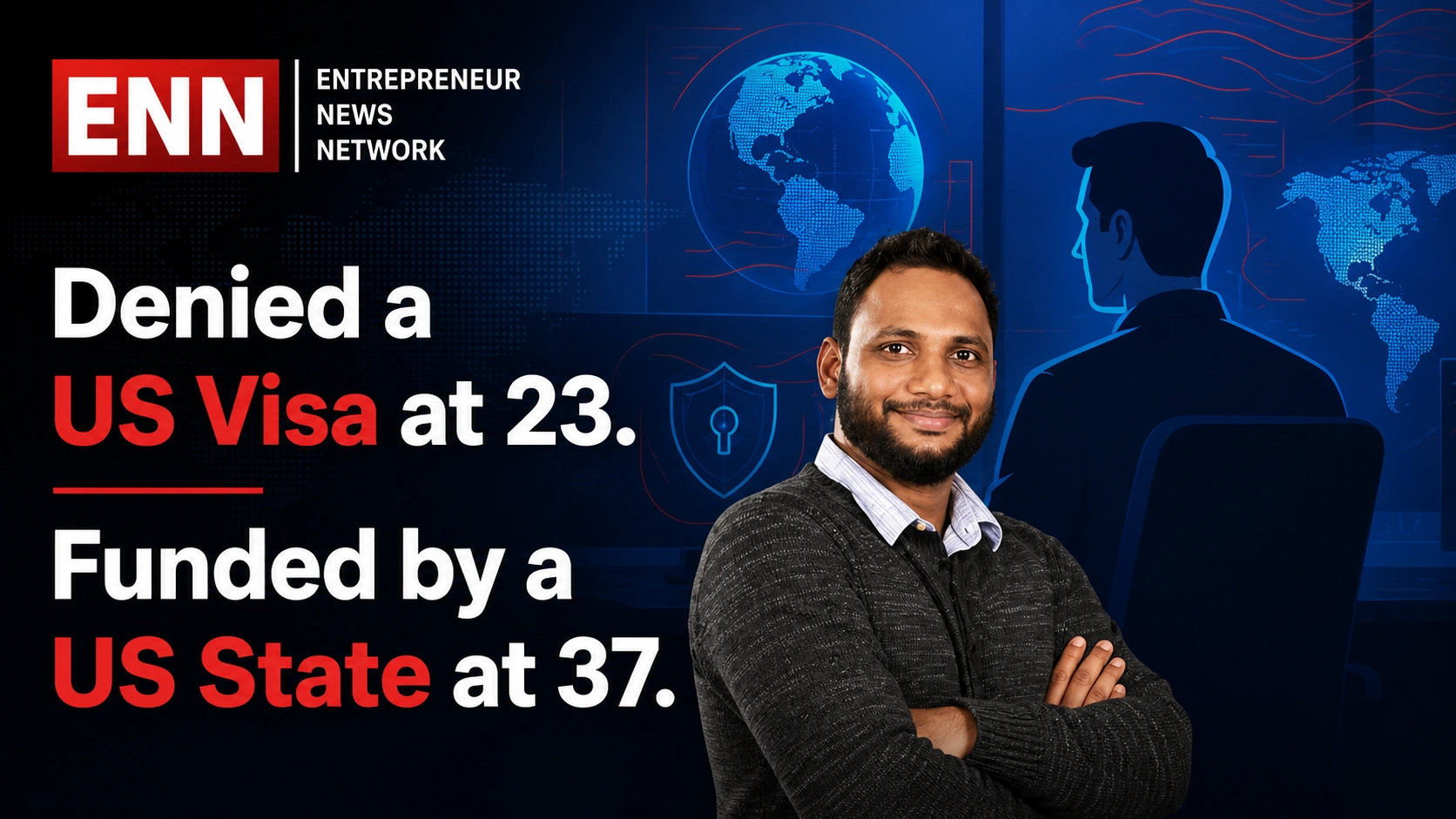
There is a particular kind of humiliation that comes when a bureaucrat tells you that your achievements are not good enough — not the right salary, not the right degree, not the right profile. In 2012, a 23-year-old from a small town in Kerala sat across a US visa officer and heard exactly that. He had been officially invited to present his cybersecurity research at Black Hat Briefings, one of the most prestigious security conferences in the world. The invitation didn’t matter. His visa was denied.
Fourteen years later, that same man — Rahul Sasi, founder and CEO of CloudSEK — walked into the United States as the head of a company that had just received $10 million from the State of Connecticut itself. The country that once turned him away at the door had just handed him the keys to build inside it.
This is not just a startup success story. It is a masterclass in what becomes possible when rejection is treated as redirection.
A Kerala Boy Who Didn’t Fit the Mould
Rahul Sasi grew up in Mavelikkara, Alappuzha, in a modest household. His father, V V Sasi, was a conductor with the Kerala State Road Transport Corporation, and resources were limited. “I didn’t own a laptop until 2008. It was a luxury back then,” Rahul recalls.
School was not easy. Diagnosed with Attention-Deficit/Hyperactivity Disorder (ADHD) during school, he says college helped him understand himself better. “I realised I could give complete attention to computers and cybersecurity, but not to routine classes. It wasn’t attention deficit — it was attention overflow,” he says with a smile. During his BTech at CSI College of Engineering in Ooty, Rahul was rarely found where he was supposed to be. He lived in the computer labs, deep in cybersecurity research, largely indifferent to lectures and attendance requirements. His instinct for finding vulnerabilities was already sharp. Once, after being pulled up for low attendance, Rahul exposed a flaw in the college’s biometric attendance system — an act that earned appreciation instead of punishment.
By 2010, the structure of formal education had become a constraint rather than a launchpad. He dropped out to pursue something more aligned with who he actually was: a hands-on cybersecurity researcher who learned by doing, not by sitting in rows.
The Internship That Changed Everything
After leaving college, Rahul joined iSIGHT Partners, a renowned threat intelligence firm, as an intern. It was an unconventional move for someone without a completed degree, but the quality of his work spoke louder than his credentials. He moved to Pune, lived frugally, and poured every spare hour into cybersecurity research.
He later joined Citrix, where he became the first person without an engineering degree to be hired by Citrix India, where he held responsibility for making Citrix products hack-proof. These were not small accomplishments — they were proof that talent, with the right advocate, can break through credential barriers. As Rahul himself has noted, sometimes all you need is one person willing to fight for you.
By 2012, his research had generated enough global recognition to earn him an invitation to Black Hat Briefings — the conference where the world’s best security researchers present their most significant work. It was a remarkable achievement for a 23-year-old from a small Kerala town, operating without a degree, at a fraction of the salary of his peers.
The US visa office saw none of that.
The Rejection That Became a Resolution
“Back in 2012, the visa authorities questioned my salary, educational background, and even how I was eligible to travel to the US, despite the fact that I had been officially invited by Black Hat Briefings to attend their conference,” Rahul recalls.
The denial stung deeply. But instead of fading into bitterness, it crystallised into a promise. He would not step onto American soil until he could arrive as someone creating opportunity there — not just consuming it. He made a resolve that he wouldn’t travel to the US until he could create jobs there.
For the next several years, he kept his word. Between 2010 and 2015, Rahul spoke at cybersecurity events in at least 27 countries, though the US remained out of reach. The world welcomed him. America would have to wait.
Building CloudSEK: From Bootstrapped to Global
In 2015, Rahul quit Citrix and founded CloudSEK with a sharp insight into a gap the cybersecurity industry had largely ignored. There was hardly any product that monitored external threats. The idea was to build a system that analysed threats from outside the organisation — from the Surface Web, Dark Web, and exposed internet infrastructure — before they could escalate.
The early days were lean. CloudSEK was initially bootstrapped. Though operations began in Kerala, Rahul later shifted the company’s headquarters to Singapore after securing its first major customer there. “It was operationally easier at the time,” he says.
Slowly, then rapidly, CloudSEK grew. The company’s AI-powered threat intelligence platform attracted enterprise clients in banking, healthcare, technology, and government. Today, CloudSEK serves more than 300 enterprises across the BFSI, healthcare, technology, and government sectors, with subsidiaries in India, the UAE, the UK, the US, and Brazil.
The Pitch That Closed the Circle
The breakthrough moment toward the US came through an unexpected channel. A startup pitch event at IIT Madras proved decisive. CloudSEK emerged as the winner, with former PepsiCo chairperson and CEO Indra Nooyi present at the event. “Soon after, we received an invitation from the US expressing interest in investing,” Rahul says. “It aligned perfectly with our plans to enter the American market.”
That invitation came from Connecticut Innovations — the strategic venture capital arm of the State of Connecticut. At the VentureClash pitch event, Rahul and product owner Nivya Ravi pitched a distinguished panel of judges, including Indra Nooyi, Connecticut Governor Ned Lamont, and senior leaders from leading venture and research institutions.
They won.
In January 2026, CloudSEK became the first Indian-origin cybersecurity company to receive funding from a US state-backed venture fund, securing $10 million as part of its Series B2 round. The total funding raised by CloudSEK now stands at $29 million, with the company valued at close to $200 million.
In early 2026, Rahul finally set foot in the United States — this time as the founder of CloudSEK. No questions about his salary. No scrutiny of his degree. Just a state government handing him capital and saying: come build here.
What This Means for India’s Cybersecurity Ecosystem
The significance of this moment reaches far beyond Rahul’s personal arc. “Becoming the first Indian-origin cybersecurity company to receive backing from a US state fund is a milestone for CloudSEK, as well as for the entire Indian cybersecurity ecosystem,” said Rahul at the announcement.
For years, the global cybersecurity investment landscape has been dominated by companies out of Israel and the United States. India’s cyber talent has been recognised, but rarely funded at that level from Western institutional sources. CloudSEK’s raise signals a shift.
CloudSEK plans to establish its US regional headquarters in Connecticut, recruit high-quality cybersecurity and AI talent from the region, build partnerships with local academic and research institutions, and drive region-specific cybersecurity research and innovation. The company currently serves 20 clients in the US and aims to reach 200 within the next twelve months.
The boy who couldn’t get a visa to attend a conference is now building American jobs, partnering with American universities, and anchoring an American state’s cybersecurity ambitions.
The Lesson No Classroom Could Teach
Rahul Sasi’s story is often framed as an underdog narrative, but it is more precise than that. It is a story about what happens when someone refuses to accept the world’s initial verdict on their worth.
ADHD told him he couldn’t focus. He focused on the one thing that mattered. A visa officer told him he wasn’t qualified. He spent a decade qualifying in 27 other countries. A system built around degrees told him he needed one. He became the first hire at Citrix India without one.
His father’s steady rise from KSRTC conductor to district transport officer after two decades of service shaped his philosophy: progress doesn’t always come early. Persistence matters.
Sometimes the door closes not because you are unworthy, but because the room isn’t ready for you yet. Rahul Sasi didn’t wait for the room to be ready. He went and built a bigger one.
And then, eventually, they came to him.
Read more: India’s Sibling Founder Mafia: Built on Blood, Scaled on Trust

Ruchi Kumar is the associate editor at Entrepreneur News Network and TVW News India, where she leads editorial strategy, brand storytelling, and startup ecosystem coverage. With a strong focus on innovation, business, and marketing insights, he curates impactful narratives that spotlight India’s evolving entrepreneurial landscape. She has written extensively on fintech, AI and emerging startups.