

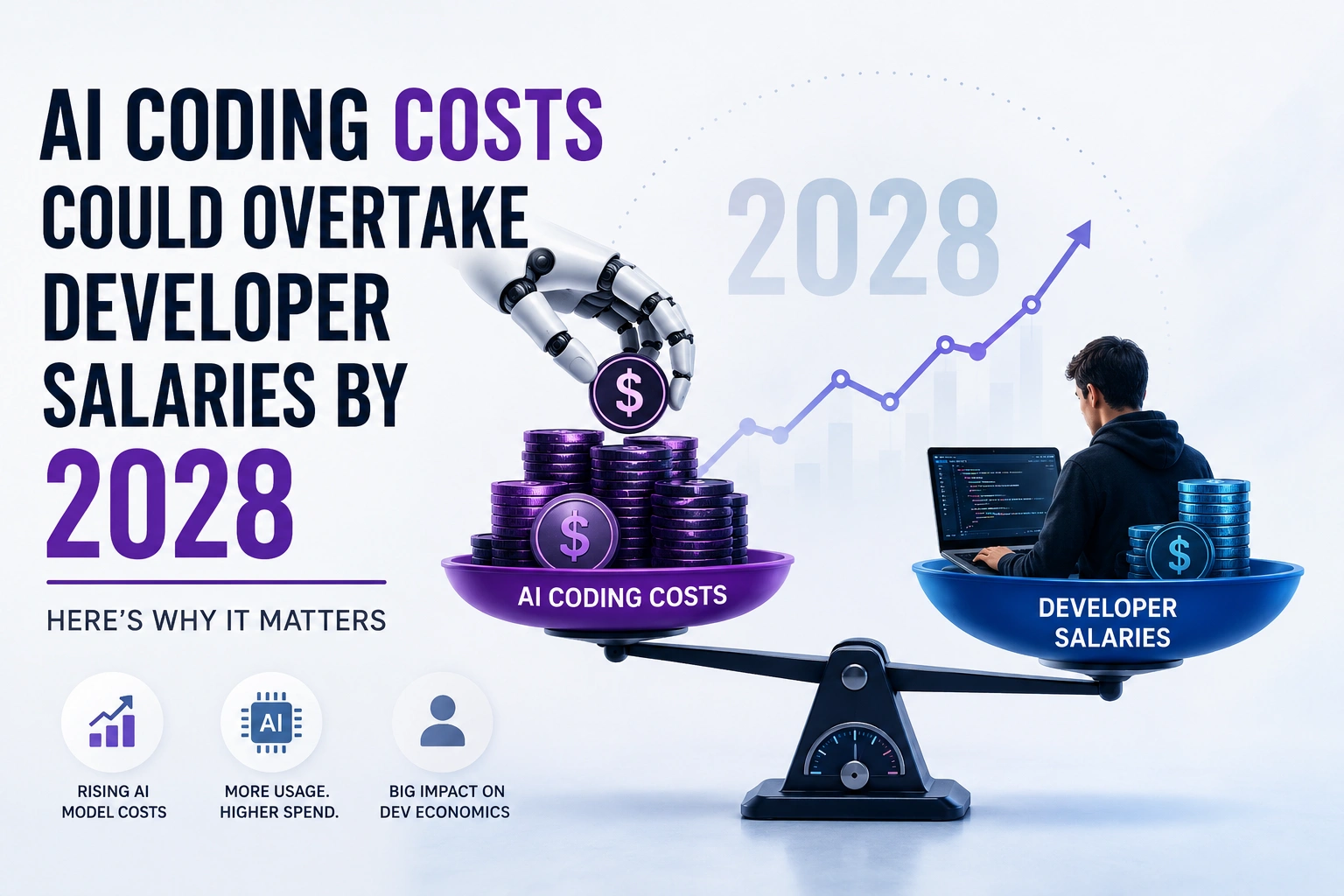
There’s an uncomfortable conversation happening in the war rooms of enterprise IT right now, and it goes something like this: we invested in AI to reduce costs, so why is the invoice getting larger?
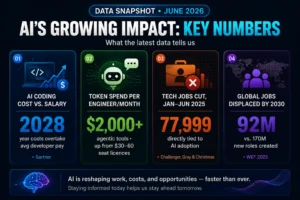
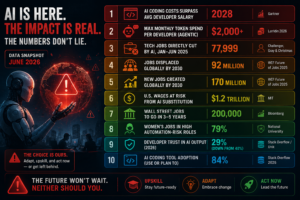
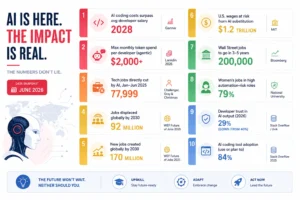
A new Gartner prediction, published June 2026, puts a hard date on what many engineering leaders already quietly suspect. By 2028, the cost of AI coding tools — driven by voracious token consumption and a sweeping shift to consumption-based pricing — will surpass the average developer’s annual salary. The AI that was supposed to make developers cheaper is, in many organizations, already costing more than a mid-level engineer.
To understand how we got here, you have to follow the money — and the tokens.
From $30 seat licences to $2,000 monthly bills
Not long ago, AI coding tools were priced like Spotify subscriptions: a flat monthly fee, predictable, easy to budget. GitHub Copilot launched at around $10 per seat. Teams added it as a line item and moved on.
Then something changed. Tools became agents. Instead of autocompleting a line of code, they began executing multi-step autonomous workflows — spinning up environments, writing tests, refactoring entire modules, making dozens of API calls per task. Each action consumes tokens. And under consumption-based pricing models, those tokens cost money.
Today, according to 2026 benchmark data from engineering analytics firm Larridin, agentic tools like Claude Code can run developers between $200 and $2,000 or more per month in token spend alone. When you account for subscriptions plus overages, the average total AI tool cost per engineer sits at $200 to $600 monthly — not the $30 to $60 seat licence that most budget assumptions still use.
Gartner’s Nitish Tyagi, senior principal analyst, puts it plainly: “Token discipline will not emerge through developer choice alone, as developers tend to optimize for speed and convenience over cost efficiency. Without a governed engineering operating model, costs can escalate faster than the productivity gains these tools are designed to deliver.”
The productivity paradox hiding in the data
Here’s the thing nobody in a vendor pitch deck will tell you: the productivity gains are real, but so is the fine print.
Developers save around 3.6 hours per week on average when using AI coding assistants, according to DX data drawn from 135,000 developers. Daily users merge significantly more pull requests. An average productivity increase of 31.4% is reported by developers using AI coding assistants compared to traditional approaches. BlogsTrigidigital
But then there’s METR’s randomized controlled trial from early 2025. Experienced open-source developers were actually 19% slower with AI tools, despite feeling 20% faster — a striking divergence between perceived and measured output. Confidence in speed is not the same as actual speed. Uvik Software
Independent code analysis has found roughly 1.7 times more issues in AI-coauthored pull requests, and review time expands to compensate. One developer summarized it plainly: “AI can significantly speed up initial engineering time, but often that saved time is spent on extended reviews, fact-checking, or issue remediation, resulting in net-zero productivity gain.” Blogs
The ROI picture, in other words, looks very different depending on who’s doing the math. Healthy ROI on AI coding tools ranges from 2.5 to 3.5 times on average, reaching 4 to 6 times for top-quartile organizations — but only when the cost denominator includes actual token and usage-based costs, not just seat licences. Larridin
Meanwhile, across the wider workforce: 92 million jobs in the crosshairs
Pull back from the coding suite and the picture grows larger and more sobering. AI is not only making developers expensive — it is actively displacing workers across entire industries.
Nearly 55,000 job cuts in 2025 were directly attributed to AI, according to Challenger, Gray & Christmas, out of a total 1.17 million layoffs — the highest level since the 2020 pandemic. AIMultiple
Between January and June 2025 alone, 77,999 tech job cuts were directly tied to AI adoption — hundreds of people losing jobs every single day. Wearetenet
The companies doing the cutting aren’t hiding it. Amazon eliminated 14,000 corporate roles, stating that AI enables leaner structures and faster innovation. Workday cut 8.5% of its workforce to reallocate resources toward AI investments. AIMultiple
Wall Street banks plan to remove approximately 200,000 jobs over the next three to five years, particularly in entry-level and back-office roles. Wearetenet
The World Economic Forum’s Future of Jobs Report 2025 — drawing on data from over 1,000 employers across 55 economies — projected that 92 million jobs will be displaced by 2030 while 170 million new ones will be created, a net gain of 78 million jobs. But that net positive number obscures a brutal reality: the workers trapped in the gap — those displaced from routine cognitive roles and unable to quickly acquire AI-complementary skills — are the central policy challenge of the AI labour transition in 2026. AIMultiple–
The impact is not distributed equally. Workers aged 18 to 24 are 129% more likely than those over 65 to worry AI will make their job obsolete. Entry-level jobs, disproportionately filled by young workers, are especially at risk, with nearly 50 million U.S. jobs affected. And the gender gap is stark: 79% of employed women in the U.S. work in jobs at high risk of automation, compared to 58% of men. National University + 2
Some roles face near-total extinction on a short timeline. Medical transcription is already 99% automated. Paralegals face an 80% risk of automation by 2026. Manual data entry clerks, who can be outpaced by AI systems processing over 1,000 documents per hour with error rates below 0.1%, face a 95% risk. DemandSage
The governance gap: who’s actually in control?
Gartner’s warning goes beyond cost. The deeper problem is structural: organizations are deploying increasingly powerful AI agents without the governance frameworks to manage them.
Token overspending, the report notes, is tied directly to how engineering leaders — or don’t — govern usage. Common failure modes include ungoverned autonomy in agent-driven workflows, bloated context windows, and absent feedback mechanisms.
Only 29% of developers trust AI outputs to be accurate in 2026 — down sharply from 40% in 2024, even as 84% report using or planning to use AI tools. Usage and trust are moving in opposite directions. The more embedded these tools become, the less confidence developers have in what they produce. Uvik Software
Gartner’s four-point framework for regaining control is practical and worth internalizing:
First, establish a use-case-driven decision framework — categorize every development task into developer-led, developer-with-agent, or fully agent-led, and match autonomy levels to each. Second, align model selection to task complexity: route high-frequency simple tasks to smaller, cheaper models and reserve frontier models for genuinely complex work. Third, mandate context engineering: train developers to provide only the relevant input context an AI needs, cutting token consumption without compromising output. Finally, embed token usage reviews into regular sprint retrospectives, treating AI cost efficiency as a recurring engineering discipline, not a one-time audit.
What comes next
Between 2025 and 2030, 2025 to 2028 represents the period when career transitions spike and displacement peaks, before a new equilibrium forms with fewer but more leveraged roles. We are, right now, at the sharpest edge of that window. CLICKVISION Digital
Professionals with specialized AI skills now command salaries up to 56% higher than peers in identical roles without those skills. The market is not punishing AI adoption — it is punishing the absence of it. But it is equally punishing organizations that adopt AI without a coherent strategy for managing what it costs, what it produces, and who it displaces. DemandSage
The bill for the AI coding revolution is coming due. The question is whether leaders — in boardrooms, in engineering functions, and in government — will have built the frameworks to pay it intelligently, or whether they will simply absorb the shock.
India’s Data Centre Ambitions: What the Numbers Reveal About What the Country Still Needs

Ruchi Kumar is the associate editor at Entrepreneur News Network and TVW News India, where she leads editorial strategy, brand storytelling, and startup ecosystem coverage. With a strong focus on innovation, business, and marketing insights, he curates impactful narratives that spotlight India’s evolving entrepreneurial landscape. She has written extensively on fintech, AI and emerging startups.