

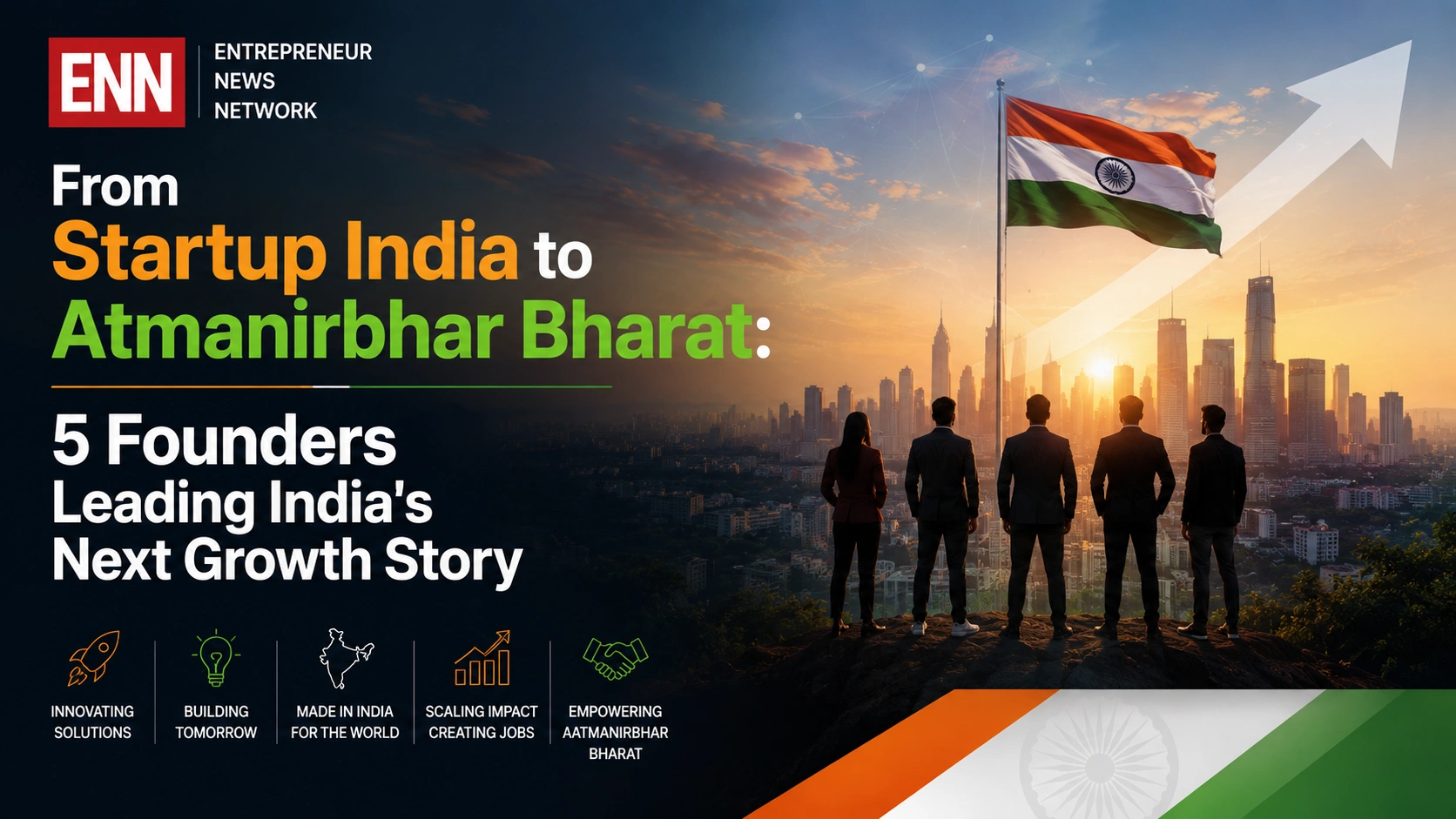
A decade ago, Startup India was a bet that the country could build companies, not just consume products. Today the bet has matured into something more ambitious: Atmanirbhar Bharat, a push to build the sovereign capability — in chips, rockets, batteries, and quantum machines — that a rising power can no longer afford to import. These five founders sit exactly at that hinge point.
The Decade That Changed the Default
When Startup India launched in January 2016, India had roughly 350 recognized startups and almost no cultural muscle memory for founding a company as a legitimate career choice. A decade on, that has changed by an order of magnitude. DPIIT-recognized startups have grown to more than 2.09 lakh as of December 2025. India now counts over 120 unicorns, placing it third globally behind only the United States and China. Close to half of new startups are emerging from Tier II and Tier III cities, not just Bengaluru and Gurugram. The ecosystem has created more than 21 lakh jobs.
DPIIT-RECOGNIZED STARTUPS, 2016 → DEC 2025 ~350 → 2.09 lakh+
INDIAN UNICORNS (GLOBAL RANK: 3RD) 120+
NEW STARTUPS FROM TIER II/III CITIES ~50%
JOBS CREATED BY THE STARTUP ECOSYSTEM 21 lakh+
That first decade was largely a software and services story — e-commerce, fintech, SaaS, food delivery. It proved Indians could found and scale companies. It did not, on its own, prove India could build the physical and deep-technology capability a large economy needs to be strategically self-reliant. That is the second, harder chapter now underway.
From Software to Sovereignty
Atmanirbhar Bharat, the self-reliant India push, is the government’s answer to a blunter question: what happens if the world’s supply chains for chips, batteries, satellites, and defense hardware stop being reliable? The policy response has been large and specific. The India Semiconductor Mission 2.0 carries a fiscal outlay of roughly ₹1,27,500 crore. Four new semiconductor projects, worth about ₹4,600 crore combined, were cleared in a single Cabinet approval in August 2025, expected to create over 2,000 skilled jobs. Defense manufacturing has been opened to 74% FDI, with an import embargo placed on 101 military items to force domestic sourcing. Deep-tech is being backed with government funds exceeding $10 billion alongside PLI incentives and semiconductor design support.
The founders below are not abstractions in that policy story — they are the people actually building the hardware it depends on. Between them: India’s first private orbital rocket, its first indigenous general-purpose quantum computer, a new semiconductor packaging and test plant, the country’s first ground-up EV cell manufacturing line, and the largest private funding round in India’s drone industry.
Five Founders, Five Frontiers
01 Pawan Kumar Chandana — Skyroot Aerospace
Chandana was, by his own account, an unremarkable student who once scored just 51 marks in mathematics. He went on to IIT Kharagpur, spent nearly six years as a scientist at ISRO, and then walked away from a stable government job to build rockets from a standing start. In June 2018 he co-founded Skyroot Aerospace with fellow ISRO engineer Naga Bharath Daka, starting with a team of ten.
On July 18, 2026, a Skyroot rocket built in Hyderabad lifted off from Sriharikota and, roughly fifteen minutes later, reached orbit — making Skyroot only the third private company in the world, after American and Chinese counterparts, to independently put a rocket into orbit. The company that started with ten people now runs two campuses in Hyderabad with more than 1,000 employees. It is, in the most literal sense possible, India’s private space program.
02 Dr. Nagendra Nagaraja — QpiAI
Nagaraja spent more than 25 years in the industry before founding QpiAI in 2019, including senior engineering roles at Nvidia and Qualcomm, alongside a PhD spanning wireless systems, machine learning, and AI. That background shaped a specific bet: that AI and quantum computing needed to converge, not develop in isolation, for either to be commercially useful.
In 2025, QpiAI launched QpiAI-Indus, a 25-superconducting-qubit quantum computer built in Bengaluru — India’s first indigenous general-purpose quantum machine, unveiled on World Quantum Day. In 2026 the company closed a $32 million Series A round, co-led by Avataar Ventures and India’s National Quantum Mission, a direct signal that the country’s quantum ambitions now come with serious institutional capital behind them.
03 Venkata Simhadri — ASIP Technologies
Simhadri is a semiconductor industry veteran, not a first-time founder chasing a trend — he built and exited two earlier ventures, Time To Market Inc. and Gigacom Semiconductor, and later turned around Moschip Semiconductor from a loss-making company into one of India’s leading semiconductor services firms between 2019 and 2023. He founded ASIP Technologies in 2017 alongside MM Pallam Raju and Sreenivas Vaddi with a specific, unglamorous goal: build a world-class chip packaging and testing operation on Indian soil.
That bet has materialized as a ₹2,500 crore Outsourced Semiconductor Assembly and Test (OSAT) facility in Visakhapatnam — the first semiconductor unit in Andhra Pradesh and South India approved under the India Semiconductor Mission, with an annual capacity of 96 million units feeding into mobile phones, set-top boxes, and automotive electronics. Prime Minister Modi personally inaugurated the facility, a rare honor for what is, fundamentally, a packaging and testing plant rather than a headline-grabbing fab.
04 Dr. Akshay Singhal — Log9 Materials
Singhal co-founded Log9 Materials in Bengaluru in 2015 — just months before Startup India formally launched — with Kartik Hajela and Pankaj Sharma, describing it as a deep-tech nanotechnology company building cell and battery technology from the ground up, engineered specifically for tropical operating conditions rather than adapted from cold-climate chemistries developed elsewhere.
The company has since unveiled India’s first indigenously developed EV cell manufacturing facility at its Bengaluru campus — designed to become Southeast Asia’s largest cell production line — with an explicit target of self-sufficiency in India’s own cell requirements by 2025–26. Having raised $90.3 million across sixteen rounds, Log9 is one of the clearest bets that India’s EV transition should not simply mean assembling foreign battery cells domestically, but manufacturing the chemistry itself.
05 Vikash Mishra & Vivek Mishra — Raphe mPhibr
The Mishra brothers, both aerospace technologists, founded Raphe mPhibr in 2016 and began operations the following year with just ten employees. Nearly a decade later, the company employs over 600 scientists and engineers out of facilities in Gautam Buddh Nagar that include a drone manufacturing unit, an aircraft engine facility, and what is described as the country’s largest aero engine test bed.
In 2025, Raphe mPhibr raised $100 million in a round led by General Catalyst — the largest private fundraise in India’s drone industry to date, taking its total capital raised to $145 million. The company has framed the raise directly around the post-Operation Sindoor urgency for indigenous defense manufacturing, describing its mission as building in India what the country can no longer afford to import. Defence Minister Rajnath Singh cited the round as a marker of progress toward Atmanirbhar Bharat in the defense sector specifically.
The Common Thread
None of these five companies exist because of a single policy announcement, and none of them are simple beneficiaries of government contracts handed down from above. What connects Chandana’s rocket, Nagaraja’s quantum processor, Simhadri’s packaging plant, Singhal’s battery chemistry, and the Mishra brothers’ drones is a shared refusal to treat “import it instead” as an acceptable default — in categories where India has historically done exactly that.
It is also worth noting what these five are not: none of them are consumer apps optimizing a checkout flow, and none of them are Series A decks promising disruption through a slicker interface. They are capital-intensive, multi-year, deep-hardware bets in categories where China, the US, or a handful of legacy suppliers have held structural advantages for decades. That they exist at meaningful scale in 2026 — an orbital rocket company, a quantum computer maker, a semiconductor OSAT plant, an indigenous battery line, and a $145-million-funded drone manufacturer — is the clearest evidence yet that Startup India’s first decade of software confidence has started converting into Atmanirbhar Bharat’s harder, second-decade project: sovereign hardware capability, built and owned in India.
Sources: Vision IAS and Drishti IAS coverage of Startup India’s 10-year milestones; Rukam Capital, “Startup India @ 10”; Global Indian and Viestories profiles of Pawan Kumar Chandana; Wikipedia and Intelligent CIO APAC on QpiAI-Indus; NewsMeter, The Week, and PM India press releases on ASIP Technologies and the Cabinet’s semiconductor approvals; Forbes India on Log9 Materials; Business Standard, Outlook Business, and IBEF on Raphe mPhibr’s $100 million round. Compiled August 2026 for Entrepreneur News Network.
The Founder Who Held a Funeral for the SIM Card—and Built a Billion-Dollar eSIM Unicorn

Ruchi Kumar is the associate editor at Entrepreneur News Network and TVW News India, where she leads editorial strategy, brand storytelling, and startup ecosystem coverage. With a strong focus on innovation, business, and marketing insights, he curates impactful narratives that spotlight India’s evolving entrepreneurial landscape. She has written extensively on fintech, AI and emerging startups.