
August 16, 2026 | ENN
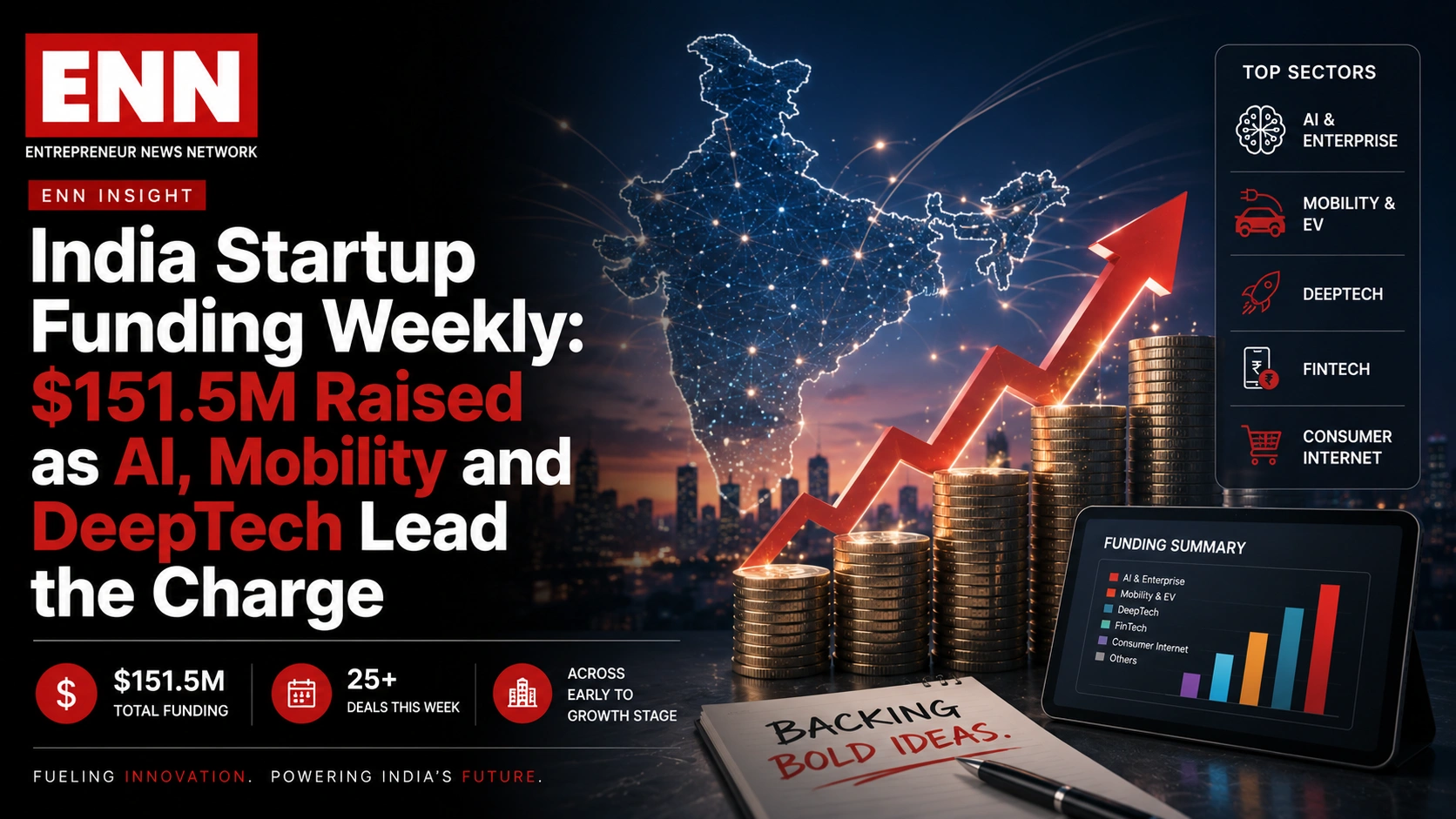
India’s startup funding market saw a sharp slowdown this week, with startups raising $151.5 million across 14 funding rounds between August 9 and August 14, compared with approximately $383.8 million across 28 deals in the previous week.
Despite the decline, the week delivered several notable developments across electric mobility, fintech, deeptech, healthtech, AI and consumer businesses. Yulu’s $93 million Series C emerged as the biggest deal, while Centricity’s $30 million Series A and Discovered Materials’ $9 million seed round highlighted continued investor interest in wealthtech and deeptech.
Beyond funding, the week also brought major fund launches, leadership changes, acquisitions, an ESOP-led unicorn milestone and several developments across India’s startup ecosystem.
Yulu Leads Weekly Funding With $93 Million
Bengaluru-based electric mobility company Yulu topped the funding charts with a $93 million Series C round, comprising $63 million in equity and $30 million in debt.
The round was led by GEF Capital Partners and gives Yulu additional capital to expand its electric mobility operations.
The deal also reflects continued investor interest in India’s transition toward electric two-wheelers and shared mobility.
Centricity Raises $30 Million to Scale Wealth Management
Gurugram-based wealth management startup Centricity raised Rs 280 crore, or approximately $30 million, in Series A funding from SMBC Asia Rising Fund.
The investment places wealthtech among the sectors attracting meaningful growth capital as India’s affluent and mass-affluent investor base continues to expand.
DeepTech Draws Fresh Capital
Deeptech startup Discovered Materials raised $9 million in seed funding, led by Lightspeed India Partners.
The funding highlights the growing appetite for technology businesses working on specialised scientific and industrial applications rather than purely consumer-facing products.
Other early-stage companies that raised capital during the week included Scrubsy, Ayati Devices, Wippi, Lane and Vecton AI.
Startup Funding Fell More Than 60% Week-on-Week
The week’s $151.5 million total represents a decline of more than 60% from the previous week’s $383.8 million.
The eight-week average stood at approximately $297 million across 20 deals per week, suggesting that the latest number was significantly below the recent funding run rate.
Bengaluru remained the leading startup hub, accounting for 10 deals, while Delhi-NCR recorded two. Pune and Chennai contributed one deal each.
From a sector perspective, healthtech and deeptech recorded two deals each, while AI, fintech, mobility, foodtech, edtech and ecommerce also attracted funding.
Seed and pre-seed rounds dominated the deal count, with four deals each. Series A and pre-Series A recorded two deals each, while Series B and Series C contributed one deal apiece.
Accel Launches $550 Million India Fund
Despite the weekly funding slowdown, institutional capital continues to move into India’s startup ecosystem.
US venture capital firm Accel raised a $550 million India-focused early-stage fund as part of a larger $3.5 billion fundraising programme covering four new funds globally.
Meanwhile, Aum Ventures announced the first close of its India Innovation Fund II at Rs 225 crore against a targeted corpus of Rs 750 crore.
Mirae Asset Venture Investments India announced the first close of its second Venture Opportunity Fund at Rs 1,125 crore, while frontier-tech investor Bluehill.VC completed the final close of its maiden Rs 400 crore fund.
BlackSoil Asset Management also disclosed that it had deployed Rs 750 crore across 40 companies through its second credit fund.
The fund activity suggests that while individual startup rounds may fluctuate, investors continue to build capital pools for India’s next generation of companies.
Astrotalk Enters the Unicorn Club
Noida-based astrology and spiritual technology platform Astrotalk reached a $1 billion valuation through an ESOP buyback involving more than 100 employees.
The transaction gives eligible employees an opportunity to realise liquidity while continuing to participate in the company’s future growth.
The milestone also demonstrates how secondary liquidity and employee share programmes are becoming important components of India’s startup ecosystem.
GalaxEye Acquires StarOps
Space-tech startup GalaxEye acquired Bengaluru-based spacecraft engineering company StarOps.
The acquisition brings StarOps’ satellite platforms, systems engineering capabilities, proprietary technologies and engineering talent into GalaxEye.
The deal comes as India’s private space ecosystem continues to move toward more integrated capabilities across satellite design, launch technology and space-based applications.
Redcliffe Labs Expands Into Space Diagnostics
Healthcare diagnostics company Redcliffe Labs partnered with Skyroot Aerospace to explore the future of diagnostics in space.
Their first mission, DRIFT-1, is expected to place Redcliffe’s dry diagnostic reagents in low Earth orbit for 90 days alongside a ground-control experiment.
The project will study how space conditions affect diagnostic reagent stability, with potential applications in astronaut healthcare and future space-based medical systems.
PayU Focuses on Accessible Digital Payments
Fintech company PayU launched what it describes as India’s first RBI-compliant Accessible Payments Checkout for blind and visually impaired users.
The checkout is designed to improve navigation and interaction for users with visual and cognitive accessibility requirements.
The development comes as accessibility becomes a more important consideration for India’s rapidly expanding digital payments ecosystem.
Swiggy’s Rs 99 Strategy Gains Traction
Swiggy’s 99 Store is gaining momentum, now accounting for approximately one in seven food orders on the platform.
The offering has expanded to more than 500 cities and over 1.8 lakh restaurant partners, with meals priced at Rs 49, Rs 79 and Rs 99.
The strategy reflects the growing importance of affordability in India’s online food-delivery market.
Ola Electric Gets More Time Under PLI Scheme
Ola Electric has secured a revised timeline under the government’s Advanced Chemistry Cell Production Linked Incentive scheme.
Its battery subsidiary, Ola Cell Technologies, now has until December 2026 to achieve the first 6 GWh installed-capacity milestone.
The company is targeting incentives of up to Rs 7,240 crore, making battery manufacturing a critical part of its longer-term strategy.
Zetwerk Moves Closer to IPO
B2B manufacturing platform Zetwerk filed its updated draft red herring prospectus with SEBI for a proposed Rs 2,600 crore fresh issue, alongside an offer-for-sale component.
The company’s FY26 revenue from operations reportedly grew 40% year-on-year to Rs 15,900 crore, while its net loss widened significantly.
The proposed IPO will provide investors with another window into India’s rapidly expanding technology-enabled manufacturing sector.
Infra.Market Explores Reverse-Merger Route
Building-materials platform Infra.Market could pursue a public-market listing through a reverse merger with listed company Shalimar Paints.
The proposed transaction involves a share-swap structure valued at approximately Rs 10,440 crore.
If completed, the deal could offer an alternative pathway for a large private startup to access public markets.
Tiger Global Exits TVF
Tiger Global Management has exited The Viral Fever (TVF) after selling its stake to a group of investors including Lighthouse India Fund-I, Frontier Globecap Ventures and LC Nueva Advisors.
The transaction reportedly values TVF at approximately $22 million, significantly below its reported $82 million valuation peak in 2019.
Tiger Global first backed TVF’s parent company in 2016, making the exit the end of a decade-long association with the digital content company.
Leadership Moves Across the Ecosystem
The week also saw several senior executive changes.
Delhivery announced a leadership reshuffle, with COO Ajith Pai Mangalore set to exit and Chief Business Officer Vani Venkatesh elevated to Deputy CEO.
Troogue appointed former Thoughtworks Data & AI leader Madhusudhana Rao Podila as Chief Product and Technology Officer.
SLMG Beverages named Lagan Shastri as CEO, while Qlik appointed Saugata Saha as President and CEO.
MOS Utility also appointed Atish Shelar as Group CEO.
What This Week Tells Us
The headline number — $151.5 million — points to a significant week-on-week slowdown in startup funding.
But the broader picture is more nuanced.
Investors continue to deploy capital into electric mobility, wealthtech, deeptech, AI, healthtech and specialised technology, while major venture firms are simultaneously raising new funds for India.
At the same time, startups are increasingly looking beyond conventional venture funding. IPOs, reverse mergers, acquisitions, ESOP liquidity and strategic partnerships are becoming important parts of the growth playbook.
For founders, the message is clear: capital is still available, but investors are becoming more selective about where and how they deploy it.
For the Indian startup ecosystem, the next phase may be less about chasing funding volume — and more about building companies capable of converting capital into sustainable growth.

Ruchi Kumar is the associate editor at Entrepreneur News Network and TVW News India, where she leads editorial strategy, brand storytelling, and startup ecosystem coverage. With a strong focus on innovation, business, and marketing insights, he curates impactful narratives that spotlight India’s evolving entrepreneurial landscape. She has written extensively on fintech, AI and emerging startups.