
From a Teen Chatbot to the “GitHub of AI”
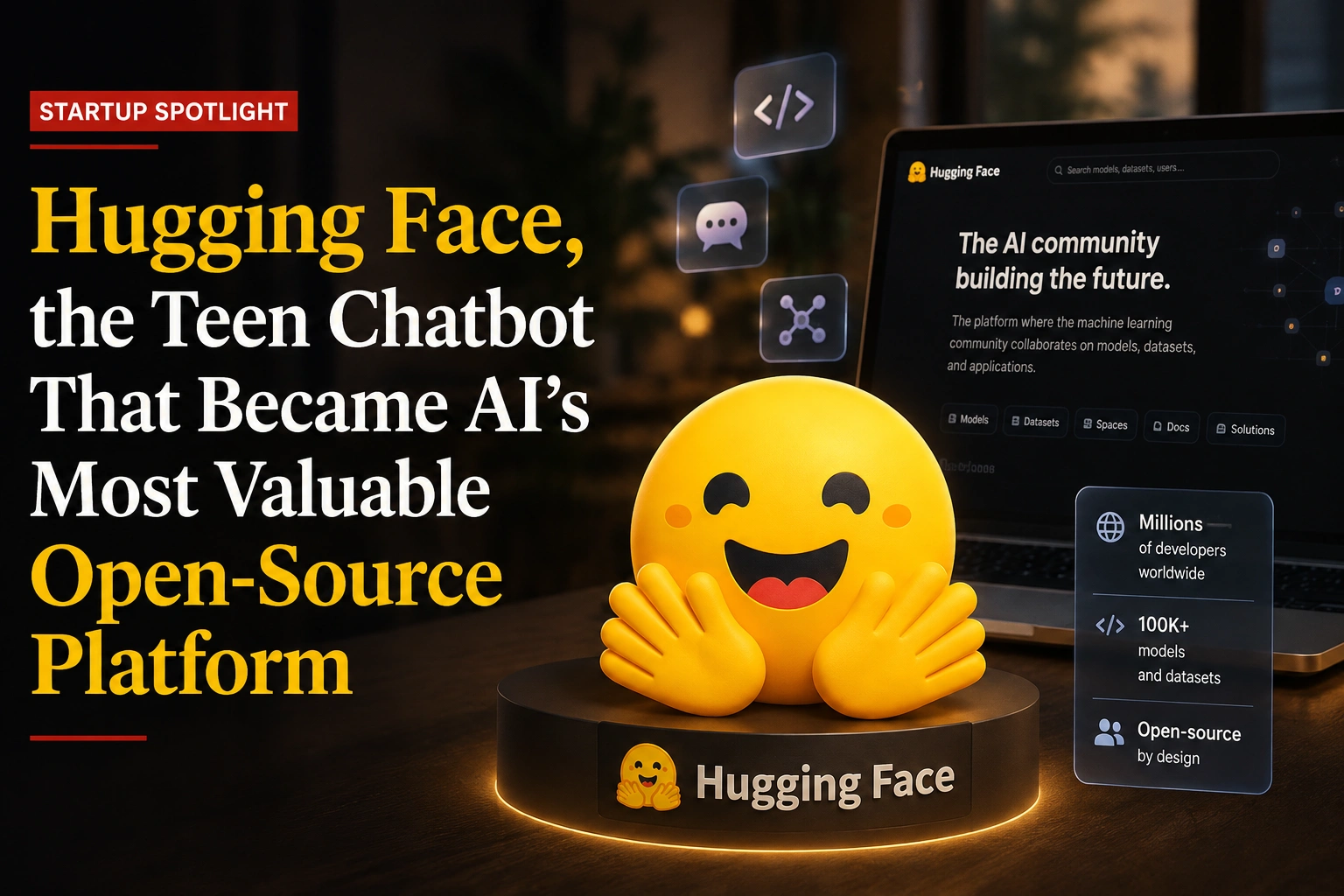
Few startups pivot as dramatically as Hugging Face did. Founded in 2016 in Brooklyn by Clément Delangue, Julien Chaumond, and Thomas Wolf, the company’s original product was a chatbot app aimed at teenagers — its quirky name borrowed from the 🤗 emoji. That consumer app barely registers as a footnote today, because building the natural-language technology to power it led the founders somewhere far more consequential: an open platform for sharing the AI research and tools they’d built along the way.
The reaction to that open-sourcing was, by Delangue’s own account, so enthusiastic that it redefined the company’s mission entirely. Rather than chase consumer chatbot growth, Hugging Face rebuilt itself around a small community of contributors adding features to an open platform — a bet on openness that would come to define the company for the next decade, and that is now the centerpiece of a reported $12.9 billion sale to Nvidia.
The BERT Moment That Changed Everything
If there’s a single inflection point in Hugging Face’s history, it’s late 2018. When Google released BERT, a breakthrough language model that reset expectations for what natural-language AI could do, Thomas Wolf and the Hugging Face team produced a PyTorch implementation of the model and released it as open source on GitHub within a week. The speed and quality of that release drew serious attention from the machine-learning research community and proved something that wasn’t obvious at the time: there was enormous unmet demand for accessible, well-engineered open-source NLP tooling that didn’t require a research lab’s resources to use.
That moment set the template Hugging Face has followed ever since — get ahead of major model releases with high-quality open tooling, and let the resulting community goodwill compound. It’s a strategy that scaled into today’s platform: more than a million open-source model repositories and datasets, used by an estimated 15,000-plus companies integrating AI into their products.
Turning Down Nvidia Once Before
What makes this week’s reported deal notable is that Hugging Face had the chance to sell to Nvidia before — and said no. In late 2025, the company turned down a $500 million investment offer from Nvidia that would have valued Hugging Face at $7 billion, telling the Financial Times at the time that it didn’t want a single investor large enough to influence its decisions. That instinct toward independence is consistent with a company whose entire value proposition has rested on being seen as neutral infrastructure rather than an arm of any one hardware or cloud vendor.
Less than a year later, that calculus has apparently changed. Reports surfaced around August 23-24 that Hugging Face was exploring a sale at a $13 billion valuation, and by Wednesday, August 26, The Information reported Nvidia had reached an agreement to acquire the company outright for $12.9 billion — a deal CNBC, Business Standard, and Invezz all confirmed in reporting published Thursday, though Business Insider has cautioned the talks “could still fall apart.”
The Numbers Behind a Landmark Exit
Hugging Face’s valuation trajectory tells its own story of how fast the open-source AI category has grown. The company raised $235 million in 2023 at a $4.5 billion valuation, in a round led by Salesforce Ventures with participation from Alphabet’s GV, IBM Ventures, and — notably — Nvidia itself, which has been a Hugging Face backer for years. A reported $12.9 billion sale price would represent nearly a threefold jump from that 2023 mark in under three years, a rate of appreciation that reflects just how central open-weight models have become to the broader AI industry since.
What an Nvidia-Owned Hugging Face Means for Open Source
For the developers and researchers who’ve built careers and companies on top of Hugging Face’s free tooling, the acquisition raises a genuine question about what “neutral infrastructure” means once the platform is owned by the industry’s dominant chipmaker. Delangue has spent years positioning Hugging Face as the platform that keeps AI development accessible to anyone, regardless of which hardware or cloud vendor they use. Whether that positioning survives ownership by the company whose chips increasingly determine who can afford to train and run the largest models at all will be the real test of this deal — not the price tag, but what Hugging Face becomes after it closes.
Salesforce and Anthropic Launch Claudeforce to Bring Agentic AI Into Enterprise CRM

Ruchi Kumar is the associate editor at Entrepreneur News Network and TVW News India, where she leads editorial strategy, brand storytelling, and startup ecosystem coverage. With a strong focus on innovation, business, and marketing insights, he curates impactful narratives that spotlight India’s evolving entrepreneurial landscape. She has written extensively on fintech, AI and emerging startups.