
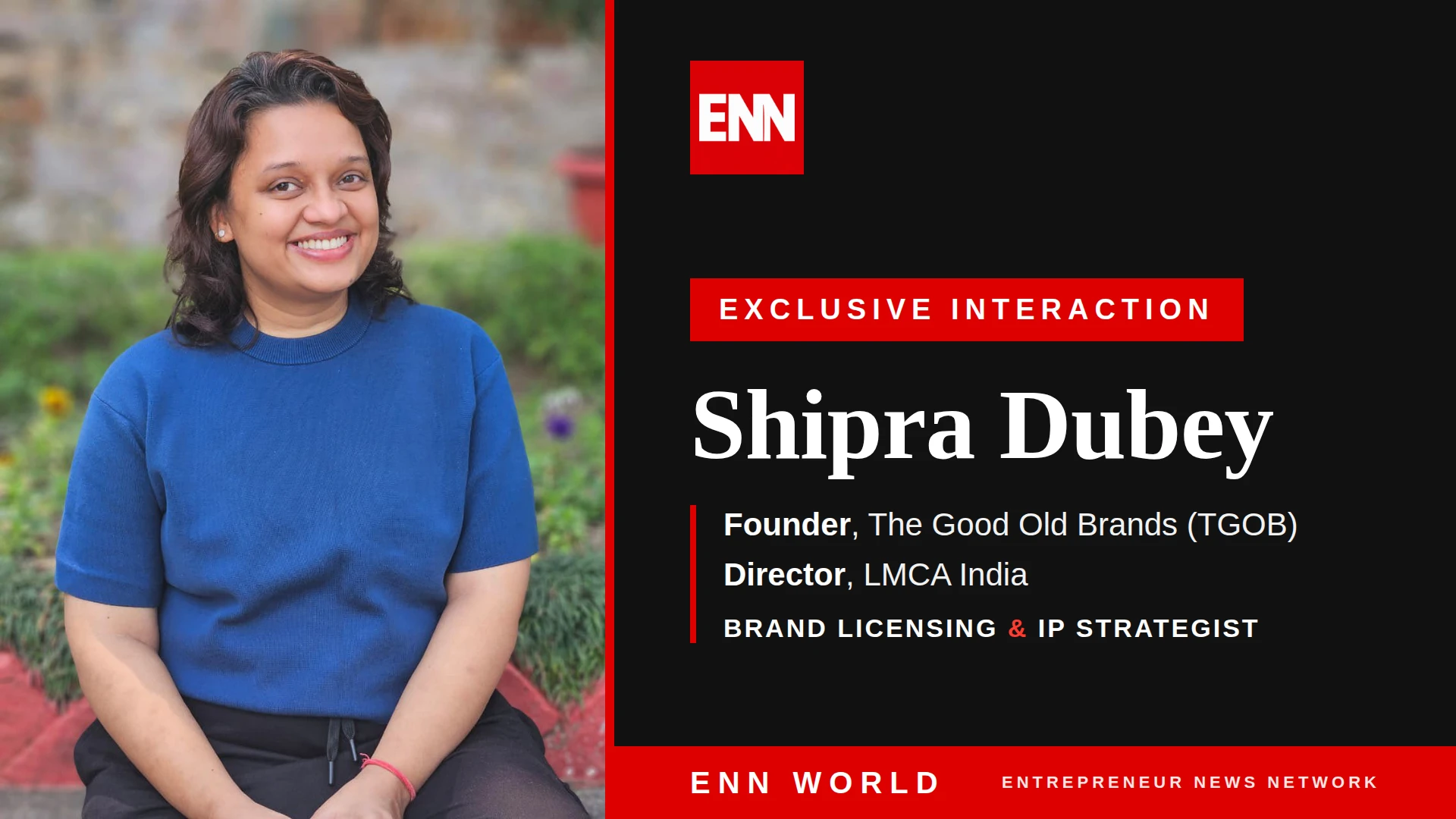
New Delhi, 28 September 2026: Licensing in India used to mean a cartoon on a school bag or a logo on a jersey. Shipra Dubey wants to change that. As Founder of The Good Old Brands (TGOB) and Director of LMCA India, she has worked with global IPs such as PepsiCo, NBA, WWE, NASA, EMOJI® and The Witcher, and has been part of more than $50 million in signed licensing deals. Her agency is also the first in India to enter gaming licensing, bringing Cyberpunk and The Witcher to the Indian market. In this exclusive conversation with ENN, Dubey talks about how licensing is moving from merchandise to business strategy, where global brands get India wrong, which categories are ready for IP-led growth, and what it takes for women to build businesses in a sector that is still taking shape.
1) India’s licensing market is evolving rapidly. What are the biggest shifts you are seeing today, and how has the role of licensing changed from traditional merchandise to a broader brand and IP strategy?
The biggest shift I am seeing is that licensing is slowly moving from being viewed as a merchandising exercise to a business-growth strategy.
Traditionally, when people heard licensing, they thought of cartoon characters on school bags, movie merchandise or sports jerseys. That is still an important part of the business, but it is only one piece of the opportunity.
Today, we are seeing brands explore licensing across fashion, beauty, food and beverage, consumer electronics, automotive, home, gaming, experiences and even technology. The question is no longer simply, “What product can we put this IP on?” It is becoming, “What new consumer or business opportunity can this IP unlock for us?”
Globally, the scale of the industry reflects that shift. Licensing International estimates that sales of licensed merchandise and services reached $389.8 billion globally in 2025, growing 5.45% yoy and outpacing the broader retail market. Sports licensing grew 8.5%, entertainment and characters 8%, while software, video games and apps grew 12.5%.
India is still a relatively underdeveloped licensing market compared with mature markets such as the US and UK, but that is precisely what makes it exciting.
At The Good Old Brands, we are increasingly looking at licensing as a way to connect IP, consumer behaviour, product categories and retail, rather than treating it as simply a royalty arrangement. Thats the reason we are the first agency to enter into gaming licensing, our IPs Cyberpunk and Witcher are first time being represented in India market and we are hopeful that these will get a good response now.
I also think Indian companies are beginning to understand that licensing can help them enter categories faster. If you already have manufacturing, distribution and retail capabilities, partnering with an established IP can add brand equity and consumer relevance without having to build that equity from scratch.
That is where I see the next phase of Indian licensing coming from.
2) You have worked with global IPs such as PepsiCo, NBA, WWE, NASA, EMOJI®️ and The Witcher. What makes an international brand or IP successful in India, and where do companies most often get localisation wrong?
The biggest mistake international brands make is assuming that India is one large market that can simply be added to their global strategy.
It isn’t.
India has its own consumer behaviour, price points, retail structures, regional preferences, cultural nuances and distribution realities. A strategy that works in the US or Europe cannot simply be copied here and expected to perform in exactly the same way. I always tell my brands that here every 200 Km language consumer preferance , food everything changes India is several different market in one market and you can have any strategy replicated here.
For me, successful “localisation is not about changing the DNA of the IP. It is about finding the Indian expression of that DNA.”
When we work with an international IP at TGOB, I look at four things: Does the Indian consumer understand the IP? Which category does it naturally belong in? What is the right price and retail environment? And what can we do locally without compromising the global identity of the brand?
NASA is a good example of why this matters. You cannot take an American IP with very specific brand guidelines and simply treat it like a graphic asset. The history, symbolism and visual language have to be respected. At the same time, the opportunity in India has to be commercially relevant to Indian consumers.
Similarly, with entertainment or gaming IPs such as The Witcher or Cyberpunk 2077, the opportunity isn’t necessarily just T-shirts. It could extend into collectibles, gaming accessories, experiences, technology, fashion or lifestyle depending on where the fandom actually exists.
India is also becoming a much more interesting market for international IP owners. Licensing International’s 2025 study showed South Asia/Pacific growing 6.8% in 2024, above the global market’s growth rate for that year.
The opportunity is enormous, but localisation needs to be done with market knowledge, not just translated packaging.
3) You have been involved in more than $50 million in signed licensing deals. What factors determine whether a licensing partnership becomes commercially successful rather than simply creating visibility for the brand?
One thing I have learnt over the years is that “a big logo does not automatically make a big business.”
Visibility is the easiest part of a licensing deal. The difficult part is converting that visibility into a commercially sustainable product, category and consumer proposition.
Before we pursue a licensing opportunity at The Good Old Brands, I look at several things.
First is brand-product fit. Does the IP genuinely make the product more desirable, or are we simply putting a logo on it?
Second is the licensee. Does the partner understand the category? Do they have manufacturing capabilities, distribution, retail access and the financial ability to build the business?
Third is consumer demand. Who is actually going to buy this product, and why?
Fourth is price and positioning. An international IP does not automatically mean the product can command an international price point in India.
And finally, there is execution approvals, quality control, retail strategy, marketing, inventory and timelines.
I have seen licensing programmes fail even when the IP itself was extremely strong because the product, price, partner or distribution strategy was wrong.
One of the things we focus on at TGOB is therefore building the ecosystem around the IP rather than simply finding a licensee.
A successful licensing programme should create value for the IP owner, the licensee and ultimately the consumer.
“The royalty cheque is the outcome. The real work is everything that happens before it”.
4) Gen Z and fandom-driven consumption are creating new opportunities across gaming, entertainment, sports, fashion, beauty and technology. Which categories do you believe are most underdeveloped in India’s licensing ecosystem, and why?
I think the biggest opportunity is actually in the categories where we have traditionally not thought of licensing at all.
Technology and consumer electronics are one. A strong IP can transform something functional into something collectible or aspirational. Think headphones, speakers, gaming accessories, smart devices or even EV-related products.
Beauty and fragrance is another. Globally, licensing has already shown how characters, fashion houses, celebrities and cultural IPs can move into beauty and fragrance. India has a huge beauty and personal-care consumer base, but there is still enormous room for IP-led products.
I also see significant opportunity in automotive and mobility, particularly as Indian automotive companies increasingly think about lifestyle rather than simply selling vehicles. The vehicle can become an ecosystem of merchandise, accessories, experiences and collaborations.
Gaming and experiential licensing is another major opportunity. Globally, software, video games and apps were the fastest-growing major licensed product category in 2025, growing 12.5%.
I also see Real estate rising a lot see Elle Saab, Jacob and co and more brands entering real estate infact there is a very exciting real estate project we are working on details will be revelaed soon.
At TGOB, this is exactly where we see the opportunity taking IP beyond the obvious merchandise category and asking where it can naturally become part of the consumer’s lifestyle.
The next generation of licensing in India, in my view, will be less about “merchandise” and more about identity, fandom and experiences.
5) As a founder building a specialised business in a niche industry, what have you learned about creating a globally relevant licensing company from India—and what advice would you give to women entrepreneurs looking to build businesses in emerging sectors?
Building The Good Old Brands has taught me that being in a niche industry can actually become your biggest advantage if you are willing to stay with it long enough.
When I started, licensing was still a relatively small and misunderstood industry in India. You would explain what you did and then spend the next ten minutes explaining what licensing actually meant. I still do that but the awareness is better what it was 10 years ago.
Today, the conversation is very different. More global IP owners are looking at India, more Indian companies are looking at brand collaborations, and consumers are increasingly comfortable buying into fandom, nostalgia and lifestyle brands.
Globally, licensed merchandise and services generated $389.8 billion in 2025. The opportunity is clearly not small. The opportunity is to build the Indian ecosystem around it.
For TGOB, that has meant thinking beyond simply being a licensing agency. We want to be a bridge between global IP and Indian commercial opportunity understanding the IP, identifying the right category, finding the right partner and then helping both sides navigate the Indian market.
My biggest lesson as a founder has been that you don’t always need to build a business in a crowded market. Sometimes it is more powerful to build expertise in a market that is still being created.
And to women entrepreneurs, particularly those entering emerging sectors, I would say: don’t wait for the industry to become established before you claim your space in it. We dont have many licensing agencies in India drivern by Women infact there are just handful of females in licensing business in India while globally you see it domeinated by females see Maura Regan, Allison Ames, Debra Joester, Deirdre Cross all these females have spent more than 20 years buliding in licneisn gand all are inspiration.
I have learnt that you can build credibility by showing up consistently, doing the work and becoming the person people associate with that category.
You don’t have to be the biggest player in the room to have a voice. You need to understand your subject deeply, build relationships patiently and keep creating value.
For me, the ambition with TGOB has never been just to build another agency. It is to help build a stronger licensing ecosystem in India, not just licensing deals I want to educate new kids n licensing maybe have a course around it do talks to make people aware of this mammoth yet unexplored sector and to prove that a specialised business built from India can have a global point of view.
Databricks Acquires Row Zero to Bring Governed Spreadsheets to Enterprise AI

Ruchi Kumar is the associate editor at Entrepreneur News Network and TVW News India, where she leads editorial strategy, brand storytelling, and startup ecosystem coverage. With a strong focus on innovation, business, and marketing insights, he curates impactful narratives that spotlight India’s evolving entrepreneurial landscape. She has written extensively on fintech, AI and emerging startups.