

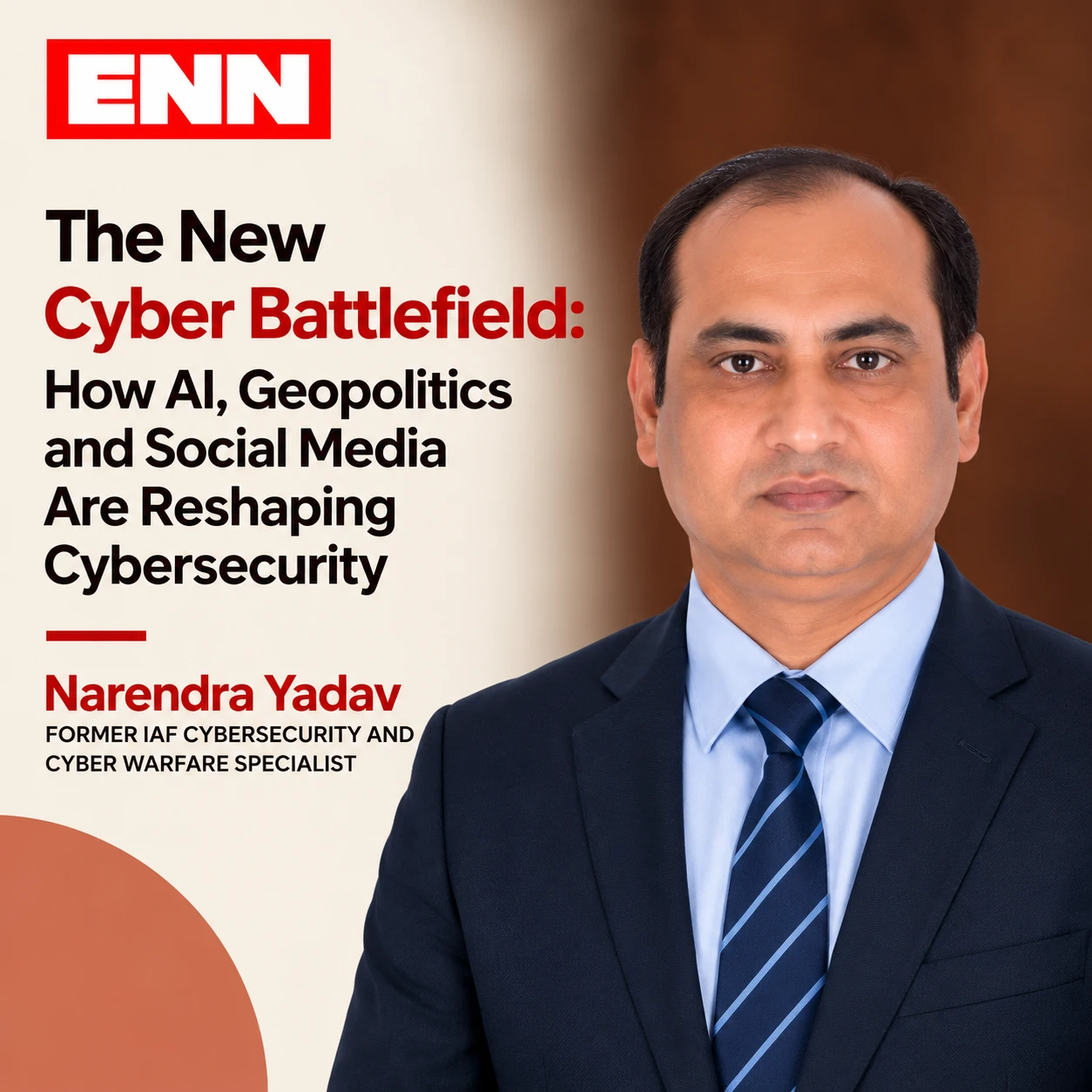
By Narendra Yadav
For cybersecurity entrepreneurs and startups, the next frontier is not simply preventing attacks. It is building trust, anticipating intelligent adversaries and securing an increasingly connected digital world.
The cybersecurity industry is entering a defining era. Artificial intelligence is transforming how businesses operate, how people communicate and how startups innovate. At the same time, it is changing the nature of cybercrime. Attackers can automate phishing campaigns, impersonate executives, generate convincing fake identities and exploit vulnerabilities at a speed that traditional security systems struggle to match.
For entrepreneurs, this presents both a serious challenge and a significant business opportunity. Cybersecurity is no longer just an IT function reserved for large corporations. It is a fundamental requirement for every digital business, from early-stage startups and social media platforms to fintech companies, e-commerce ventures and AI-powered applications.
The question is no longer whether a business will face a cyber threat, but how prepared it will be when one arrives.
WHERE THE OPENINGS ARE
- AI-driven identity verification.
- Automated security monitoring for teams without a SOC.
- Deepfake detection and fraud prevention.
- Incident investigation tooling built for small and mid-sized businesses.
AI Is Making Threats Smarter and Harder to Detect
Traditional cyberattacks often depended on technical expertise, manual effort and relatively predictable methods. Generative AI has lowered these barriers, enabling criminals to produce polished phishing emails, convincing voice clones, fraudulent documents and highly personalised scam messages.
AI-assisted attacks can use publicly available information to tailor messages to an individual’s role, interests and professional relationships. A founder might receive a fabricated investment proposal, while a finance executive could be targeted with a convincing payment instruction that appears to come from the chief executive.
Deepfakes add another dimension. Fraudsters can imitate a senior leader’s voice or appearance to manipulate employees into transferring funds, disclosing credentials or sharing confidential information. Meanwhile, AI-powered malware and automated vulnerability discovery can accelerate certain stages of an attack.
However, AI is not exclusively a weapon for criminals. Security teams can use it to identify anomalous behaviour, analyse threat intelligence, prioritise vulnerabilities and respond to suspicious activity. The competitive advantage will belong to organisations that combine AI’s analytical capabilities with human oversight, sound processes and reliable security controls.
For cybersecurity startups, promising opportunities include AI-driven identity verification, automated security monitoring, deepfake detection, fraud prevention and tools that help smaller businesses investigate incidents without maintaining large security teams.
Geopolitics Meets Cyber Warfare
Geopolitical tensions increasingly spill into cyberspace, making cyber incidents a concern for businesses well beyond the countries directly involved. Governments, critical infrastructure operators, technology companies and private organisations can all become targets of espionage, disruption or information operations.
Security researchers and government agencies have repeatedly documented campaigns attributed to state-sponsored or adversary-linked groups, including operations involving espionage, credential theft and access to sensitive networks.
When discussing a recent attack in the Middle East attributed to China — the activity tracked as SilkParasite — it is essential to distinguish a verified incident from an allegation or an unconfirmed attribution. Public reporting does not always establish who conducted an operation, and a compromised organisation’s location alone does not prove state sponsorship. Responsible reporting should identify the affected organisation, the date, the technical evidence and the agency or research team making the attribution.
The broader lesson remains clear: cyber threats are increasingly shaped by geopolitical objectives. Startups serving energy, logistics, financial services, healthcare or government suppliers must consider nation-state espionage alongside conventional cybercrime. Even a small technology vendor can become an entry point into a much larger organisation’s network.
For founders, geopolitical risk should therefore be part of enterprise risk management, investor discussions and customer due diligence — not an afterthought reserved for security specialists.
Official accounts should use multifactor authentication, preferably phishing-resistant methods where practical.
Social Media: The New Front Line
Social media has become an indispensable business tool. Entrepreneurs use platforms such as LinkedIn, Instagram, Facebook and X to attract customers, build investor relationships and establish their brands. Unfortunately, the same platforms provide attackers with a rich source of information for impersonation, fraud and targeted manipulation.
AI makes these threats more convincing. Fake executive profiles, cloned voices, fabricated customer testimonials and synthetic videos can undermine trust in a brand. Fraudsters may impersonate a startup’s founder to solicit investments, create fake customer-support accounts to steal credentials, or spread misleading information during a product launch.
Social engineering is particularly effective because it exploits human trust rather than relying exclusively on technical vulnerabilities. Attackers can study employees’ public posts, identify reporting relationships and construct believable messages around conferences, funding announcements or breaking news. The World Economic Forum’s 2026 Global Cybersecurity Outlook highlights how generative AI is increasing the sophistication and scale of phishing, deepfake fraud and online manipulation.
Businesses should respond by treating social media security as part of their overall cybersecurity strategy. Official accounts should use multifactor authentication, preferably phishing-resistant methods where practical. Organisations should verify sensitive requests through a second communication channel, monitor impersonation attempts and establish clear procedures for responding to fake accounts or manipulated content.
OPINION
Businesses should respond by treating social media security as part of their overall cybersecurity strategy.
Founders must also recognise that their personal digital presence can expose their companies to risk. A public announcement about a new technology, an employee’s role or an upcoming partnership can supply an attacker with valuable intelligence.
Social engineering works because it exploits human trust, not technical vulnerabilities.
OPINION — THE NEW CYBER BATTLEFIELD
Six Functions, Not a Shopping List
For startups, effective cybersecurity does not necessarily require an expensive security operations centre or a large compliance department. It requires a structured, risk-based framework that grows with the business.
The US National Institute of Standards and Technology’s Cybersecurity Framework (NIST CSF 2.0) provides a practical foundation through six core functions: Govern, Identify, Protect, Detect, Respond and Recover. Its approach suits organisations of different sizes and maturity levels. Here is how entrepreneurs can translate that framework into action.
Govern. Assign clear responsibility for cybersecurity, define risk tolerance and establish policies for data handling, AI usage, vendor access and incident reporting. Security should be discussed at board level, not left entirely to technical teams.
Identify. Maintain an inventory of devices, applications, cloud services, AI tools and sensitive information. Assess which systems would cause the greatest financial or operational damage if compromised.
Protect. Enforce multifactor authentication, least-privilege access, encryption, secure backups and regular patching. Train employees to recognise AI-enabled impersonation and phishing. Secure development pipelines and review third-party software dependencies.
Detect. Centralise relevant logs, monitor unusual login activity and use endpoint detection and cloud security tools. AI can help identify suspicious patterns, but automated alerts should be evaluated in context to reduce false positives.
Respond. Prepare an incident-response plan that defines decision-makers, technical responsibilities, legal support, customer communications and escalation procedures. Conduct realistic exercises before a crisis occurs.
Recover. Maintain tested, isolated backups and documented recovery procedures. Establish recovery priorities, learn from incidents and improve controls continuously.
For startups operating in India, the framework should also be aligned with applicable legal and regulatory obligations, including relevant provisions of the Digital Personal Data Protection Act, 2023, and applicable CERT-In directions. Requirements vary according to the organisation, its activities and the rules in force; legal and compliance advice should be obtained where necessary.
A framework is effective only when it is implemented and tested. A policy document that nobody follows offers little protection.
The Startup Security Blueprint
The challenge for an early-stage company is to balance security investment against limited budgets and the pressure to innovate. The answer is not to purchase every available security product, but to prioritise the controls that reduce the greatest risks. Three principles deserve particular attention.
First, secure by design
Build authentication, encryption, access control and privacy into products from the beginning, rather than attempting to retrofit them after a breach.
Second, adopt a zero-trust mindset
Verify users, devices and applications before granting access, and continuously review permissions. No employee, contractor or third-party application should receive unrestricted access simply because it operates inside the corporate network.
Third, govern the use of AI
Employees should know which AI tools are approved and what information they may share with them. Startups should assess whether AI vendors retain submitted data, how they protect it, and whether customer information could be exposed through integrations or automated agents.
Founders should also test their defences through vulnerability assessments, penetration testing and incident-response simulations. Cyber insurance may provide an additional layer of financial protection, but it cannot replace sound security practices.
Cyber insurance may provide an additional layer of financial protection, but it cannot replace sound security practices.
Verify users, devices and applications before granting access, and continuously review permissions.
Turning Security Into a Competitive Advantage
Cybersecurity is often perceived as a cost centre. For ambitious startups, it can instead become a differentiator. Enterprise customers increasingly scrutinise suppliers’ security practices before signing contracts, while investors need confidence that a company’s intellectual property, customer data and business continuity are adequately protected.
Startups that demonstrate strong security governance can build trust earlier, shorten customer due-diligence processes and compete for opportunities that might otherwise be inaccessible. This creates room for innovative businesses offering managed detection and response, cloud security, identity protection, AI governance and accessible security solutions for small and medium-sized enterprises.
The opportunity is particularly significant for entrepreneurs who can simplify complex security challenges without compromising protection. The winners will not necessarily be those with the most sophisticated algorithms, but those that solve real problems reliably, integrate with existing systems and communicate risk clearly.
Trust Will Define the Next Generation
The convergence of AI, social media and geopolitical conflict has transformed cybersecurity from a technical specialisation into a strategic business priority. The China-linked campaign targeting Gulf-region organisations in March 2026 illustrates how quickly regional events can be converted into opportunities for cyber espionage and social engineering; researchers at Check Point and Zscaler reported activity involving conflict-themed lures and the deployment of PlugX malware.
For entrepreneurs, the message is clear: innovation without security creates fragility, while security integrated into innovation creates resilience.
The next generation of successful cybersecurity startups will combine intelligent technology with disciplined governance, responsible AI adoption and a deep understanding of human behaviour. In a world where digital identities can be fabricated and attacks can cross borders in seconds, trust is becoming one of the most valuable assets a business can possess. For founders, building that trust should begin on day one — not after the first breach.
IBM and MeitY Startup Hub Partner to Accelerate India’s Deep Tech Startup Ecosystem

Ruchi Kumar is the associate editor at Entrepreneur News Network and TVW News India, where she leads editorial strategy, brand storytelling, and startup ecosystem coverage. With a strong focus on innovation, business, and marketing insights, he curates impactful narratives that spotlight India’s evolving entrepreneurial landscape. She has written extensively on fintech, AI and emerging startups.