
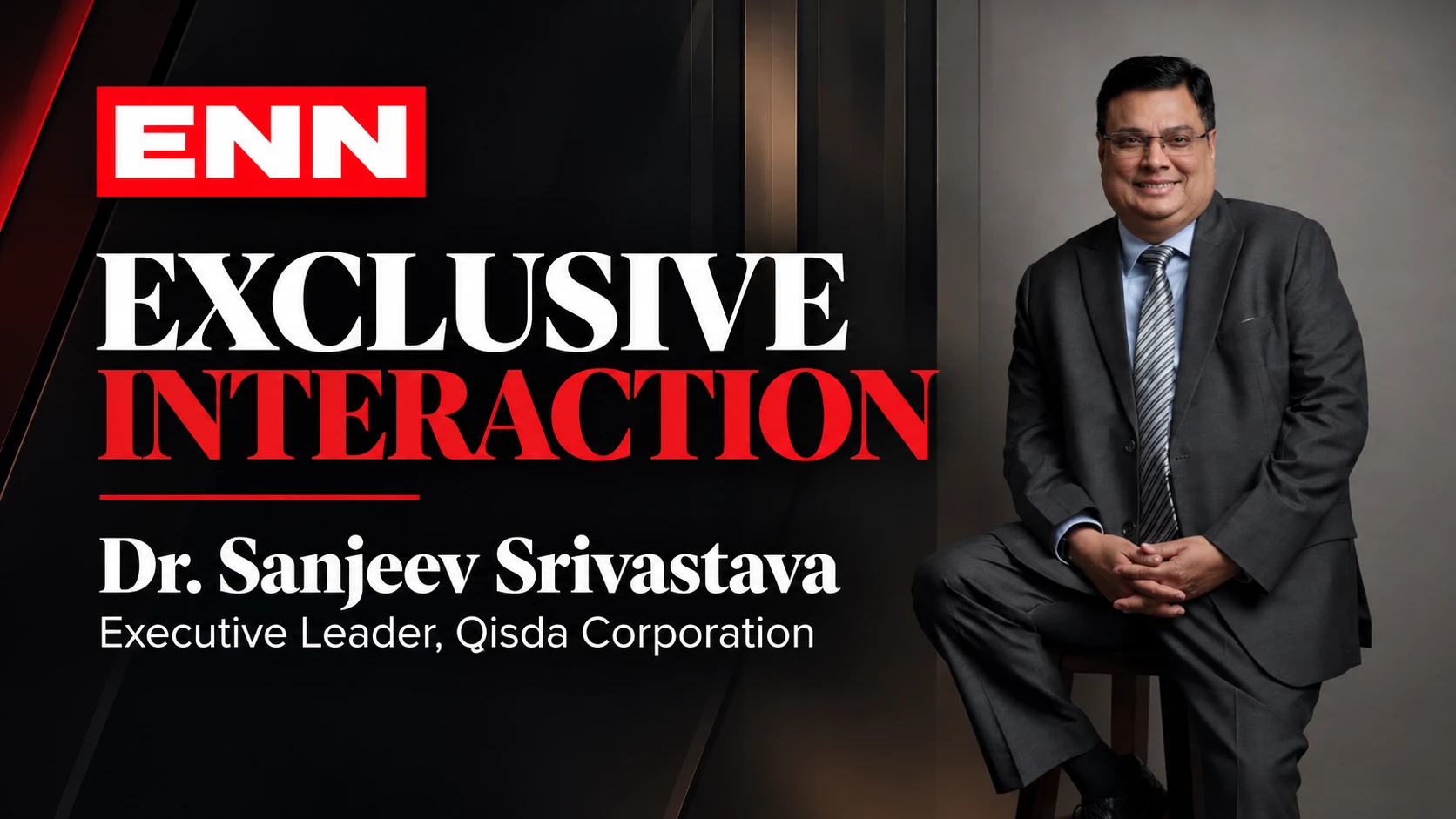
NOIDA, India, Oct. 23, 2026 In an exclusive interaction with Ankitt Y, Editor, ENN, Dr. Sanjeev Srivastava, Executive Leader at Qisda Corporation, shares insights into the company’s India growth strategy, its evolving technology ecosystem and the opportunities emerging across AI infrastructure, smart manufacturing, healthcare and connected solutions. The conversation explores how Qisda plans to bring its global capabilities together, strengthen its identity in India, build strategic partnerships under the Make in India initiative, and collaborate with Indian companies to develop technology solutions for domestic and international markets.
“Qisda is a Taiwan-based global technology group with businesses spanning information technology, medical, smart business solutions, and networking communication. We have more than 200 locations and sales offices worldwide and approximately 29,000 employees. Qisda has also been ranked among the top 5% in the S&P Global Sustainability Yearbook for three consecutive years.
What is particularly exciting is the breadth of our technology ecosystem. Our businesses are increasingly focused around four important areas — AI Vision & Display, AI Infrastructure, AI Solutions & Smart Manufacturing, and AI Hospital & Wellness Ecosystem.
Our ambition in India is to bring these capabilities together and work with Indian customers and partners to solve real business problems. We see India not only as an important market, but also as a growth, innovation and, over time, an important part of Qisda’s global ecosystem.”
Qisda is a global technology group with a strong presence across displays, smart solutions, healthcare and networking. Where does India fit in Qisda’s global strategy today, and why is now the right time to deepen that focus?
India is a very important market for Qisda, and we see India not only as a large market but also as a growth, innovation and potentially an important technology and manufacturing hub.
India is going through a significant transformation. We are seeing rapid growth in digitalisation, artificial intelligence, healthcare, electronics manufacturing, smart factories, data centres and connected technologies.
Qisda brings together a broad range of capabilities across AI Vision & Display, AI Infrastructure, AI Solutions & Smart Manufacturing, and AI Hospital & Wellness Ecosystem. These capabilities give us the opportunity to address a much wider range of customer requirements.
Our objective in India is therefore not simply to sell individual products. We want to build partnerships, develop solutions around local customer requirements and contribute to India’s long-term technology journey.
We also see India as a market that can contribute to Qisda’s global ecosystem. The partnerships and capabilities we develop in India can potentially create opportunities beyond India as well.
So, for us, this is the right time because India’s technology transformation is accelerating, and Qisda has the breadth of capabilities to participate meaningfully in that transformation.
Many Qisda Group brands have operated independently in India. How do you plan to bring the Group’s strengths together and build a stronger Qisda identity in the Indian market?
This is a very important opportunity for us.
The Qisda Group has many companies with specialised capabilities. One company may have strength in displays, another in networking, another in medical technology, another in industrial computing or smart solutions.
The opportunity is to bring these capabilities together when a customer has a larger business problem to solve.
For example, a customer may require displays, computing platforms, connectivity, software, automation and system integration. Rather than looking at these as separate products, we can bring together the relevant capabilities across the Qisda Group to provide a more comprehensive solution.
This is also consistent with the direction in which Qisda is developing globally — bringing together technology, companies and channels to create broader and more integrated solutions for customers.
In India, my focus will be to make this capability easier for customers and partners to understand:
One Qisda ecosystem, multiple technology capabilities, and solutions built around customer needs.
At the same time, we want to emphasise that our partnership approach is not limited to the Indian domestic market. We are also looking forward to working with Indian companies and partners who can collaborate with Qisda on a global scale.
That could mean an Indian company working with Qisda on a solution for India, but it could also mean jointly developing a solution that can eventually be taken to other markets.
Which sectors in India — education, healthcare, manufacturing, enterprise or retail — do you see as the biggest growth opportunities for Qisda over the next few years?
I would not look at only one sector because India’s opportunity is quite broad.
However, I see particularly strong potential in healthcare, manufacturing, enterprise and retail, along with emerging opportunities in AI infrastructure and digital transformation.
Healthcare is becoming increasingly technology-driven. AI, medical imaging, connected medical equipment and digital healthcare can improve both the quality and accessibility of healthcare.
Manufacturing is another very important area. Indian companies are investing in automation, robotics, smart factories and Industry 4.0 technologies. This creates opportunities for Qisda’s AI Solutions & Smart Manufacturing capabilities.
Enterprise and retail are also changing rapidly through AI, intelligent displays, computing, connectivity and data-driven operations.
At the same time, the rapid growth of AI is creating significant requirements for AI Infrastructure — including computing, networking, display and other supporting technologies.
Our AI Vision & Display capabilities can also play an important role across several of these sectors.
So rather than approaching the market sector by sector, our philosophy is:
Understand the customer’s business challenge first, and then bring together the right Qisda technologies and capabilities to solve that challenge.
With Make in India and the push for local manufacturing and supply chains, how is Qisda looking at investment, partnerships or local operations here?
India’s Make in India initiative is creating an important opportunity for global technology companies, and Qisda sees strong potential to participate in this ecosystem.
Our approach is to build the India business progressively through local partnerships, local talent, customer engagement and stronger supply-chain relationships.
We believe India can play an important role not only as a market but also as part of the broader global technology and manufacturing ecosystem.
Qisda already has significant global manufacturing and supply-chain capabilities. Our objective in India is to understand where we can create the greatest value together with Indian companies and partners.
We are therefore looking at this as a long-term journey rather than a short-term initiative.
As the business develops, there can be opportunities for deeper localisation, stronger local capabilities and broader collaboration.
And importantly, our partnership philosophy goes beyond simply serving the Indian market. We are keen to explore partnerships with Indian companies that can work with Qisda globally, creating solutions and business opportunities that can extend to international markets.
AI, smart displays and connected solutions are reshaping the industry. How is Qisda positioning itself to lead in this shift, and what trends excite you most?
AI is going to change almost every industry, but I believe the real value will come when AI is connected with real-world applications.
For example, AI in a factory can help improve productivity, quality and operational efficiency. In healthcare, AI can support doctors, improve medical imaging and make better use of medical information.
In retail, AI can enhance customer experiences and make store operations more intelligent.This is where I believe Qisda has a very interesting position because our capabilities span the entire ecosystem.
We are looking at four broad areas:
- AI Vision & Display
- AI Infrastructure
- AI Solutions & Smart Manufacturing
- AI Hospital & Wellness Ecosystem
These areas allow us to look beyond individual products and think about how technologies can work together.
I am particularly excited about the combination of AI + automation + connectivity + intelligent displays + healthcare technologies.
When these technologies come together, we move from simply using technology to actually making businesses, industries and healthcare ecosystems smarter.
And I believe India is an excellent environment for this because of its scale, technology talent, entrepreneurial ecosystem and willingness to adopt new technologies.
On a personal note, what defines your leadership style, and what does success for Qisda India look like three to five years from now?
I believe leadership is primarily about people, trust and execution.
My style is to listen first, understand the situation, bring the right people together and then focus on execution.
I also believe that a leader should give people the freedom to take ownership while remaining accountable for the outcome.
For me, success for Qisda India three to five years from now would not be measured only by revenue.
I would like to see Qisda recognised in India as a trusted technology and solutions partner.
I would like to see strong Indian customers, strong local partners, talented local people and successful projects that demonstrate what Qisda can do.
But I would also like to see something beyond that.I would like India to become an important part of Qisda’s global growth story — contributing not only through business, but also through innovation, local talent, partnerships and solutions that can eventually be taken to other markets.
If Indian companies and Qisda can jointly develop solutions that are successful not only in India but internationally, that would be a very meaningful measure of success.
Ultimately, my ambition is to build an ecosystem where Qisda’s global technology capabilities and India’s talent, market opportunity and innovation ecosystem come together to create something much larger than either could achieve independently.

Ruchi Kumar is the associate editor at Entrepreneur News Network and TVW News India, where she leads editorial strategy, brand storytelling, and startup ecosystem coverage. With a strong focus on innovation, business, and marketing insights, he curates impactful narratives that spotlight India’s evolving entrepreneurial landscape. She has written extensively on fintech, AI and emerging startups.