

From Bengaluru’s IT corridors to Wall Street’s trading floors, artificial intelligence is reshaping employment at a pace and scale that demands honest accounting. Here is what the data actually says.
Every technology revolution in history has been accompanied by a version of the same argument: yes, some jobs will be lost, but more will be created. The steam engine. Electricity. The internet. In each case, the long arc of economic history vindicated the optimists. More jobs did emerge. Prosperity did broaden.
The question being asked with increasing urgency in 2026 is whether artificial intelligence will follow the same arc — or whether this time, the disruption is different enough, fast enough, and broad enough to break the historical pattern before the safety net of new job creation can catch those falling through it.
The data available today is sobering. Not catastrophic — but sobering.
The Global Picture: What the Numbers Say
Start with what has already happened, before projections and forecasts enter the conversation.
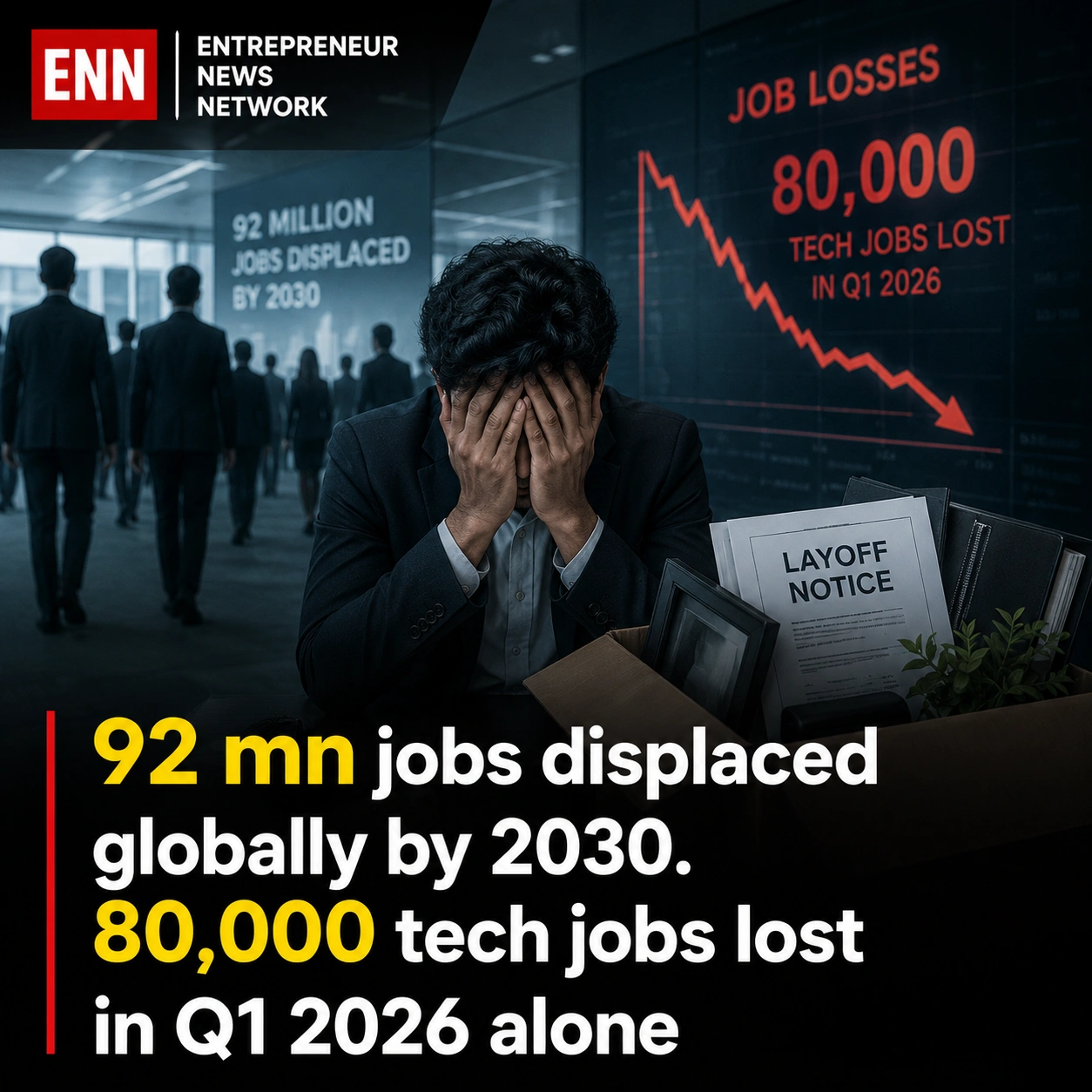
Around 78,000 to 80,000 tech jobs were cut globally in the first quarter of 2026 alone — a considerable increase over the 29,845 jobs lost during the same period of 2025. Nearly half of these job cuts were attributed directly to AI or automation, though analysts note this figure may be an underestimate, as many companies cite cost-cutting measures rather than explicitly naming AI as the driver.
Tech companies worldwide have eliminated over 100,000 jobs in the first five months of 2026, with AI and automation driving major restructuring across the sector. Oracle laid off approximately 30,000 people globally. Meta is planning around 8,000 job cuts — nearly 10% of its workforce. Snapchat’s parent company announced 1,000 role eliminations, representing 16% of its headcount. Freshworks cited increased AI adoption explicitly as the driver of its 11% workforce reduction.
Pull back to the full year 2025 and the picture is starker. Nearly 55,000 job cuts were directly attributed to AI in the US in 2025 alone, according to Challenger, Gray & Christmas, out of a total 1.17 million layoffs — the highest total since the pandemic year of 2020. Globally in 2025, more than 177,000 tech workers were laid off — approximately 586 every single day. Of these, around 78,000 were linked directly to AI-driven automation.
The sectors feeling this most acutely are not on the factory floor. Administrative and office support roles face the highest automation risk, with 46% of tasks potentially automatable. Manufacturing stands at 45%, customer service at 41%, data processing at 38%, and basic financial services at 37%. These are the jobs that built the global middle class — and they are being restructured faster than any previous technological transition.
Wall Street banks plan to remove approximately 200,000 jobs over the next three to five years, particularly in entry-level and back-office functions. Goldman Sachs research has found that AI could automate tasks equivalent to 300 million full-time jobs worldwide, with 26% of office roles and 20% of customer service positions highly exposed.
The authoritative long-range forecast comes from the World Economic Forum’s Future of Jobs Report 2025. The report projects that 170 million new roles will be created by 2030, while 92 million existing roles will be displaced — a structural labour market churn of 22% of the 1.2 billion formal jobs in the dataset. The net result is a projected increase of 78 million jobs.
That net positive figure is real — but it conceals a timing problem that is already causing serious social disruption. New jobs in AI engineering, data science, and green technology do not automatically absorb laid-off customer service representatives, mid-level IT managers, or accounts processing clerks. The skills gap between the jobs being lost and the jobs being created is wide, and the reskilling infrastructure to bridge it is still being built.
India: The White-Collar Nation at the Sharpest End
No country faces the AI employment challenge with higher stakes than India.
India built its modern economic identity on a specific bet: that its large, English-speaking, technically educated workforce could serve as the services engine of the global economy. The IT and business process outsourcing sectors that grew from this bet now employ approximately 5.4 million people directly and support tens of millions more through indirect employment. They generate over $315 billion in annual revenue and represent India’s most significant integration into the global knowledge economy.
That foundation is now being structurally challenged.
In FY22, India’s IT sector added 600,000 net jobs. In FY26, it added only 140,000 — an 86% decline. This is the first time in Indian IT history that revenue growth and employment have structurally decoupled. Revenue per employee has risen sharply: Infosys now generates $63,000 per employee, TCS $52,000, HCLTech $48,000, and Wipro $45,000. Companies are producing more output with fewer people — and the gap between revenue and headcount is widening, not closing.
TCS, India’s largest IT services exporter, shed more than 23,400 jobs in FY2026 alone, with its headcount falling from 607,979 to 584,519. India’s tech ecosystem as a whole has seen close to 40,000 layoffs in the past year, with many mid-level managerial roles particularly affected, according to talent solutions firm TeamLease Digital.
TCS cited its pivot to an AI-first services model, reduced bench requirements per client engagement, and lower fresher hiring targets as the drivers of its workforce reduction. Wipro cut its fresher hiring guidance to 7,500–8,000, significantly below earlier estimates, and saw nearly 200 recruits publicly flag deferred onboarding of over seven months.
Major Indian IT firms — TCS, Infosys, Wipro, HCLTech, and Tech Mahindra — recorded a combined net reduction of nearly 7,000 employees in FY26. Oracle laid off about 10,000 people in India as part of its global restructuring of 30,000 roles.
The structural nature of this shift is what distinguishes it from previous cyclical downturns in the IT sector. A World Bank report from October 2025 highlighted that unlike previous waves of automation, AI has the potential to displace a range of non-routine, white-collar service sector jobs — precisely the category that India’s IT sector specialises in. In the worst-case scenario modelled by the World Bank, the headcount in India’s tech services sector could fall from 7.5–8 million in 2023 to 6 million by 2031. The customer experience sector could shrink from 2–2.5 million to 1.8 million.
India’s Economic Survey for FY2025-26 acknowledged the challenge directly, citing “early evidence” of AI-driven displacement in financial services and noting that over 60% of formal sector jobs are susceptible to automation by 2030, particularly in IT and BPO sectors.
Nomura’s chief economist for India and Asia ex-Japan put it plainly: “AI adoption is a major challenge for India. Entry-level routine jobs are being displaced, and mid-level jobs are transforming.”
The Jobs Being Cut Are Not Equally Distributed
Within India’s IT workforce, the burden of AI-driven displacement is not evenly shared. Three cohorts are disproportionately affected.
The first is entry-level graduates. The traditional pipeline — engineering degree, campus placement at a large IT services firm, two to three years of training on basic coding and quality assurance — is breaking down. Traditional quality assurance, routine coding, and recruitment roles are being downsized as automated tools take over repetitive tasks. The entry point that an entire generation of Indian engineers relied on is narrowing.
The second is mid-level professionals. Between 2025 and 2026, major firms collectively laid off over 80,000 employees, primarily mid- to senior-level professionals deemed unable to reskill for AI-augmented workflows. Chief information officers report emerging service fragility as experienced professionals exit, creating institutional knowledge gaps — particularly in security and application modernisation.
The third is geography. Bengaluru and Hyderabad — cities whose entire economic identity is built around IT employment — are absorbing the concentrated impact of these changes. Many global companies operate large back-offices and development centres in India, and these units are now being heavily optimised. Young Indian graduates who recently completed degrees abroad are entering a hyper-competitive job market where they must compete against experienced, laid-off professionals for entry-level positions.
What Makes This Wave Different
Previous waves of technology-driven job displacement — ATMs replacing bank tellers, ERP systems reducing data entry roles, call centre automation cutting basic customer service positions — eliminated specific, discrete functions. The work that remained was generally higher-skilled and better compensated.
Generative AI is different in kind, not just degree. It can perform tasks that were previously considered safely in the domain of human cognition: drafting legal documents, writing code, generating financial analysis, translating languages, designing marketing material. What makes the current wave of layoffs distinct from previous years is that companies are not cutting because they are losing money. Many are reporting record profits. They are deliberately shrinking their traditional teams to free up capital to invest in AI infrastructure.
About 40% of companies that adopt AI choose full automation rather than using AI to support workers — actively increasing job displacement rather than augmenting human capacity. Approximately one in six employers expects AI to reduce their headcount in 2026.
The psychological impact is compounding the economic one. For India’s middle class — which built its financial security and social identity around stable, white-collar, knowledge economy employment — the realisation that those jobs are now structurally at risk is a source of genuine anxiety that is not captured in employment statistics.
The Other Side of the Ledger: What Is Being Created
The displacement story cannot be told honestly without the creation story alongside it.
AI hiring in India is projected to grow 32% in 2026, reaching nearly 380,000 positions, with Bengaluru, Hyderabad, and emerging Tier-II cities leading job creation across machine learning, data science, and AI safety roles. AI-related requirements now appear in 74% of all new IT contracts. Wipro is executing 83 AI-focused deals and TCS is managing 81. TCS has announced plans to train 100,000 employees in AI orchestration by mid-2026.
Global Capability Centres — the India-based operations of multinational companies that handle higher-value analytical, product, and engineering work — are expanding aggressively. Karnataka’s government has set a target to double its Global Capability Centre count to 1,000 by 2029.
The WEF’s net projection of 78 million new jobs globally by 2030 includes significant growth in green economy roles, healthcare, education, and technology infrastructure — areas where India has genuine competitive potential. But as WEF itself notes, collective action across public, private, and education sectors is urgently needed to address the growing skills gap between the jobs being created and the workforce currently available to fill them.
India’s government has invested over $1.2 billion through the IndiaAI Mission to build the talent pipeline for this transition. Whether that investment — and the reskilling programmes being run by the large IT firms — can move fast enough to absorb those displaced is the central question of India’s economic decade.
The Policy Gap That Needs Closing
There is currently no coordinated national policy framework in India that specifically addresses AI-driven workforce displacement — its measurement, its support structures, or its long-term management. The BRSR framework captures some ESG dimensions of corporate behaviour, but workforce displacement from AI adoption is not yet a mandatory disclosure category. Global frameworks like the EU’s AI Act include employment impact assessments; India’s regulatory approach to AI governance does not yet go this far.
Companies cutting thousands of jobs while simultaneously reporting record profits and increasing executive compensation are making legitimate business decisions — but they are externalising the social cost of those decisions onto workers, families, and governments. In the same way that carbon emissions were externalised for decades before climate regulation forced internalisation, AI-driven labour displacement is currently being treated as someone else’s problem to solve.
It will not remain that way. The political and social pressure building around this issue — visible in how prominently it featured at the India AI Impact Summit in February 2026, and in how consistently it appears in parliamentary questions — is a leading indicator that regulatory attention will arrive. Companies that get ahead of this, by investing seriously in reskilling, by measuring and disclosing workforce transition data, and by treating their people as stakeholders in the AI transition rather than costs to be optimised, will be better positioned when that attention arrives.
The AI revolution is not a threat to be resisted. It is a reality to be managed — with the same seriousness, the same accountability structures, and the same long-term thinking that any transformation of this magnitude demands.
The Cost of Fuel is So High, This Hyderabad Tech Firm is Buying EVs for Its Staff!

Ruchi Kumar is the associate editor at Entrepreneur News Network and TVW News India, where she leads editorial strategy, brand storytelling, and startup ecosystem coverage. With a strong focus on innovation, business, and marketing insights, he curates impactful narratives that spotlight India’s evolving entrepreneurial landscape. She has written extensively on fintech, AI and emerging startups.