

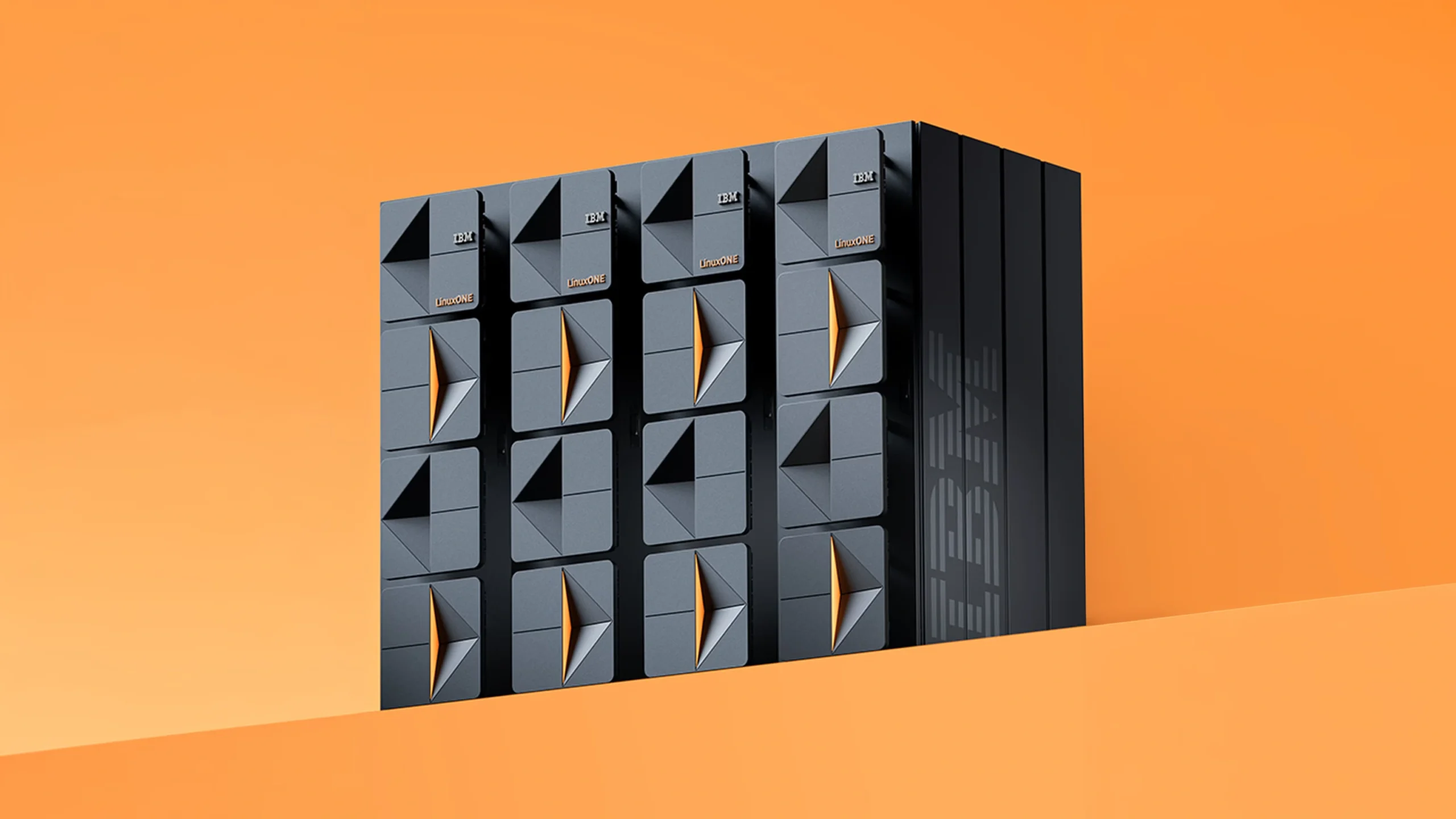
IBM has announced an expansion of its z17 and LinuxONE 5 systems, and the headline change is about form factor as much as performance: for the first time across its entire Z and LinuxONE portfolio, IBM is offering rack mount configurations alongside its traditional single frame systems. Both options are built on the same flagship performance, security, and ecosystem standards IBM’s mainframe and Linux-focused hardware is known for — the difference is how, and where, organizations can physically deploy them.
It’s a shift aimed squarely at a problem enterprises are increasingly running into: data center space itself has become scarce and expensive. IBM points to CBRE’s 2026 Global Data Center Trend Report, which found data center vacancy rates at record lows and rental rates now exceeding $400 per kW/month. For enterprises running highly sensitive, large-scale workloads, that combination of scarcity and cost is forcing hard tradeoffs between performance, AI integration, and physical footprint — exactly the tension IBM says these new configurations are designed to ease.
Tom McPherson, General Manager of IBM Z and LinuxONE, framed the update as a response to the rising volume of mission-critical workloads pushing organizations to rethink infrastructure decisions, and said the new systems are meant to make it easier to run workloads wherever makes the most sense — while opening these platforms up to a wider range of organizations than before.
What’s Actually New: Specs and Configurations
The updated z17 and LinuxONE 5 systems support up to 82 cores and 18 TB of memory across two processor drawers — roughly a 20% increase in core count and a 12% increase in memory capacity over the prior generation. On the z/OS side, the single-processor IBM z17 ME2 configuration delivers about 10% greater throughput per core compared with the IBM z16 A02, though IBM notes actual gains will vary by workload and configuration.
The lineup now breaks down into four deployment options:
- IBM z17 single frame — a fully enclosed, pre-packaged system built into an IBM rack with intelligent power distribution units, ready to deploy out of the box. It now also allows clients to co-locate other technologies within the same frame.
- IBM z17 rack mount — lets organizations install IBM Z components directly into their own industry-standard racks, alongside other technologies they may already be running.
- IBM LinuxONE Rockhopper 5 — a scalable, multi-drawer system built for high-density workloads, with on-chip AI acceleration, confidential computing, and post-quantum cryptography, available in both single frame and rack mount form.
- IBM LinuxONE Rockhopper 5 rack mount and Express — a more compact, 18U configuration aimed at organizations running a smaller set of workloads, offering a lower-cost entry point that can scale up as needs grow.
Every configuration in the lineup carries over the AI capabilities IBM introduced with the broader z17 and LinuxONE 5 portfolio last year — multi-model AI inferencing powered by the IBM Telum II processor, Red Hat OpenShift AI, and the IBM Spyre Accelerator, enabling both in-transaction predictive AI and generative AI workloads.
Beyond Hardware: New Software and Security Capabilities
Alongside the new form factors, IBM is rolling out software and management tools designed to make these systems easier to run and get more value out of:
- IBM Infrastructure Management for Z and LinuxONE brings provisioning, configuration, and operations into a single interface, using Terraform and Infrastructure-as-Code to automate deployments and reduce the specialist skills needed to manage the platform.
- IBM COBOL Elevate for z/OS is designed to help organizations modernize and optimize COBOL applications running on z17 without rewrites or specialized skills, available from September 18, 2026.
- Post-quantum cryptography is now standard across z17 and LinuxONE Rockhopper 5 systems, paired with confidential computing and enterprise-wide secrets management.
- New Crypto Discovery & Inventory capabilities give security teams a consolidated view of their cryptographic posture across the enterprise, helping prepare for post-quantum standards with end-to-end visibility.
Dr. Owain Kenway, Head of Research and Development (Platform Technologies) in ARC at University College London, noted that the new LinuxONE 5 models give organizations like his access to advanced technology at cost-effective prices, supporting academic research teams that need to securely process sensitive datasets amid the rise of generative AI.
https://entrepreneurnewsnetwork.com/global-women-power-list.html#timeline
Availability
The new z17 single frame and rack mount configurations, IBM LinuxONE Rockhopper 5, and LinuxONE 5 Express will be generally available August 12, 2026. IBM Infrastructure Management for Z and LinuxONE follows on August 14, 2026, with IBM COBOL Elevate for z/OS available from September 18, 2026.
Why This Matters for the Broader Data Center Conversation
IBM’s move lands at a moment when data center capacity, power, and physical space have become the industry’s defining bottleneck — a theme playing out from hyperscaler compute deals to national data centre policies. By explicitly designing around space and rental-cost pressure rather than just raw performance, IBM is acknowledging a reality more enterprises are facing: it’s not enough to build a faster system if there’s nowhere cost-effective left to put it. Letting clients mix IBM and non-IBM equipment in the same rack, and choose between a turnkey single frame or a rack mount that fits existing infrastructure, is IBM’s answer to that squeeze — and a sign of how even traditional mainframe computing is being reshaped by the same real estate and efficiency pressures driving the broader AI infrastructure boom.

Ruchi Kumar is the associate editor at Entrepreneur News Network and TVW News India, where she leads editorial strategy, brand storytelling, and startup ecosystem coverage. With a strong focus on innovation, business, and marketing insights, he curates impactful narratives that spotlight India’s evolving entrepreneurial landscape. She has written extensively on fintech, AI and emerging startups.