


A new global survey is putting numbers to a problem many enterprise IT teams have felt for a while: companies are racing to deploy AI faster than their data infrastructure can actually support it. According to Confluent’s 2026 Data Streaming Report, which surveyed 4,625 IT leaders across 14 countries including India and Singapore, 78% of Singapore’s IT leaders say a lack of real-time data infrastructure is stalling their efforts to scale AI — even as 75% are already deploying or piloting agentic AI solutions. The disconnect between ambition and readiness shows up almost everywhere the survey looked, and India is no exception.
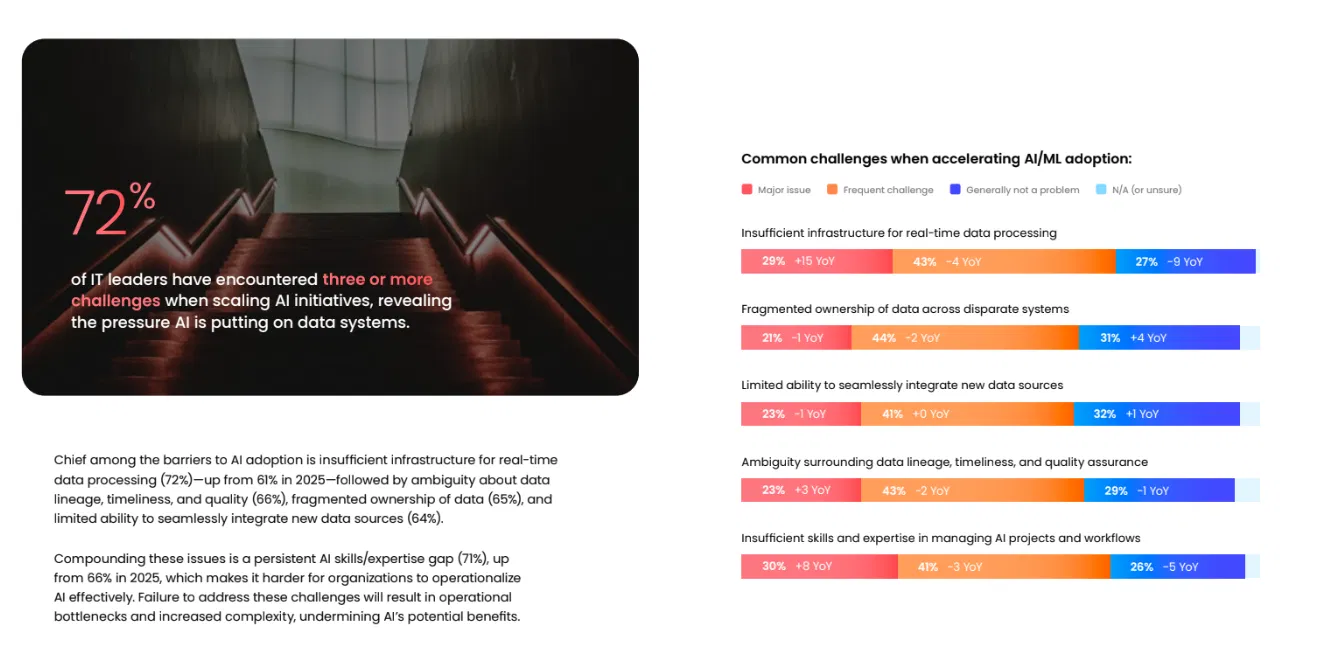
Globally, 72% of IT leaders report running into three or more distinct challenges when trying to scale AI initiatives, a figure that climbs to 78% in Singapore. The report frames this clearly: the barrier to AI success isn’t a lack of investment appetite — it’s the data foundations underneath.
What’s Actually Blocking AI at Scale
The report breaks the global barriers down in detail. The single biggest obstacle is insufficient infrastructure for real-time data processing, cited by 72% of IT leaders — up sharply from 61% just a year earlier in 2025. Close behind are ambiguity around data lineage, timeliness, and quality (66%), fragmented ownership of data (65%), and limited ability to integrate new data sources (64%). A persistent shortage of AI skills and expertise also worsened, rising to 71% globally, up from 66% in 2025.
Singapore’s specific pain points mirror the global pattern but run hotter: 78% cite insufficient real-time infrastructure, 73% point to fragmented data ownership, and another 73% cite a shortage of AI management skills.
India’s Own Infrastructure Gap — And a Surprising Vote of Confidence in the Fix
India, one of the 14 countries surveyed, shows a similar tension between enthusiasm and readiness. Separately, Confluent’s India leadership has pointed to the same underlying issue playing out domestically: enterprise data across Indian companies often remains trapped in legacy systems, cloud applications, and operational databases that were never built for real-time AI workloads — a dynamic Confluent’s India country manager has described as a “modernisation paradox,” where the most valuable data is also the hardest to access quickly.
Despite that gap, Indian IT leaders appear unusually convinced that data streaming is the fix: 95% of Indian IT leaders say data streaming simplifies AI adoption, and 96% plan to increase their investment in it — among the highest figures recorded anywhere in the survey pool. That combination — real infrastructure pain, paired with strong conviction about the solution — suggests Indian enterprises may be closer to acting on the problem than simply acknowledging it. Sectors like BFSI, retail, telecom, and digital platforms — with companies such as Swiggy and JioCinema already running real-time, streaming-based architectures at large scale — are frequently cited as proof points of what’s possible once the infrastructure catches up with ambition.

Agentic AI Is Getting Hit Hardest
If real-time infrastructure is the industry’s weak link, agentic AI is where that weakness shows up most visibly. In Singapore, 95% of leaders report experiencing or anticipating struggles with data infrastructure and quality, another 95% cite legacy system integration issues, and 93% point to concerns about LLM reliability. The consequences are tangible: over 73% of Singapore respondents report stalled agentic AI projects, and roughly half have abandoned such projects entirely — figures broadly in line with Asia-Pacific-wide rates of 74% and 53% respectively. Globally, the picture is similarly sobering: only around 32% of organizations report having agentic AI actually running in production, despite widespread piloting activity.
Where Priorities Are Shifting
The report also surfaces where IT leaders plan to direct their attention and budgets next. 86% of Singapore IT leaders rank continuous, up-to-date business visibility as a top priority, with 86% citing data sovereignty and 82% citing data provenance and tracking as increasingly important concerns — a sign that governance is becoming as central to AI planning as raw capability.
On spending, 86% of Singapore leaders rank data streaming as an investment priority, alongside AI and machine learning solutions (85%) and data management and governance (90%). Globally, 88% of IT leaders rank data streaming itself as a high investment priority. Among organizations already investing in these capabilities, 65% report richer customer experiences and 61% report greater automation of internal processes as tangible payoffs.
What Confluent’s Leadership Makes of It
Greg Taylor, Senior Vice President for Asia Pacific at Confluent, noted that while businesses across Singapore are moving quickly to embrace AI, trust in these systems can’t come from regulation alone — it’s on business leaders themselves to honestly assess whether their data infrastructure can actually support AI at scale.
Shaun Clowes, Confluent’s Chief Product Officer, put the underlying issue even more bluntly: most organizations, he said, don’t have an AI investment problem — they have a data problem. As companies move past early experimentation and start embedding AI into critical business processes, he noted, it’s not just AI spending that separates the leaders from the rest — it’s whether they’ve also invested in the data foundations needed to support it.
The Bottom Line
Whether it’s Singapore’s 78%, India’s near-universal confidence in data streaming as a fix, or the global 72% citing infrastructure as their top blocker, the same story repeats across markets: enterprises are not short on enthusiasm for AI, agentic or otherwise. What they’re short on is the real-time, well-governed data plumbing needed to make that enthusiasm pay off. For India specifically, the numbers suggest a market that already recognizes the problem and is willing to fund the fix — the real test over the next few years will be how quickly that investment converts into agentic AI projects that actually reach production, rather than joining the ranks of pilots that stall out before they scale.
Data sourced from Confluent’s 2026 Data Streaming Report (surveying 4,625 IT leaders across 14 countries, including India and Singapore), with additional India-specific context from Confluent’s India leadership commentary.

Ruchi Kumar is the associate editor at Entrepreneur News Network and TVW News India, where she leads editorial strategy, brand storytelling, and startup ecosystem coverage. With a strong focus on innovation, business, and marketing insights, he curates impactful narratives that spotlight India’s evolving entrepreneurial landscape. She has written extensively on fintech, AI and emerging startups.