

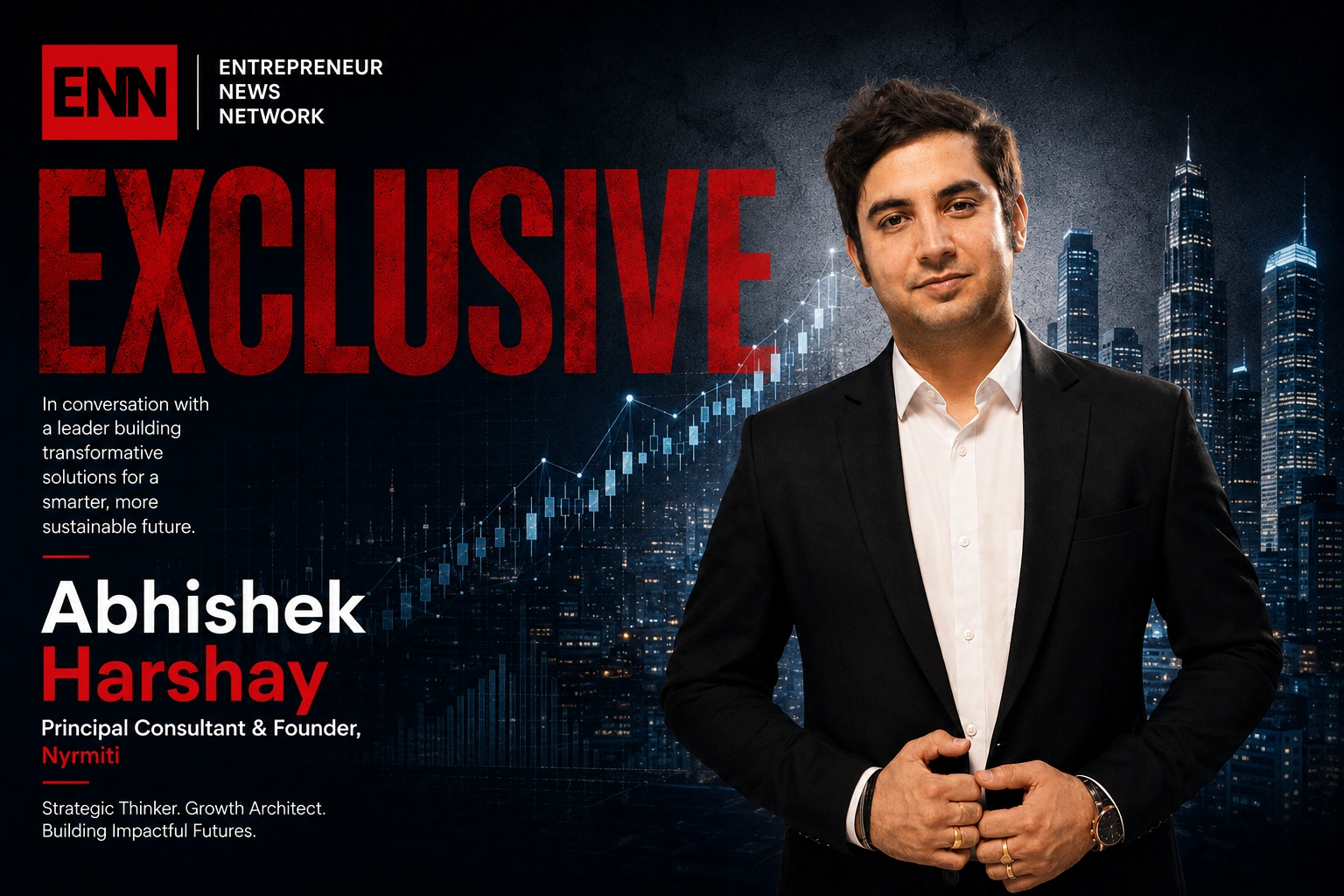
In today’s rapidly evolving digital economy, organizations are under constant pressure to embrace artificial intelligence, automation, cloud computing, and digital transformation. Yet many technology investments fail—not because of the technology itself, but because businesses adopt solutions before understanding the problems they need to solve.
For Abhishek Harshay, Principal Consultant & Founder of Nyrmiti, technology has never been about chasing trends. It has always been about building systems that make businesses stronger, more efficient, and ultimately independent of constant human intervention.
From his early days in Jaipur to leading technology transformation projects across healthcare, logistics, operations, and enterprise consulting, Abhishek has quietly built a reputation as a consultant who values long-term business outcomes over short-term technology hype.
In this exclusive conversation with ENN World, he shares his journey, his philosophy on AI, and why the future belongs to organizations that build intelligent systems—not just adopt intelligent tools.
ENN: Your journey started in Jaipur and has taken you through technology consulting, entrepreneurship, and AI. Tell us about the beginning.
Abhishek Harshay:
I come from Jaipur, where I completed my B.Tech in Computer Science from Rajasthan Technical University. Like many engineers, I entered the technology industry excited about software development and innovation.
But very early in my career, I realized something important.
Technology alone doesn’t transform businesses.
Business understanding transforms businesses.
The best software in the world cannot fix a broken process.
That realization changed how I approached technology.
Years later, in 2019, I made the decision to study Data Science at IIIT Bangalore. Many people asked why I would go back to formal education after already working in the industry.
For me, it wasn’t about collecting another qualification.
It was about strengthening the analytical foundation required to solve increasingly complex business problems using data.
That decision continues to influence every consulting engagement I undertake today.
ENN: You often describe yourself as a “pre-AI era practitioner.” What does that mean?
Abhishek:
Today everyone talks about AI.
Five or six years ago, people talked about automation.
Before that, it was digital transformation.
The terminology changes.
The business challenges don’t.
Long before Generative AI became mainstream, I was helping organizations automate workflows, optimize field operations, improve compliance, and remove repetitive manual tasks.
Back then automation meant understanding how people worked.
You couldn’t simply plug in an AI model.
You had to study operational bottlenecks.
Understand departments.
Understand workflows.
Understand human behaviour.
Only then could you design systems that genuinely improved productivity.
That experience taught me something valuable.
Technology should always follow business understanding—not replace it.
Even today, when organizations ask me about AI, my first question isn’t “Which AI platform do you want?”
It’s “What business problem are you trying to solve?”
ENN: You founded Nyrmiti in 2020. What gap were you trying to address?
Abhishek:
After working with different organizations, I noticed many companies were overwhelmed by technology choices.
Every vendor claimed to have the perfect solution.
Every platform promised transformation.
Every consultant recommended the technology they happened to sell.
Very few people were providing independent guidance.
That’s why I founded Nyrmiti.
The idea was simple.
Help businesses make technology decisions they’ll still be happy with two or three years later.
We don’t recommend products because we earn commissions.
We don’t push vendors because of partnerships.
Our recommendations are entirely driven by business requirements.
Sometimes that means implementing AI.
Sometimes it means improving cybersecurity.
Sometimes it’s cloud migration.
Sometimes it’s simply redesigning an operational workflow.
Technology should never be the starting point.
Business outcomes should.
ENN: What makes your consulting approach different?
Abhishek:
I believe consultants should spend less time presenting slides and more time understanding operations.
Every business has unique constraints.
Different teams.
Different cultures.
Different priorities.
The solution isn’t always the newest technology.
Sometimes improving a simple internal process creates greater value than implementing an expensive AI platform.
I also believe consultants must stay vendor neutral.
When you’re financially tied to a particular technology provider, objectivity becomes difficult.
Businesses deserve honest advice.
Even if that advice means delaying technology investments until the organization is ready.
Trust is built through transparency.
That’s how we operate at Nyrmiti.
ENN: You’ve also played a significant role at Solvono Labs. Tell us about that experience.
Abhishek:
Joining Solvono Labs was an opportunity to move beyond consulting into execution.
I joined as Technology Lead before becoming Co-Founder.
We weren’t simply developing software.
We were building operational infrastructure.
We designed field operation frameworks that included location intelligence, temperature monitoring, barcode scanning, secure communication, compliance dashboards, and operational visibility.
The biggest learning was that technology only creates value when it integrates seamlessly into people’s daily work.
Employees shouldn’t have to change their behaviour to accommodate software.
Software should support the way organizations naturally operate.
That’s a philosophy I continue to apply today.
ENN: Healthcare has been one of your strongest domains. What lessons did that industry teach you?
Abhishek:
Healthcare is unforgiving.
Systems cannot fail.
Processes cannot stop.
Delays affect real people.
During my work with diagnostic centres and later while supporting the COVID bubble operations for the Pro Kabaddi League, we experienced environments where reliability mattered far more than features.
Those experiences reinforced an important lesson.
Technology must perform consistently under pressure.
Beautiful interfaces mean very little if operations fail during critical moments.
Healthcare taught me to prioritize resilience, simplicity, and reliability above everything else.
ENN: Artificial Intelligence is transforming industries. What advice would you give business leaders?
Abhishek:
The biggest mistake organizations make is assuming AI is their strategy.
AI is simply another capability.
Business strategy comes first.
Organizations should begin by identifying repetitive work, operational inefficiencies, and decision-making bottlenecks.
Once those are understood, AI becomes far easier to implement effectively.
Another misconception is that AI replaces people.
In reality, AI amplifies capable teams.
The future belongs to organizations where humans and intelligent systems collaborate—not compete.
ENN: What are the biggest technology mistakes businesses are making today?
Abhishek:
Three stand out.
First, adopting technology because competitors are doing it.
Second, underestimating cybersecurity.
Third, failing to prepare data before implementing AI.
Many companies want advanced AI while their operational data remains fragmented across spreadsheets and disconnected systems.
Without quality data, even the best AI models produce poor outcomes.
Foundations matter.
Always.
ENN: What advice do you give founders?
Abhishek:
I usually ask founders three questions.
Where should you focus?
What should you fix?
What should your business eventually do without you?
Many founders become trapped inside daily operations.
My goal is to help them build systems that reduce dependency on individuals.
A business becomes scalable when processes—not people—drive execution.
Technology should enable that independence.
ENN: What does the future of enterprise technology look like?
Abhishek:
We’re moving toward intelligent enterprises.
Organizations will increasingly combine AI, automation, cloud computing, cybersecurity, analytics, and real-time data into unified business systems.
But success won’t depend on who buys the most technology.
It will depend on who integrates technology most thoughtfully.
The winners will be organizations that continuously improve rather than continuously chase trends.
ENN: Finally, what philosophy guides your work?
Abhishek:
Technology should create clarity—not complexity.
Every system we build should help businesses make faster decisions, reduce unnecessary work, improve customer experiences, and create sustainable growth.
At the end of the day, businesses don’t invest in software.
They invest in better outcomes.
That’s what I try to deliver.
About Abhishek Harshay
Abhishek Harshay is the Principal Consultant & Founder of Nyrmiti, a technology consulting firm that helps organizations make informed decisions across AI, automation, cloud, cybersecurity, digital transformation, and enterprise architecture. A Computer Science graduate from Rajasthan Technical University with advanced studies in Data Science from IIIT Bangalore, he brings over a decade of experience in building operationally resilient technology systems across healthcare, enterprise operations, and digital transformation. He is also Co-Founder of Solvono Labs and continues to advise organizations on creating scalable, business-first technology strategies that deliver long-term value.
PUMA Expands India Tech Presence with New Global Capability Centre in Pune

Ruchi Kumar is the associate editor at Entrepreneur News Network and TVW News India, where she leads editorial strategy, brand storytelling, and startup ecosystem coverage. With a strong focus on innovation, business, and marketing insights, he curates impactful narratives that spotlight India’s evolving entrepreneurial landscape. She has written extensively on fintech, AI and emerging startups.