

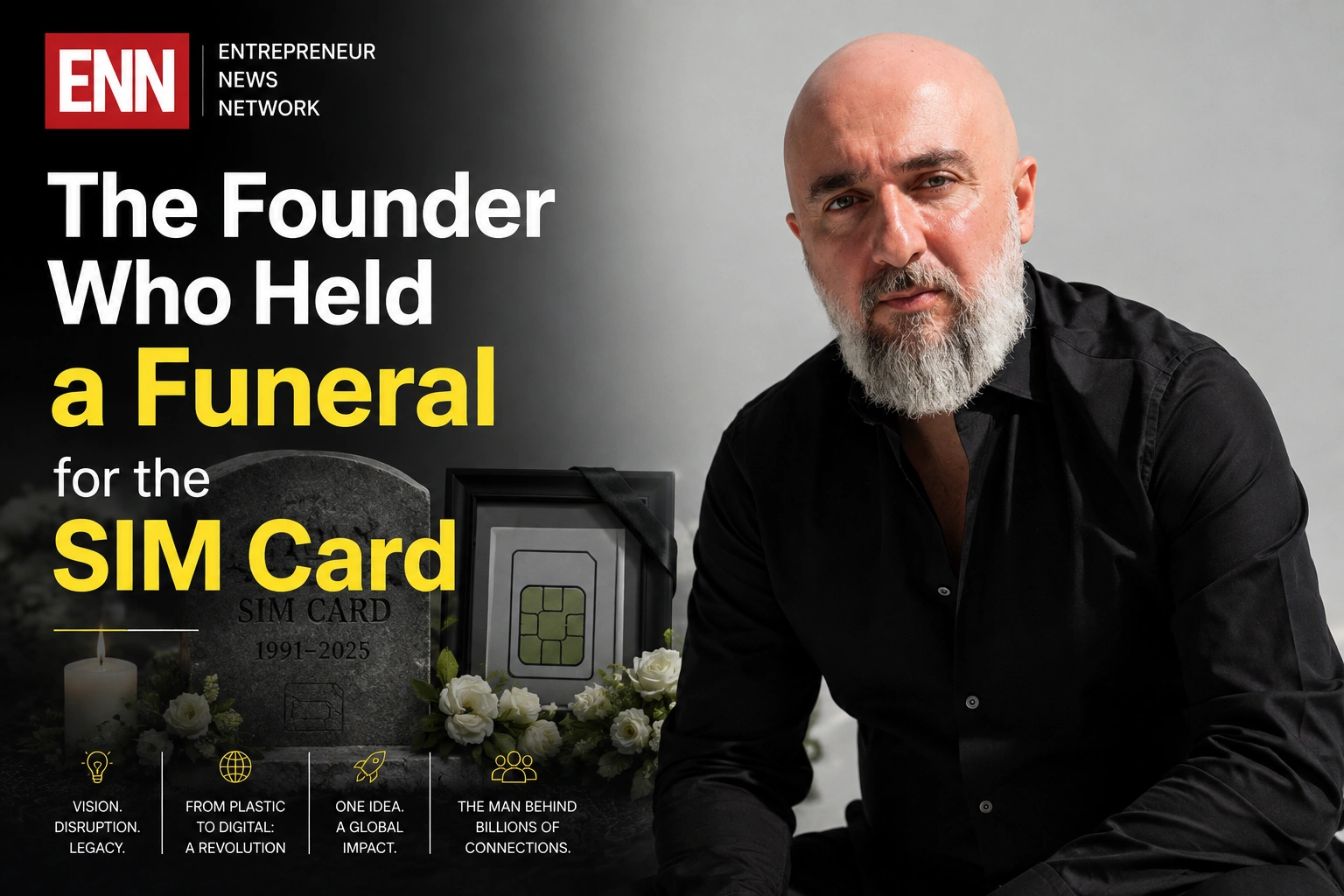
WhatsApp had just killed his last business. So when Ahmet Bahadir Özdemir walked into an investor pitch, he didn’t bring a deck — he brought a eulogy. That single unconventional pitch, backed by Antler, became the origin story of Airalo, now the world’s largest eSIM marketplace.
The Pitch That Wasn’t a Pitch
Picture a standard investor pitch: a slide deck, a market-size chart, a slick 90-second elevator line. Now picture the opposite — a founder standing up and calling for a minute’s silence. Not for a person. For a piece of plastic.
In 2019, at a demo day tied to Antler’s startup program, Ahmet Bahadir Özdemir did exactly that. He asked the room to observe a moment of silence for the death of the physical SIM card. It sounds like a stunt. It wasn’t. It was the most honest thing he could have pitched, because he had just watched a version of that death happen to his own company.
How do you get people excited over SIM cards? That doesn’t even make sense.
A FELLOW FOUNDER IN ÖZDEMIR’S ANTLER COHORT, AFTER HIS FIRST PITCH
The Accidental Telecom Guy
Özdemir didn’t set out to build a telecom company. By his own description, he was an “accidental telecom guy” who backed into the industry through a side hustle — selling ship supplies out of his parents’ home in Turkey, dealing with ports around the world and, as he’s told it, effectively pretending to be “60 different people” to keep the operation running across time zones and languages.
The pivot came from a strange, specific detail: ship captains kept asking him for the same three things — potatoes, tomatoes, and SIM cards. Seafarers spend up to nine months at sea, cut off from affordable, reliable mobile connectivity, and it turned out to be one of the most broken corners of the entire telecom industry. Özdemir built SIM4Crew around that gap — a global SIM card business serving the world’s 1.7 million-plus seafarers, taught himself the roaming business essentially from scratch, and turned a warehouse network he’d already built for ship supplies into a functioning telecom operation.
It worked. It was profitable. And then, on September 28, 2018, Apple shipped the first eSIM-compatible iPhones — and the ground moved under him.
Killing His Own Golden Goose
Most founders who watch a new technology threaten their profitable business do one of two things: ignore it, or panic. Özdemir has said he thought immediately of Nokia — the company that dismissed the touchscreen phone as “just a phase” before Apple ate its lunch. He decided he would not be the next cautionary tale.
So instead of defending SIM4Crew, he set out to disrupt it himself, building what he pitched internally as “the Amazon of eSIMs” — a single marketplace where a traveler could browse, buy, and activate local mobile data in any country before their flight even landed. It meant deliberately undercutting a business that was already making him money, on a bet that the eSIM shift was inevitable and that someone else would build the aggregator layer if he didn’t do it first.
The math on the opportunity was straightforward even if the execution wasn’t: roughly 70% of travelers don’t activate a roaming plan until they’ve already landed, still nervous about overspending on the old per-megabyte pricing model. Özdemir’s bet was that if you removed the friction and the fear, you could turn a source of travel anxiety into something people bought before they even packed their bags.
Cute Booth, Real Breakthrough
Being early to an unproven technology is not glamorous. At one industry event in the Netherlands, Özdemir’s tiny Airalo booth was, in his own retelling, dismissed by passersby as “cute” — a polite way of saying nobody thought it mattered yet. Getting telecom operators to take a digital-only, no-physical-inventory upstart seriously was its own uphill climb.
The breakthrough came down to one relationship: a single visionary operator agreed to give Airalo pay-as-you-go access with no deposit required — a structure almost unheard of for a brand-new, unproven player in telecom. That one partnership, struck on trust rather than track record, later grew into hundreds of millions of dollars in revenue flowing through Airalo’s platform.
Marketing had to be just as scrappy as the sales motion. Performance marketing — the default playbook of throwing money at Facebook and Google ads — largely failed at first, for a simple reason: almost nobody knew what an eSIM was, so there was no existing demand to capture. The team leaned instead into things that don’t scale: wearing Airalo T-shirts everywhere they went, staging phone calls in crowded elevators to casually pitch “this eSIM thing” to strangers within earshot, and running anonymous social accounts that replied to every public roaming complaint with some version of, “Sorry to hear this — have you tried Airalo?” Influencer-led education, not ad spend, is what eventually unlocked real word-of-mouth growth.
The Company That Nearly Didn’t Survive Its Own Timing
Airalo’s Series A came together in a hurry, and in hindsight, at exactly the right moment for the wrong reason. After a blunt profit-and-loss review from Sequoia and a burn rate of roughly $200,000 a month, the team pulled its Series A forward into late 2019 and closed $5.4 million from Rakuten and other investors — weeks before COVID-19 froze global travel almost overnight.
What followed was, by Özdemir’s own account, the hardest stretch of the company’s life. Revenue tracked on Stripe fell to zero. He has described visiting the emergency room during that period “just to feel safe” amid the panic. The company’s survival came down to what he calls a ruthless “war on waste” — cutting everything non-essential and holding on through roughly two years with almost no travel-driven revenue to speak of, waiting for the world to start moving again.
From Near-Zero to the World’s Largest eSIM Marketplace
Airalo did more than survive. It came out of the pandemic as the eSIM category’s clear leader — now widely described as the world’s largest eSIM marketplace, spanning local and global data plans across well over a hundred countries, and valued as one of the category’s first unicorns. The company that once had to explain what an eSIM even was now operates as connectivity infrastructure that other businesses build on top of.
Özdemir’s long-term vision for Airalo, as he’s described it, isn’t to stay a visible, standalone app forever — it’s to become an invisible global layer, where a gigabyte of data quietly runs on Airalo’s infrastructure no matter who actually sells it to the end customer: an airline, a fintech app, or a small mom-and-pop travel shop. The brand recedes; the infrastructure stays.
A bunch of common people putting out uncommon results.
AHMET BAHADIR ÖZDEMIR, ON THE CULTURE HE’S TRIED TO BUILD AT AIRALO
He’s also been candid that the company’s growth hasn’t come from treating people as line items. He’s spoken about building Airalo around psychological safety and deliberately rare firings, and has pushed back on what he calls “greater good” capitalism — the tendency to justify hard decisions with aggregate statistics that mean nothing to an individual employee or customer trying to pay rent, or grieving a loss. It’s an unusual thing to hear from the founder of a company now valued in the billions, and it maps directly onto the same instinct that made him stand up and mourn a SIM card in front of a room of investors: he tends to make the human stakes of a business visible, rather than hiding them behind a chart.
Why This Story Belongs Next to Antler’s Own Framework
Antler, the venture firm that backed Airalo through its residency program, has built its own investment philosophy around a simple framework for picking founders before there’s even a company to evaluate: Spike, Drive, and Grit — is there something this person is genuinely, demonstrably better at than almost anyone else; do they have the raw ambition fused with the proven ability to execute; and have they taken something hard all the way to its limit and kept going anyway.
Özdemir’s biography reads like a case study for exactly that framework. The spike was an unlikely one — a self-taught understanding of global roaming economics, built by paying for his own crash course and reverse-engineering an entire industry from a ship-supply side hustle. The grit was the two years spent keeping a company alive on a war footing with zero travel revenue. And the drive was the willingness to kill a profitable business he’d built with his own hands the moment he saw a bigger shift coming — then defend that decision through a global pandemic that seemed, for a long stretch, to prove him catastrophically wrong.
It didn’t. And the funeral he held for the SIM card in 2019 turned out to be premature in exactly one detail: it wasn’t the SIM card’s eulogy. It was the opening scene of his own company’s origin story.
Sources: New Economies podcast interview with Ahmet Bahadir Özdemir (“Forget AI: Inside the Meltdown That Made Airalo #1 eSIM Unicorn,” Dec 2025); Antler company blog, “Startup Series: How Airalo will change connectivity forever with digital sims” (2019); Web in Travel, “A minute of silence for the physical SIM card, please”; public reporting on Airalo’s Series A and COVID-era recovery. Compiled August 2026 for Entrepreneur News Network.

Ruchi Kumar is the associate editor at Entrepreneur News Network and TVW News India, where she leads editorial strategy, brand storytelling, and startup ecosystem coverage. With a strong focus on innovation, business, and marketing insights, he curates impactful narratives that spotlight India’s evolving entrepreneurial landscape. She has written extensively on fintech, AI and emerging startups.