
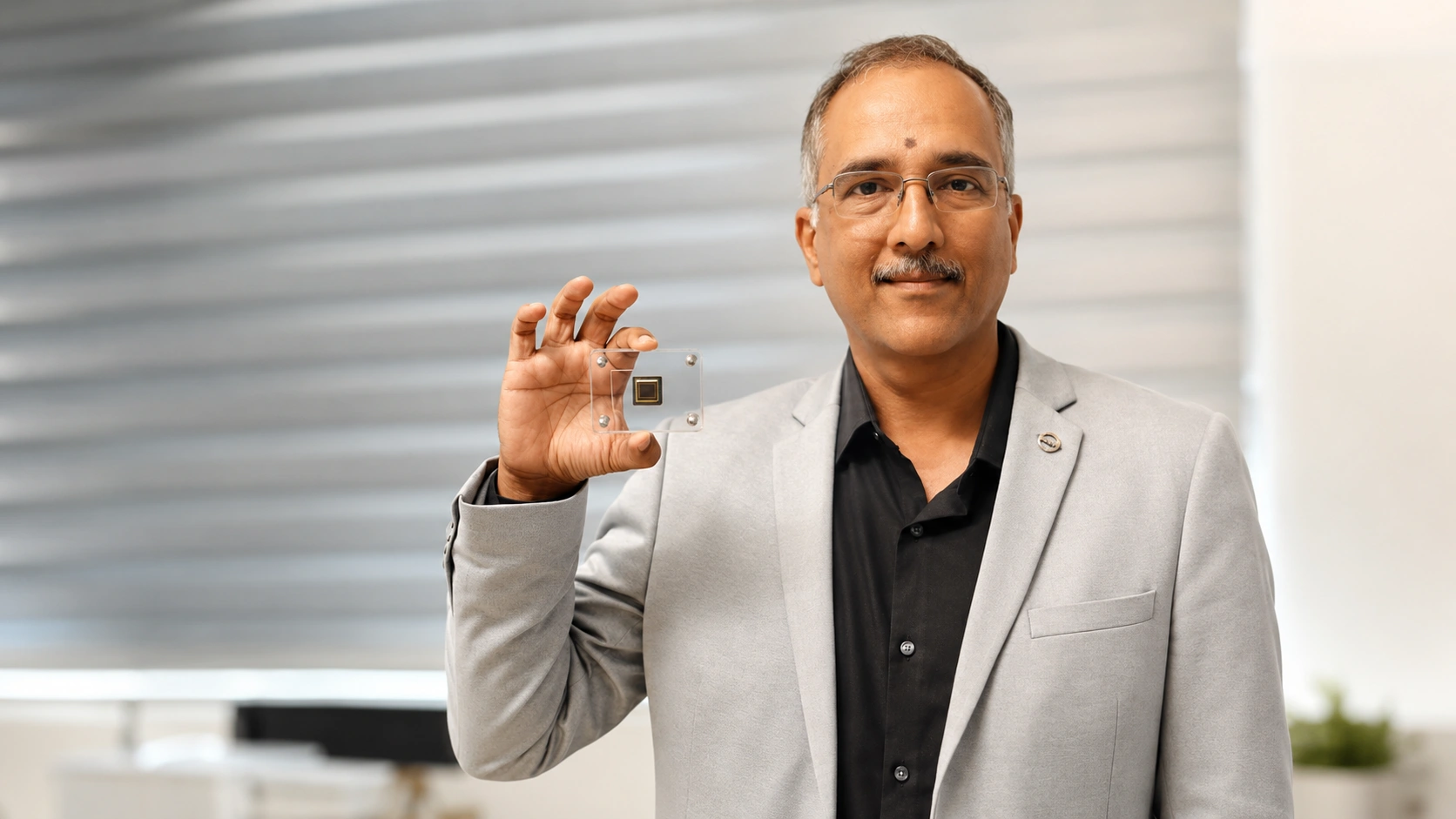
At 23, Jyothis Indirabhai left India for Japan to work as a design consultant for Hitachi. Two decades and several semiconductor companies later, including a nearly ten-year stint at Intel from 2005 to 2014 as a design manager and micro-architect, he made the opposite journey: back to Thiruvananthapuram, the city where he once studied electronics and communication engineering at the College of Engineering, Trivandrum, to build chips of his own.
In 2020, that decision became Netrasemi. Six years on, the Kerala-based startup has moved from a founding idea to a working piece of silicon: the A2000, an edge AI processor built to run artificial intelligence tasks directly on a device, without leaning on a data center every time a camera needs to recognize a face or a drone needs to spot an obstacle.
The numbers behind the chip are specific. The A2000 is fabricated on a 12-nanometer process at TSMC and delivers up to 12 trillion operations per second, or 12 TOPS, of AI performance, while drawing under 5 watts of power, low enough to sit inside a battery-powered camera or a compact industrial sensor. On chip, it packs a neural processing unit, a vision processor, an image signal processing pipeline, and a crypto engine, aimed squarely at smart cameras, drones, robotics, and industrial automation systems that need to make decisions in milliseconds rather than wait on a round trip to the cloud.
Getting there took capital as well as engineering. Netrasemi raised roughly $1.17 million in a pre-Series A round in December 2024, followed by a much larger Series A of ₹107 crore, close to $13 million, backed by Zoho Corporation and Unicorn India Ventures. Zoho founder Sridhar Vembu’s involvement is notable for another reason: Zoho itself had explored a $700 million chipmaking effort of its own, first reported in 2024, before shelving those plans. Rather than build in-house, Vembu chose to back Netrasemi’s team instead, a vote of confidence in homegrown fabless chip design over Zoho going it alone.
That confidence appears to be paying off on the technical side. Netrasemi has now completed silicon bring-up on the A2000, meaning the physical chip has been powered on, tested, and confirmed to work as designed in the lab. Since May 2026, the company has been running early trials with three customers spanning the surveillance and automotive sectors, with engineering samples already handling common object-detection workloads within that sub-5-watt power budget.
The next milestone sits about a year out. Netrasemi plans to move the A2000 into mass production at TSMC’s Taiwan facilities in 2027, targeting a commercial launch by the middle of that year. Beyond the A2000, the company has outlined plans for four system-on-chip variants in total, extending the same edge-AI approach toward industrial robots and smart infrastructure.
For a startup that is, in industry terms, still young, three unnamed customers and one validated chip may not sound like much. But in India’s fabless semiconductor sector, where most homegrown design efforts have stalled well before reaching working silicon, a 12nm chip that has cleared bring-up and entered customer trials is a genuine milestone. It is also, in its own way, a full-circle moment: an engineer who spent a decade building chips for one of the world’s largest semiconductor companies now building them, on his own terms, a few kilometers from where he started.
Sources:
- Netrasemi Brings Up A2000 AI Chip, Begins Customer Evaluation Phase — EE Times
- Netrasemi A2000 Edge AI Chip Sampling: 12 TOPS, 12nm, RISC-V and Arm Cores — IndexBox
- Sridhar Vembu’s Zoho, others invest ₹107 crore in Netrasemi — Indian Startup News
- Zoho Backs Netrasemi in ₹107 Cr Funding Round After Halting Own Chip Plans — Outlook Business
- Netrasemi Raises $1,178,730 at Pre-Series A — Founder Lodge
- Netrasemi Charts India’s Semiconductor Dream — Kerala Technology
- Netrasemi to Begin Mass Production of Indigenous A2000 AI Chip in 2026 — Indian Defence News

Ruchi Kumar is the associate editor at Entrepreneur News Network and TVW News India, where she leads editorial strategy, brand storytelling, and startup ecosystem coverage. With a strong focus on innovation, business, and marketing insights, he curates impactful narratives that spotlight India’s evolving entrepreneurial landscape. She has written extensively on fintech, AI and emerging startups.