

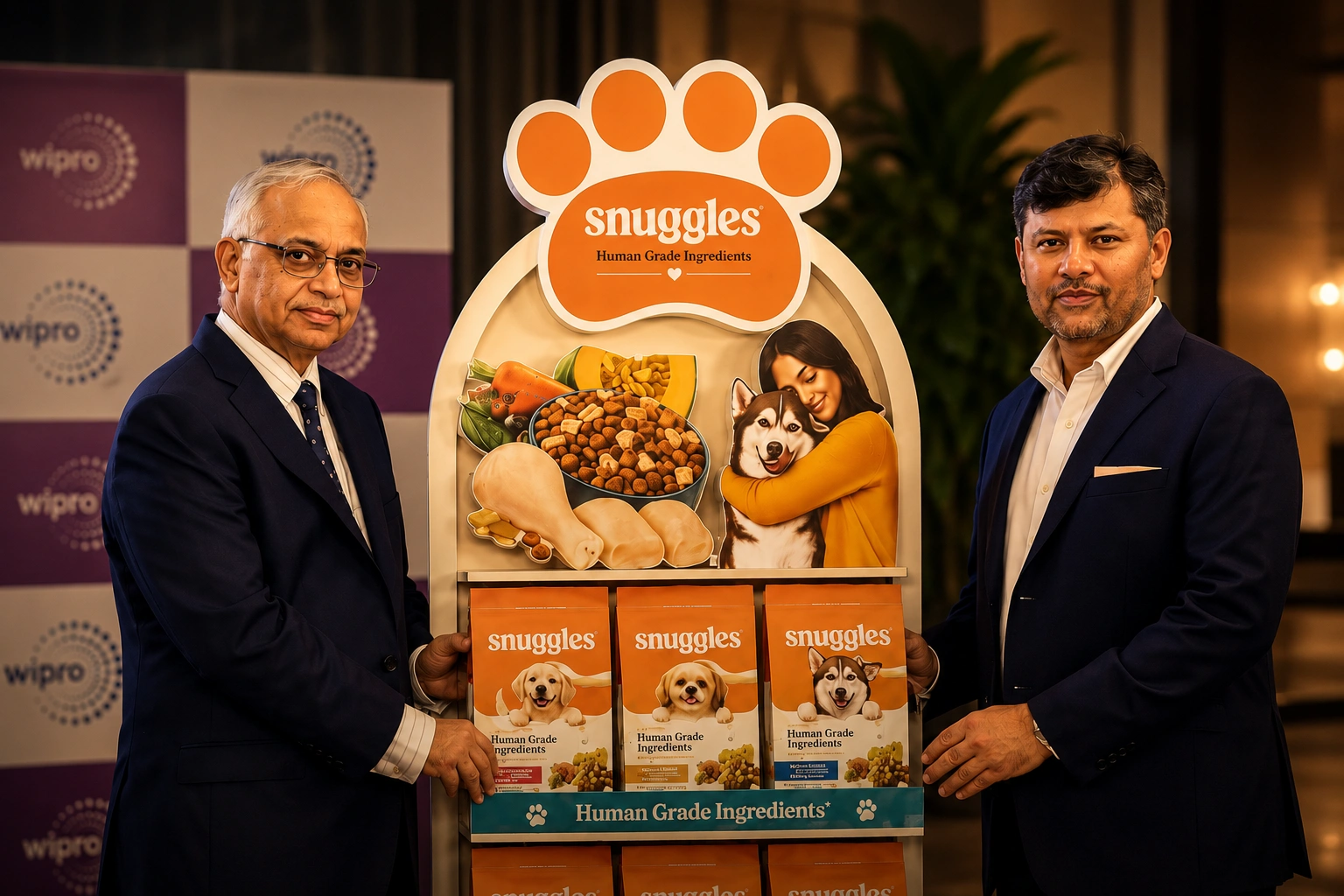
On August 26, 2026 — International Dog Day — Wipro Consumer Care and Lighting (WCCL), the unlisted FMCG arm of Azim Premji’s Wipro Enterprises, announced its entry into one of India’s fastest-growing consumer categories with a new brand called Snuggles. It is a small, almost easy-to-miss headline next to the company’s usual news about soaps and light bulbs. But it says a great deal about where India’s consumption story is heading, and why a 75-year-old conglomerate best known for Santoor soap and CFL bulbs thinks pet food is worth its time.
This piece looks at what Wipro actually launched, why a company like WCCL would move into pet nutrition at all, and what the data says about the size and shape of the opportunity it is chasing — as well as the reasons this market is harder than it looks.
What Wipro launched
Snuggles debuts with a single, deliberately positioned product: a dry dog food that combines conventional kibble with freeze-dried chicken chunks made from human-grade ingredients — a format the company describes as an industry first in India. The formulation is built around premium protein for muscle development, DHA and Vitamin A for cognitive development, prebiotics and postbiotics for gut health, and Omega 3 and 6 (via salmon oil) for coat quality, developed with veterinary input and tested across the company’s global innovation facilities as well as Indian markets.
The initial range covers three variants — Puppy (All Breeds), Adult (Small Breed), and Adult (Medium & Large Breed) — sold in 1 kg, 3 kg, 5 kg and 10 kg packs starting at ₹530. Distribution spans specialty pet retail, veterinary clinics, modern trade, e-commerce and quick commerce, layered on top of Wipro’s existing general trade network, which is one of the company’s genuine structural advantages in a category where most challenger brands struggle to get physical shelf space outside big cities.
Two executives were quoted at launch. Anil Chugh, President of Wipro Consumer Care’s Foods Business and COO of New Business, framed the ambition as category-building rather than pure share-grabbing: introducing innovation at a price point where “the consumer sees value,” in a market that is still mostly unconverted from home-cooked food. Saurabh Shekhar, Managing Partner for Pet Care, spoke to the science-and-vet-backed positioning the brand is leaning on to win trust from a large base of first-time pet owners.
Why pet food, and why Wipro
Snuggles isn’t an isolated experiment — it’s the latest move in a deliberate diversification that Wipro Consumer Care has been building for several years, and understanding that context explains the “why” better than the product sheet does.
WCCL crossed ₹10,000 crore in annual revenue in 2022-23, up roughly 30x since 2003, built primarily on soaps and personal care (Santoor alone contributes over ₹2,650 crore, more than a quarter of the business) and a lighting division that has been a steady cash generator since 1991. Roughly half the business now comes from international markets, anchored by the 2007 acquisition of Malaysia’s Unza Holdings. That is a mature, competitive core — soaps and lighting are both categories with limited structural growth left in them in India, which is precisely why the company has been hunting for a third leg.
Foods is that third leg, and it has been assembled deliberately rather than opportunistically. In 2023, WCCL entered the packaged food and spices business in the Gulf through the acquisition of Nirapara, a well-known regional spices and food brand. Around the same time, the company set up a food-innovation research centre in Bengaluru and began talking publicly about the scale of the adjacent opportunities it sees — spices alone is described internally as a ₹70,000 crore category in India, and snacks close to ₹75,000 crore. Anil Chugh’s title — President, Foods Business and COO, New Business — makes clear that pet food sits inside a broader food-and-adjacencies growth mandate, not a standalone bet. Pet food is arguably the most attractive entry point of that basket: it is younger, faster-growing, and far less penetrated by organized players than either spices or snacks, which gives a new entrant more room to build a brand from scratch rather than fight entrenched incumbents on price.
There is also a simpler logic at work. Wipro already owns two of the three things a new pet food brand needs most — a trusted household name and deep distribution into general trade, modern trade and, increasingly, quick commerce — and it can build or buy the third (formulation and category expertise) far more cheaply than a challenger can build the first two. That asymmetry is exactly why FMCG conglomerates tend to move into adjacent categories once their core business plateaus, and it is the same logic Reliance, Godrej, Tata and Mankind Pharma have each followed into pet food over the past two years, discussed below.
The size of the prize: India’s pet food market
Wipro’s own figure for the addressable opportunity is a total pet food market of over ₹5,500 crore (roughly $650-700 million), with packaged food penetration among pet-owning households at just 7%. That last number is the real headline: the vast majority of India’s pets are still eating home-cooked scraps, and the entire industry’s bet is on converting that base to packaged nutrition over the next decade, not on stealing share from rivals in an already-saturated market.
Independent research firms size the market differently, which is worth being transparent about rather than picking whichever number sounds best. IMARC Group puts the India pet food market at roughly $2.69 billion in 2026, growing to about $4.6 billion by 2034 at a 6.9% CAGR, with dog food accounting for about 86% of value and dry food about 90%. Mordor Intelligence, using a narrower market definition, estimates the market at $0.87 billion in 2025, rising to $1.68 billion by 2031 at an 11.3% CAGR — a faster growth rate off a smaller base. The gap between these estimates (roughly 3x) reflects real methodological differences — what counts as “pet food” versus treats, supplements and home-style wet food, and how informal/unbranded volume is treated — rather than one source being wrong. What both agree on, along with Wipro’s own figures, is the direction: high single-digit to low double-digit compounding growth for at least the rest of this decade, from a very low base of packaged penetration.
Zoom out to the broader “petconomy” — food, healthcare, grooming, accessories and services combined — and the numbers get bigger still: roughly $10.5 billion in FY24, projected to reach $16.2 billion by FY32 (a 5.65% CAGR) by one estimate, while consultancy Redseer has pegged the wider pet care market to roughly double from $3.5 billion to $7 billion by 2028. Food remains the dominant slice of that spend, estimated at 70-75% of total petconomy revenue, which is exactly why nearly every new entrant — Wipro included — is starting with food rather than accessories or services.
| Metric | Figure | Source |
|---|---|---|
| Total pet food TAM (Wipro’s estimate) | ₹5,500+ crore (~$650-700M) | Business Standard / afaqs! |
| India pet food market, 2026 (IMARC) | $2.69B, →$4.6B by 2034 (6.9% CAGR) | IMARC Group |
| India pet food market, 2025 (Mordor) | $0.87B, →$1.68B by 2031 (11.3% CAGR) | Mordor Intelligence |
| Packaged food penetration among pet owners | ~7% | Wipro / Business Standard |
| Overall petconomy, FY24 → FY32 | $10.5B → $16.2B (5.65% CAGR) | GlobalPETS |
| Pet-dog population, 2024 | ~31 million | Mordor Intelligence |
| Share of pet parents who are first-time owners | 67-69% | Wipro / Mars Petcare survey |
Why pet food, specifically — the underlying shift
The category’s growth is not really about pets; it’s about what has changed in Indian households. A few forces are doing most of the work.
The most important is the humanization of pets among India’s younger, urban population. A Mars Petcare global survey found that 67-69% of Indian pet parents are first-time owners, and that two-thirds of Gen Z and millennial pet owners — the exact demographic driving India’s broader consumption upgrade — consider their pet “the most important part of their lives.” Roughly 60-64% say their pets actively reduce their stress and anxiety, and dogs in particular are valued for unconditional love and a sense of family completeness. This is the pattern the industry calls “pet humanization”: animals moving from utility (guarding a house) to family membership, which directly correlates with willingness to pay a premium for nutrition, exactly as it did with baby food and later with organic and specialty groceries in urban India.
Second, this shift is happening inside a growing and increasingly affluent urban middle class. Upper-middle-class households are reported to spend around ₹5,000 a month on premium pet nutrition and veterinary care, and India’s pet-dog population — estimated around 31 million in 2024 — is rising fastest in exactly the cities where disposable incomes and nuclear-family formation (later marriage, smaller families, pets as a first “child”) are also rising fastest.
Third, e-commerce and quick commerce have solved the distribution problem that constrained pet food for years — bulky, low-frequency-but-recurring purchases that are inconvenient to carry home from a store. Quick commerce platforms now reach dozens of cities and have shortened replenishment cycles dramatically; online and quick-commerce pet food sales are reported to be growing at 40%+ CAGR, far outpacing the category average, which makes it possible for a new brand to reach a national urban audience without first winning shelf space in every kirana store.
Finally, veterinary-led recommendation is professionalizing what used to be an entirely word-of-mouth category, nudging owners from home-cooked food toward “prescription” and science-backed diets — precisely the trust lever Snuggles is pulling with its vet-developed, human-grade-ingredient positioning.
A crowded, and suddenly fashionable, field
Wipro is late to notice the opportunity but not late to the market — it is simply the newest name on a list that has grown quickly over the past two to three years, as India’s biggest consumer companies have all reached the same conclusion at roughly the same time.
Drools remains the market’s homegrown leader, with FY25 revenue reported at ₹932 crore, up 29% year-on-year, and it has drawn serious institutional confidence: private equity firm L Catterton invested $60 million, and Nestlé SA — the world’s largest packaged food company via its Purina pet care arm — took a minority stake, its first-ever investment in an Indian pet brand. International majors Mars (Pedigree, Royal Canin) and Nestlé Purina anchor the premium and mainstream segments respectively, alongside Charoen Pokphand and Colgate-Palmolive’s Hill’s Pet Nutrition, and together these players are still described as controlling the bulk of the organized market.
What has changed recently is the entry of Indian conglomerates from completely outside the pet category. Godrej Consumer Products launched “Godrej Ninja” in April 2025 backed by a reported ₹500 crore investment. Reliance Consumer Products entered with “Waggies,” pricing 20-50% below incumbents to widen accessibility — a classic Reliance playbook of using pricing power to force category expansion rather than just take share. Mankind Pharma, a top-five Indian pharmaceutical company, has built out PetStar (dog food) and more recently PetStar Delight (cat food), leaning on its pharma-grade credibility. Tata 1mg launched PawsNPurrs, extending its healthcare logistics and digital reach into pet medicines, supplements, food and grooming. Emami took a 30% stake in pet-care startup Cannis Lupus Services (Fur Ball Story) back in 2022, and Himalaya, as the category’s true first mover from 2019, remains a well-regarded natural-ingredients player.
The read-through is straightforward: nearly every major Indian consumer, pharma and retail conglomerate with a distribution network has now placed a pet food bet within the last three years. That is a strong external signal that the category’s growth numbers are credible — capital-allocators at Reliance, Godrej, Nestlé, Tata and now Wipro do not typically converge on a category by accident — but it also means Snuggles is entering a market that is rapidly consolidating attention and shelf space, competing for the same first-time pet owner that Godrej Ninja, Waggies and PetStar are all also courting. Wipro’s differentiation — the freeze-dried-chicken-plus-kibble format and its veterinary-clinic-first distribution push — will need to hold up against rivals with equal or greater capital behind them.
The headwinds nobody’s slide deck shows
The bull case is real, but so are the frictions that have kept packaged penetration at just 7% for this long. Home-cooked food — rice, chicken, dal — remains the primary diet for an estimated 60-70% of pet-owning households, partly on cost and partly because many owners simply don’t see a reason to switch a pet that looks healthy. Rural and even many tier-2/tier-3 markets remain largely untouched by organized pet food distribution, which caps near-term addressable volume to a fairly narrow urban band. Cold-chain infrastructure gaps continue to restrict the wet and fresh/frozen food segments that are growing fastest in mature pet food markets elsewhere, pushing Indian brands — Snuggles included — toward dry kibble formats that travel and store more easily but command lower average selling prices. And regionally, the market itself is uneven: North India (led by Delhi-NCR) accounts for roughly 35% of demand, with the South growing fastest but the East still lagging at around 15% — meaning a “national” pet food strategy in India is, in practice, several different regional strategies stitched together.
None of this undermines the growth story, but it does mean the category will likely reward patient capital and distribution muscle over quick wins — which, not coincidentally, is exactly the kind of advantage a company like Wipro, with decades of general-trade reach into small-town India, believes it holds over venture-funded challenger brands that are strong online but thin on the ground.
The bottom line
Snuggles is a small brand launch by revenue today, but it is a legible piece of a much bigger story: India’s biggest consumer companies have independently concluded that pet food is one of the few genuinely under-penetrated, high-growth categories left in Indian FMCG, and they are racing to plant flags before the market’s structure hardens the way soaps, biscuits and detergents already have. Wipro’s advantages — balance-sheet patience, an existing food-innovation pipeline, and a distribution network built over decades — are real, but so is the crowd it has walked into, with Reliance’s pricing muscle, Godrej’s marketing scale, Nestlé’s global pet care expertise (now partly deployed through Drools), and Mars’ category leadership all competing for the same first-time pet parent. Whether Snuggles becomes a meaningful line in Wipro’s food business or a footnote will likely be decided less by the product’s science-backed formulation — most competitors can and will match that — and more by who converts India’s home-cooked-food households to packaged nutrition fastest, and at what cost.

Ruchi Kumar is the associate editor at Entrepreneur News Network and TVW News India, where she leads editorial strategy, brand storytelling, and startup ecosystem coverage. With a strong focus on innovation, business, and marketing insights, he curates impactful narratives that spotlight India’s evolving entrepreneurial landscape. She has written extensively on fintech, AI and emerging startups.